March 27, 2014

A bolero sewing pattern search

A mink bolero
A mink bolero

An anonymous commenter left this inquiry:
Do you know of a good pattern for making bolero (sp)? I want to make some pretty but basic ones to go over shirts, etc. I can't seem to find a pattern for a basic one.
I have a personal preference for boleros or shrugs made of knitted fabric or actually crocheted or knitted. I haven't sewn any for myself, so I can't really recommend any patterns. Though after looking at Pinterest, there are several I might actually look at trying. I pinned several possible sewing patterns to a pinterest board titled Boleros, but as I haven't actually sewn them I can't recommend any of them.

The simplest bolero/shrug is merely a rectangle, folded in half with short seams sewn along the long edge to form an underarm or sleeve seam. There are of course many variations that can be created from this by modifying the shape from a rectangle.

Pattern drafting for a simple bolero or shrug


Style is always subjective and I'm not sure what would be helpful. Boleros come in all kinds of shapes, from fitted to structured, and many fabrics. There are tailored, modern, and vintage styles. It is difficult to offer a suggestion without knowing more. If you have a suggestion, please leave a comment.

March 17, 2014

Vintage pattern reivew : Simplicity 5040


It's rare that I find a vintage pattern in my size, or close to my size, at the thrift store. I can't help looking through them anyway. I have yet to make up any of the styles that I've acquired over the years because I would need to grade them up or down in order for them to fit. I was happy when I found this one, Simplicity 5040, in my size and in a style that I like.

I initially assumed this style would have a side zipper and that the skirt was gathered. How else would one get it on? There is no back zipper and only the button front closure that ends at the waist. I was a little surprised to find that the skirt has a placket hidden under a pleat below the front button closure. A pleated skirt is, in many ways, more flattering than a gathered skirt - at least on me..

The suggested fabrics run quite a range: cottons, synthetics, blends, silk, linen, chiffon, brocade, lightweight wools, wool-crepe, wool jersey, and corduroy. While I'm sure any of those fabrics might work, they would all give an entirely different look and require different handling. I don't have a fabric picked out for this yet, but I'm leaning toward cotton. I'll have to look at my stash and see what might work. I'll also need to make a petticoat slip.

Even though the pattern has all the appearances of being my size, the measurements on the back envelope indicate I will have to make adjustments. This is looking more and more like a lot of work. Hmm... I do plan to make this up, just not sure when.

February 25, 2014

Applying Elastics in A Swimsuit or Leotard

I was asked a while back to write a post on elastic application for a swimsuit. So the following is a pictorial demonstration on how I do it. I hope it will be helpful to someone.


Do not overlap the elastic, butt up the ends


I don't overlap the elastics instead a have the ends touch each other. This means I cut the elastic the exact length I need - nothing extra.The reason I don't overlap the elastics is to eliminate bulk and since it is stitched through I am not worried about it coming undone or shifting. I do overlap elastic ends for elastics placed in casings. Most patterns will give you an amount to cut for each area and they usually include an overlap amount (I subtract that out). But, you may find you need to adjust the length depending on the stretch and memory or return of your elastic. If I'm working with a questionable elastic I will sew up a sample and make incremental adjustments. I have learned a more calculated method of finding percentages/ratios and such but I can't be bothered by this and it gives me a headache.


Sew the elastic ends with a zig-zag
The elastic is sewn together using a wide zigzag with a tight stitch length (close to buttonhole stitch length).


Mark the leg openings into four equal sections

Next, I marked the leg in four equal sections. I learned from patternschool.com that elastics placed in modern stretch fabrics should be sewn in by stretching the elastic over 4 equal sections. This differs from information found in basic pattern-making books which have you leave the front elastic unstretched in 1:1 ratio and the back stretched with remainder of elastic in a sense creating what I feel a bubble butt. This unstretched and then stretched method was developed when fabrics for swimsuits were not as stretchy as today.


Mark the elastic in four equal sections
Elastics were also marked in four equal sections.  I used the seam as one mark, hence only 3 pins.


Pin the elastic into the leg opening matching up the sections
Here elastics are pinned into both legs and ready to sew.


Sew the elastic to the leg opening with a zig-zag stitch
I start my sewing in the crotch area so the outside leg area will look nice and even with no back stitching or overlapped stitching. This is also where I placed the elastic seam (or butt up elastic ends). I sew using a medium width zigzag 3.5-4 and about 3 in length.


Elastic sewn to the leg openings


Initial application of elastic is done.


Fold the elastic to the inside and stitch again with a zig-zag stitch


Next, I folded the elastic over to the inside and sewed with the same zigzag stitch while stretching the elastic evenly.


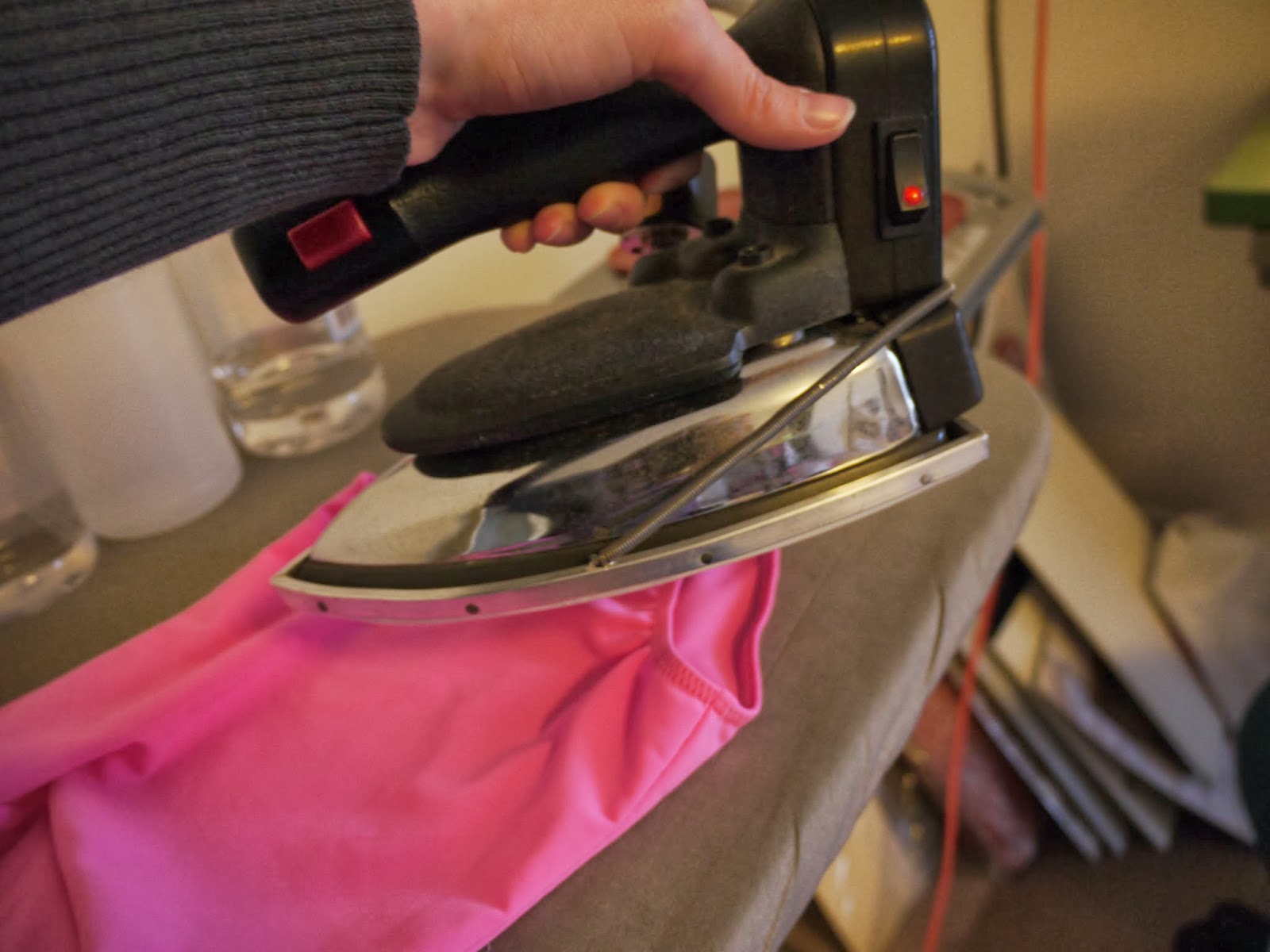
Steam the elstic back into shape with an iron
I like to steam the elastic back into shape. You can also wash and dry (in the dryer) if it is suitable for the fabric. This leotard is made from nylon Lycra and I am choosing to line dry it.


Finished leg opening
All done. One more note, when sewing through elastic use knit elastic not braided. Knit elastic can be sewn through without stretching out of shape. 1/4" wide is appropriate for children's swimsuits and 3/8" is better for women's.