You can easily spend a lot of time creating a pattern on paper but at some point, it needs to be sewn up. It is while sewing that you'll see your design take shape and lead you to make modifications as needed. I changed the design a bit by eliminating the folded neckband. The neckband is instead a single layer that is allowed to roll. I made this change because the fabric is pretty light and it would need some kind of stabilizer, which I didn't have. The cardigan is very comfortable and fits pretty well. Even so, I added just a bit too much wearing ease. So I need to reduce some of the body width. The upper back is a tad long and the sleeves need shortened.
It's pretty hard to get everything just right on the first attempt. I've done enough girls dress patterns that I don't usually have to do many iterations. Adult clothing takes a bit more tries because I lack experience with it. Industry pattern makers and sample makers will sometimes make many iterations of a design before they get it just right. This is a slightly different approach than home sewists might take. But once the pattern is nailed down, I won't have to worry about it anymore. It will be much easier to create variations on this style too.
Before I could tackle the pattern adjustments, I needed to stop and get organized. I assigned a style number, created a style and cutting spec sheet, and assigned pattern numbers. I explain how to do this along with providing printable blank forms to fill out in my book. If you prefer keeping a digital record, you can use the examples in the book to create your own spreadsheets. In many ways I still prefer paper and pencil. It forces your brain to think differently - perhaps more analytically. I have used both paper and pencil and spreadsheets. There are advantages to both.
November 21, 2013
November 13, 2013
Recovering Shoes - a step by step how to guide
Now that Halloween is over I can breathe for just a moment. My girls were Tinker Bell and Periwinkle based from Disney's movie Secret of the Wings. I was super excited for the request and the chance to make wings again, cause let's be honest, little fairies are just cute. The movie takes place in winter fairyland which is a bonus for staying warm while trick or treating. As part of their designs, I needed shoes that matched their outfits and is the focus of my post today. Tinker Bell wears boots and Periwinkle wears slip-on style slippers. I pulled shoes from the girls' closet according to overall shape and ones that would be easy to sew through, so no leather.
I learned to recover shoes in grad school and was taught to actual separate the sole from the main part of the shoe, not completely but enough to stuff about 1/2" or so of fabric into, and gluing everything back together with Barge cement. This method is a permanent change and I wanted to undo what I was doing.
This is the shoe before:
The fabric used for this project was stretch velour. I placed it on the shoe with the greatest stretch running from side to side. (If you are using a woven fabric then you will need to use the fabric on the bias).
I used a lot of pins and stabbed them straight in the shoe, right above the rubber sole.
After the fabric was draped and pinned in place, I trimmed off excess fabric leaving about 3/8" to turn under.
Here, I turned the seam allowance and repinned.
Ready to sew.
A curved needle would have been nice at this point but I made it work.
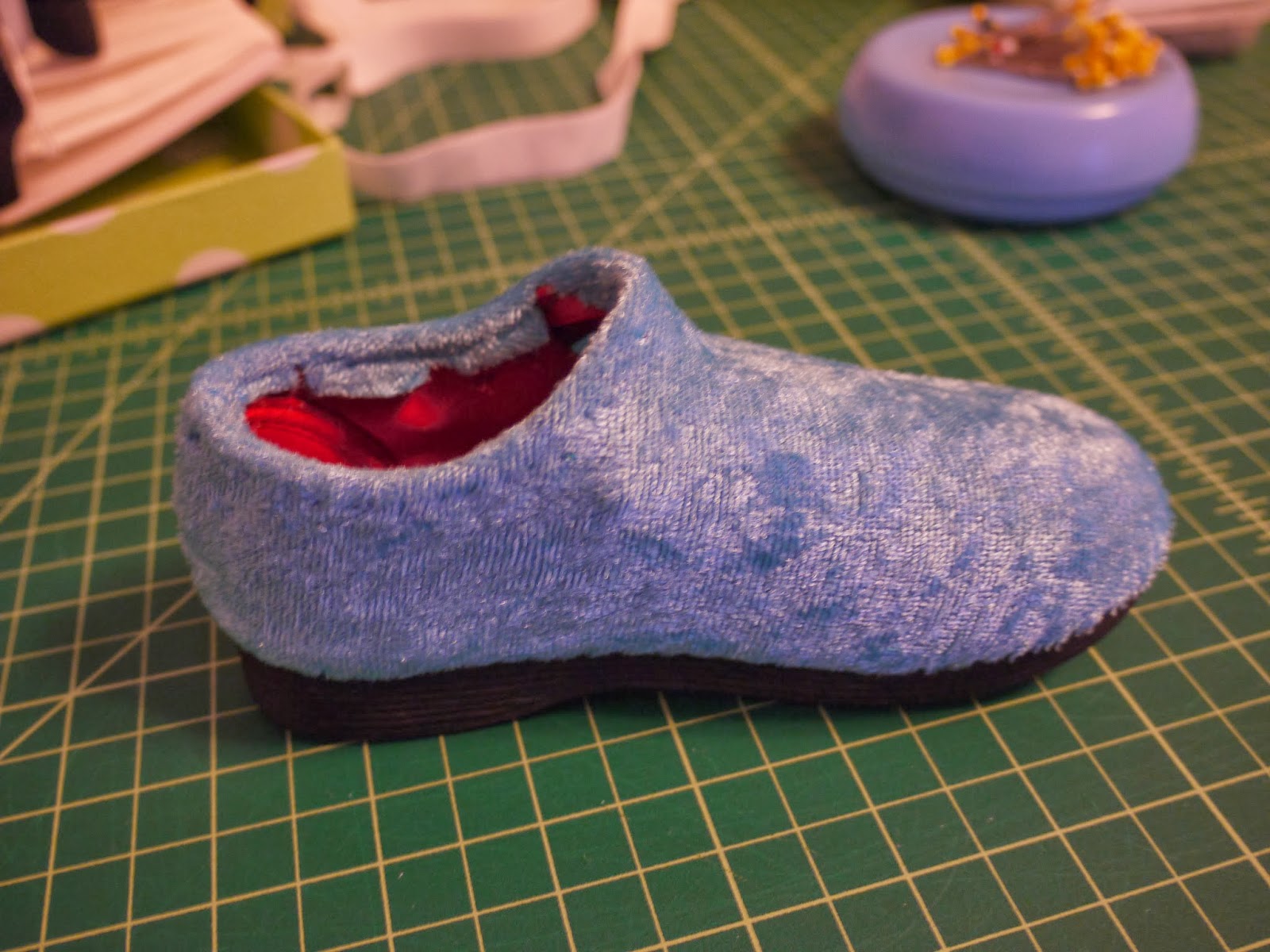
All finished except the puff ball.
I learned to recover shoes in grad school and was taught to actual separate the sole from the main part of the shoe, not completely but enough to stuff about 1/2" or so of fabric into, and gluing everything back together with Barge cement. This method is a permanent change and I wanted to undo what I was doing.
This is the shoe before:
The fabric used for this project was stretch velour. I placed it on the shoe with the greatest stretch running from side to side. (If you are using a woven fabric then you will need to use the fabric on the bias).
I used a lot of pins and stabbed them straight in the shoe, right above the rubber sole.
After the fabric was draped and pinned in place, I trimmed off excess fabric leaving about 3/8" to turn under.
Here, I turned the seam allowance and repinned.
Ready to sew.
A curved needle would have been nice at this point but I made it work.
All finished except the puff ball.
I added puff balls and fur trim.
| The fairies exploring the outdoors. |
November 12, 2013
Adapting a block pattern into something else pt. 5 : Making the pocket pattern
Here's a sneak peak of the first sample of my cardigan pattern. I'm fairly pleased with the results, though there are a couple of minor pattern modifications to make. So more about all that later.
For now, we need to finish up the pattern. The last two pieces to deal with are the pockets (shown above) and the elastic casing. I referenced my sweater to determine the pocket dimensions and placement, which is basically a rectangle. Pockets come in all sorts of shapes and sizes with varying amounts of functionality. Pockets should be proportional to the overall garment. They can be graded for larger or smaller sizes to maintain proper proportions. Pockets can be applied in various ways and include seam and hem allowances.
I wanted a very casual look to my pocket so I used a narrow 3-thread serger hem around all four sides and topstitched it on. This allowed the fabric at the top of the pocket to roll. This detail mimics the detail on my sweater. I didn't have a lot of confidence in producing a neat topstiched pocket in which the raw edges are turned under. This is partly due to the fabric and my machine. For a more structured pocket this fabric would need a fusible to help stabilize it.
Pocket placement is noted on the pattern piece by a drill hole. In a factory, an actual hole is drilled into the fabric. I have seen knits marked with a drill that also contained a marking medium such as a washable marker. In that case, the drill bit was like a needle. My pattern at home will contain a hole large enough for a chalk marking pencil to fit. Even though there are lines on the pattern pieces indicating placement, they are not transferred to the actual fabric. They are just there for clarity.
The elastic casing is just another rectangle large enough to cover the elastic. I think mine is about 1/2" x 8".
Subscribe to:
Comments (Atom)