October 26, 2009

Do professional pattern makers work with seams on or off the pattern?

Professional apparel pattern makers work with seam allowances on their patterns nearly all the time. It's faster. I would argue it's more precise. This practice goes counter to what most pattern making classes teach. They teach that you must remove the seam allowances and add them back later. I don't know anyone in the industry that works this way. I think the idea is that working with seam allowances one can create variations that lead to fitting problems later. That's simply not true if you check your new pattern against the original block later. (This is assuming you make a copy or rubbing of your original before you start on a new style. But I'm sure you knew that).

If you are drafting by hand, it is time consuming to remove the seam allowances. Pattern blocks are made with seam allowances on. You would have to keep a set of blocks without seam allowances. It would be so easy to mix up seamed and unseamed pattern blocks. Apparel pattern makers leave their blocks seamed and theatre pattern makers or cutters leave their blocks (or rather slopers) unseamed. In fact a block is a finished pattern piece that includes all pattern markings and is seamed.

If you are drafting in CAD, you can turn the seam allowances on and off. You can work on the cutting line or the stitching line. It's a simple matter of hitting a few buttons. BUT, I have found that CAD programs have difficulty in calculating between seamed and unseamed because it involves a complex series of mathematics. So constantly switching between cutting and stitching lines can produce some weird anomalies. (As an aside, weird things can happen with notches on stitching versus cutting lines too). I have found this is true no matter which CAD system you use. So I work with seam allowances on and directly on the cutting line nearly 99% of the time. This means that I keep the seam allowances in mind while I work.

One Exception


In CAD, it is important to turn the seam allowances off and walk the pattern pieces along the stitching line in a few areas. Collars and necklines is one area that I nearly always check for matching on the stitching line. There are other situations that come up where this important. I learned this the hard way recently.

Two pattern pieces with seam allowances on

In this situation, I split a jacket back pattern piece and added corresponding seam allowances along the split line.

Comparing two pattern pieces to see if the cut edges match

Next, I aligned the pattern pieces to make sure they match. At this point they did and I assumed all was right. Until I got complaints from the sewing machine operators that things weren't matching up. I had to go back and double check.

Comparing two pattern pieces with seam allowances off

I took the seam allowances off the pattern pieces and realigned them. They didn't match, so I redrew the stitching line of the side piece to make sure it matched the center. I added back the seam allowances and realigned the edges.

 Correcting the seam allowances so the stitching line matches

The pieces didn't match again. Sewing machine operators also do not like this because they do not know how to align the pieces. In this particular case, the seam allowances are small, so I left the little "dog-ear". It can be difficult to cut those "dog-ears" off by hand when they are really small. It is easier to machine cut. In any event, there are different ways of dealing with this. I show one method below.

Trimming seam allowances on a pattern piece for better matching

Your pattern pieces will then look like this and match up in every way possible.

Two pattern pieces that match on the stitching and cutting lines

August 31, 2009

Comparing pattern shaping and children's sizes follow-up

Kathleen suggested that I post an update on a previous grading post I did about a year ago. You can read what I wrote previously at When Patterns Collide. In that post I suggested that it would be possible to combine the 24M and 2T and the 4T and the 4. My reasoning being that the 24M and the 2T are essentially the same sizes - why differentiate them? The subject is a little complex and perhaps controversial - at least to pattern making geeks. My goal was to reduce the work load. I was drafting and grading all of my patterns by hand. I am incredibly slow grading by hand. In addition, I was trying to solve one particular sizing problem that shows up in childrenswear, that is hard to illustrate. Since I shut down my Prairie Roses line, I am not knee deep in pattern making as I was a year ago. But perhaps it may be helpful to explain what I ended up doing.

Originally, I broke up my sizes into these ranges:

3M, 6M, 9M, 12M, 18M, 24M - sample size 12M

2T, 3T, 4T - sample size 3T

4, 5, 6, 6x - sample size 5

These ranges are rather typical of what you will find in retail stores. When developing my patterns, I have to make and grade the patterns for each size range separately. You cannot make one set of patterns in one size and grade them up and down all the way. It won't work because that many sizes will cause minute grading errors and strange fit, especially on the smallest and largest sizes. As you define your grading and size measurements, you will find that the 24M and 2T and the 4T and 4 overlap. I followed the Jack Handford grading rules, which are pretty darn good, but end up with a result like this:

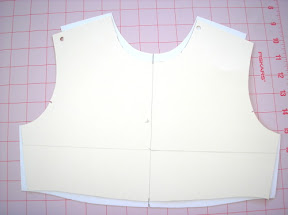
Bodice pattern pieces in a size 4T and 4 and how they compare

In the picture above, the size 4 is laying on top of the size 4T. The size 4T is actually too long in length and too wide. I double checked all of my grading and there was no mistake. The size 4T was graded off my 3T and the size 4 off of the 5. The shaping of the sample size pattern pieces varied a little. The toddler was a little boxier because toddlers don't have any waist shaping, whereas a 5 year old does. If I were to leave my patterns this way, someone will eventually hang the two sizes next to each other and think there was some kind of manufacturing mistake. I needed to fix my patterns so that each size is incrementally bigger.

To do this, I rearranged my size ranges, combining some sizes:

3M, 6M, 9M, 12M, 18M - sample size 12M

24M/2T, 3T, 4T/4 - sample size 3T

5, 6, 6x - sample size 5

The next thing I did was reworked the shaping of my toddler sizes to look more like the 4-6x range. I pulled the waist in some and made the armhole smaller. I made these shaping changes because I found that my toddler patterns were just a little too big. Now, I can lay all of my bodice pattern pieces in order and they get incrementally larger from the 3M to the 6x. Your patterns may look different, but it is worth comparing the sizes on the outside edges of your ranges to make sure you don't have something weird show up like I did.

Even though I combined some sizes, I kept this behind the scenes. My customers still saw all of the sizes separated out. If someone ordered a size 24M and another ordered a 2T, the dress would be exactly the same except for the size tag. I offered all of the sizes on my website so that customers would see something familiar. Perhaps it seems a little dishonest? I don't think so because in the real world a 24M child is the same size as a 2T and I was willing to take the chance. For what its worth, no one ever complained or returned those sizes for fit issues.

Now, I don't know that what I did is "the way it should be done". In the past though, I have had people question why the 24M was larger than the 2T and I had no explanation. Once I worked through grading all of my patterns by hand, it started to click in my head. The relationship of the shape of the pattern pieces, the grade, and body measurements are all connected.

August 12, 2009

A Warning on Labeling Bamboo Textiles


Bamboo fabric has long been considered a miracle green fabric. It is super soft, absorbent, biodegradable, and considered antimicrobial. It is true that bamboo is considered an eco friendly plant because it can be grown quickly without the use of chemicals. Many products have been produced from bamboo - from floors to textiles. Some of the eco friendly claims have come under scrutiny, especially bamboo textiles.

Bamboo textiles are produced by two methods. One can be considered sort of green and the other not. With the first method, bamboo stalks are crushed and broken down with enzymes and then combed out. The second utilizes harsh chemicals to break down the bamboo stalks into pulp which is extruded by spinnerets. This second method is the same process in which Rayon fabrics are manufactured.

You can bet that the majority of the bamboo fabrics on the market are manufactured by the second method. Because of this, the FTC has declared that bamboo fabrics must be labeled Rayon with the qualifier from bamboo. While this is a controversial position taken by the FTC, it is more accurate due to the actual processes being used. The FTC has clamped down on some companies claiming their bamboo textiles are "green". The charges include falsely advertising some of the more outlandish claims of being antimicrobial and biodegradable.

Anyway, be careful of how you label bamboo. The FTC has further guidance on how to deal with bamboo.

July 22, 2009

More aggressive intellectual property enforcement by Taggies and Gerber

Taggies


My most popular blog entries have to do with taggies. Taggies are those square blankets with ribbon loops around all edges. I have received a lot of comments asking what the latest is on the patent and enforcement. I can only repeat what other commenters have stated:

1. The Taggies people are continuing to enforce their patent.
2. The patent enforcement lawyers appear to be going after anyone who has any form of a ribbon loop on a blanket edge, whether it is one ribbon loop or several.
3. No one has taken up the task of challenging the patent.

If Etsy or Ebay receive notice from Taggie's lawyers that the product is a potential infringement, those companies will pull your listing. These companies have little resources to investigate the claims, so legitimate or not the listing will be pulled down. You will not be able to defend yourself. If you list an item in your own store or blog for sale, you will receive a letter directly.

To date, it would appear there is plenty of evidence that the patent can be challenged. Commenters claim they had these style of blankets as children or that they have bought a current home sewing pattern with this style. Patterns and instructions abound on the net as do product listings in various online stores. The Taggies people were the first to obtain a patent and therefore believe they own it despite the evidence that the idea has been around for decades. This only illustrates the problem with the current patent protection system. The system is just complex enough that ordinary people have no idea what patents are being sought and if they should be challenged. The patent bureaucrats and lawyers don't understand the manufacturing processes and how common a folded ribbon loop in a seam is. Who has the time and money to fix the problem? Taggies is expanding into Europe and South America, so despite calls for a boycott the company appears to be growing.

Gerber and the word Onesie

Another aggressive brand enforcement problem has to do with the word onesie. Onesie is a registered trademark brand owned by Gerber. You cannot use that particular word to describe an infant bodysuit or unitard unless it is an actual Gerber branded Onesie. Various acquaintances of mine and online shop owners are receiving threatening letters about their use of this word in their product descriptions. Gerber appears to be ramping up their enforcement of their trademark.

These companies have not technically done anything illegal. They have the right to apply for patent and trademark protection. That protection is only worth as much as they are willing to enforce it. So, IMO, let them waste spend their money on it. The one thing these companies are doing is creating ill will among potential customers and retailers. Customers and retailers have long memories and will think twice about buying or indirectly promoting those products to friends. They may be doing more damage than they know.

Baby and children's apparel products seem to have more patent and trademark protection than other sewn product categories. There are bibs, hand covers, sensory objects, diapers, and so much more that have patent protection. I haven't quite figured out why.

July 17, 2009

What is a fabric converter?

Fabric prints

Fabric or textile converters may not be a term some are familiar with. Fabric or textile converters are factories that embroidery, dye, print, flock, bead, pleat, etc. fabric. They may specialize in one area and simply call themselves embroiderers or printers, or they may provide multiple types of conversions. A fabric converter takes specially prepared or greige (pronounced grey) fabric and converts it into finished goods.

There are various forms of greige goods. Generally greige goods are fabrics that come right off the loom. Some have been minimally processed, not processed at all, or the yarns have been processed prior to weaving or knitting. There are various types of finishes that depend on the desired outcome. There are finishes that prepare the fabric for printing or dying. Other finishes enhance the fabric's qualities, such as singeing, desizing, scouring, bleaching, calendaring, and many more. These are finishes done to the fabric prior to printing, dying, or embroidering and so they are still called greige goods by some. Since these finishes do finish the fabric to some degree, they are technically called by other names. There are various acronyms and labels for the different types of "greige" goods and it all becomes kind of fuzzy (or grey, heh) for me. In any event, greige goods are warehoused until an order comes in to print (or whatever) the fabric. Printing and embroidering are some of the fabric conversions done at the very last stage of fabric manufacturing.