I admit that sometimes I make mistakes. A person reading my previous blog entry on a wedding care/content label pointed out some inaccuracies in how I wrote my suggested label. The FTC has some guidelines on how to write labels, both for content and care. I've read these instructions many times, but I sometimes need a refresher. Yes, it would be a good idea for anyone who has to write labels to read the instructions themselves rather than rely on a blog entry (or an anonymous commenter).*
Care instructions follow the general form:
Washing
Bleaching
Drying
Ironing
Warnings
If a dress truly cannot be dry cleaned, then the label should include that instruction. My label suggestion would be more accurate if I had included that instruction. I had also placed the bleaching instruction in the wrong order. Perhaps a better, more accurate, and perhaps correct label (changes in bold) would read:
100% Polyester
Do not dry clean.
Hand wash or
Spot clean in cold
water with mild
soap. Do not bleach.
Hang to dry.
Do not iron.
Made in China
RN12345 (<------ Made up)
---------------------
Avoid the use of
alcohol based products
such as hairspray,
perfume, etc., as these
may damage the dress.
The commenter also pointed out that if there is a reasonable basis for care instructions, then a manufacturer does not need to destroy a dress to prove it. I guess the question that must be determined is what is reasonable? In my opinion (and just for this commenter, this IS my opinion, for what it's worth), a new wedding dress manufacturer should destroy a few dresses to prove their labels. If you think something can be dry cleaned, you should be able to prove it. Same with any other care instructions. Over time, you may be able to reduce the type and amount of testing provided you do not change your component parts. This is probably the reason behind some of the testing requirements in the CPSIA. When you change a component (sometimes even from the same source), you have introduced a variable which may result in different testing guidelines.
I know wedding dresses are expensive, even the initial samples. Is it reasonable that every dress be tested to prove the care instructions? I am not sure every manufacturer goes to that extreme. But it is reasonable that a few have been. Testing a whole complete unit is the only way to test for compatibility of components. Testing a whole complete unit will tell you what a customer will experience. Wedding dresses have a lot of sentimental value and you wouldn't want a customer to have a dress ruined by poor or incorrect cleaning instructions. But this decision is best left to the manufacturer and the responsibility they are willing to bear if something were to go wrong.
As a manufacturer develops, it is reasonable to also test components. It is common for a manufacturer to use the same polyester satin in multiple styles and all they do is change up the trimming. In this case, the satin has probably been washed tested a few times and they know how it should be cleaned. But the trimming is different. In this case, I take some yardage, stitch the trim on and wash it (or dry clean it) - multiple times.
I can recall some concern I had about some flocked glitter on a chiffon. The glitter can fall off because the dry cleaning solvents will dissolve the glue. Washing by hand or machine can cause the glitter to fall off due to abrasion. So we tested various scenarios and came up with a reasonable basis for care. The same scenario can be applied to beads. Though I must say, based on my experience testing, some beads can be dry cleaned and some cannot. Some will fall apart even when hand washing. You won't know unless you test.
It is reasonable that a manufacturer has proof for the testing they recommend. I believe this includes documentation. You won't have documentation unless you test something. These days, I am not sure that a government regulator will appreciate your good intentions or your word without some kind of proof.
And finally, it is true that the CPSIA does not specifically mention wash testing (as I stated in my previous blog entry). It does imply that any testing be done by a certified 3rd party lab. When I worked various private label programs for Big Box stores, they required wash testing by an approved 3rd party testing lab. At that time we were able to negotiate creating an in-house wash testing program to save money. We were required to submit a copy of our test results with the 3rd party testing reports to the technical designers of the big box stores. In the days of CPSIA, I imagine this is no longer possible (I haven't worked on any private label programs in a while, so someone else who has will have to clarify this point). So while the law may not specifically mention wash testing by a certified lab, Big Box retailers might require it anyway. This is thus my reasoning for why I said what I said.
*When I wrote my original blog entry, the FTC site was down and had been down for a few weeks. My intention was to verify and correct my article and I didn't do that because I couldn't. It was one of those things that fell off my radar and I didn't get back to it. My apologies to anyone if I misled. I appreciate comments that politely correct me when I have misstated something. However, I won't print comments that are insulting and offensive.

February 04, 2010

January 17, 2010
Warning: Tagless labels in baby clothes and the CPSIA
My sister sent me an update on the problem. It appears that the re-formulated paints may include latex tainted paint, similar to silk screen paint. My niece had another reaction even worse than previous because her entire back flared up red. The pediatrician suggested my niece now has a latex allergy and possible nickel allergy. Latex allergies can develop over time with multiple exposures.
Well over two years ago, Carter's and the CPSC issued an advisory to parents about tagless or heat transfer labels located in the back neck of their clothing. They had received reports that the labels were causing allergic reactions and irritation. The advisory stated that the reported incidents were rare and a small percentage of the thousands of units produced. The affected product was primarily the Fall 2007 line. This means the product was manufactured early 2007 or late 2006.
It is difficult to know what ingredient in the labels is causing the reaction. Some have suggested formaldehyde. Others suggest it is the pthalates, which exist at a far higher concentration than other products. It is puzzling that with documented problems that neither Carter's or the CPSC have done a more thorough investigation. Instead the CPSC is bogged down with debates over the amount of lead in the brass ball of an ink pen or whether a bicycle manufacture can use lead in a tire valve. Surely the CPSIA, that ultimate guardian of children's safety would not have allowed this kind of problem to persist. One has to wonder where the consumer protection groups are on this? Why aren't they making a big stink?
You would think that a product that proved to be a problem would have been resolved by now. No. Carter's released their Spring 2009 line with a reformulated ink and label style - two years later. Because there was no product recall there is an untold amount of product still floating around. (Even with a recall, there would still be a lot of product out there because recalls rarely recover 100% of sold merchandise).
You can accuse me of hysteria or panic if you choose. I'm most guilty of cynicism about federal regulations that don't seem to actually accomplish intended goals. But the reason I am writing this is because my youngest niece suffered a reaction to a tagless label. I was even more incensed when I saw this picture.

You see this label does not even belong to Carter's. It's an Arizona Jean Co. bodysuit, a private label product for JCPenny. The brown around the label is actually my niece's blood! You can see the rash on her back below.

My sister purchased the bodysuit in Fall of 2008 in anticipation of need later in 2009. It wasn't after her baby had worn the bodysuit a few times that she realized the source of the problem. My sister reported the problem to JCPenny and was told she would be refunded her money and receive new product. She was also advised to report the problem to the CPSC herself (which she is doing). Huh? Since I have worked on private label programs for JCPenny, I know how meticulous and thorough they are with safety. This is surprising to say the least.
This is all rather troubling. Doesn't the CPSC require companies to report safety problems immediately? Of course the CPSC may receive a report but how long will it take for them to react, especially now? This problem illustrates how upside down the whole system has become*. We focus all of our energy in silly debates about ink pens, ban rhinestones with no bio-available lead and spend all of our time recalling toys with minuscule amounts of lead - all with no reported injuries. Compare that with the many reports of injuries related to these labels, and we get, well, nothing.
Spring 2009 is two years after the initial reports. Why so long? Why not switch to traditional labeling in the interim? Carter's claims they went tagless to improve the comfort factor - no scratchy label. Well, a scratchy label can be cut out and the problem removed. A tagless label on a baby's bodysuit is not easily removed and must be thrown out. After all this, I think I prefer traditional labels.

*In fairness, the CPSC is working on a consumer database to report incidents as required by law. They are in the process of comment gathering and workshops. Problems can be reported now, but the information required by the CPSIA is not publicly available. If anything, the CPSC should look at a complete overhaul of their entire website which is a disorganized mess. But that is an argument for another day.
Well over two years ago, Carter's and the CPSC issued an advisory to parents about tagless or heat transfer labels located in the back neck of their clothing. They had received reports that the labels were causing allergic reactions and irritation. The advisory stated that the reported incidents were rare and a small percentage of the thousands of units produced. The affected product was primarily the Fall 2007 line. This means the product was manufactured early 2007 or late 2006.
It is difficult to know what ingredient in the labels is causing the reaction. Some have suggested formaldehyde. Others suggest it is the pthalates, which exist at a far higher concentration than other products. It is puzzling that with documented problems that neither Carter's or the CPSC have done a more thorough investigation. Instead the CPSC is bogged down with debates over the amount of lead in the brass ball of an ink pen or whether a bicycle manufacture can use lead in a tire valve. Surely the CPSIA, that ultimate guardian of children's safety would not have allowed this kind of problem to persist. One has to wonder where the consumer protection groups are on this? Why aren't they making a big stink?
You would think that a product that proved to be a problem would have been resolved by now. No. Carter's released their Spring 2009 line with a reformulated ink and label style - two years later. Because there was no product recall there is an untold amount of product still floating around. (Even with a recall, there would still be a lot of product out there because recalls rarely recover 100% of sold merchandise).
You can accuse me of hysteria or panic if you choose. I'm most guilty of cynicism about federal regulations that don't seem to actually accomplish intended goals. But the reason I am writing this is because my youngest niece suffered a reaction to a tagless label. I was even more incensed when I saw this picture.

You see this label does not even belong to Carter's. It's an Arizona Jean Co. bodysuit, a private label product for JCPenny. The brown around the label is actually my niece's blood! You can see the rash on her back below.

My sister purchased the bodysuit in Fall of 2008 in anticipation of need later in 2009. It wasn't after her baby had worn the bodysuit a few times that she realized the source of the problem. My sister reported the problem to JCPenny and was told she would be refunded her money and receive new product. She was also advised to report the problem to the CPSC herself (which she is doing). Huh? Since I have worked on private label programs for JCPenny, I know how meticulous and thorough they are with safety. This is surprising to say the least.
This is all rather troubling. Doesn't the CPSC require companies to report safety problems immediately? Of course the CPSC may receive a report but how long will it take for them to react, especially now? This problem illustrates how upside down the whole system has become*. We focus all of our energy in silly debates about ink pens, ban rhinestones with no bio-available lead and spend all of our time recalling toys with minuscule amounts of lead - all with no reported injuries. Compare that with the many reports of injuries related to these labels, and we get, well, nothing.
Spring 2009 is two years after the initial reports. Why so long? Why not switch to traditional labeling in the interim? Carter's claims they went tagless to improve the comfort factor - no scratchy label. Well, a scratchy label can be cut out and the problem removed. A tagless label on a baby's bodysuit is not easily removed and must be thrown out. After all this, I think I prefer traditional labels.

*In fairness, the CPSC is working on a consumer database to report incidents as required by law. They are in the process of comment gathering and workshops. Problems can be reported now, but the information required by the CPSIA is not publicly available. If anything, the CPSC should look at a complete overhaul of their entire website which is a disorganized mess. But that is an argument for another day.
December 15, 2009
Metric pattern cutting for children's wear and babywear - 4th Edition


Winifred Aldrich has released an updated edition of her pattern making book. Besides having a much nicer cover design, it reportedly contains a revised organization and emphasis on flat pattern making. I find this change interesting because more and more design entrepreneurs are utilizing flat pattern making today and this confirms my personal experiences in the industry.
From the abstract at Amazon:
Today’s popularity of easy-fitting styles and knitted fabrics means that basic ‘flat’ pattern cutting is used to construct the majority of children’s wear and babywear and this type of cutting is therefore emphasized in this new edition. Shaped blocks and garments, cut to fit the body form, are still included, and are placed in chapters covering some school uniform garments or more expensive fashion or formal clothes.
One primary difference between flat versus fitted pattern making is that the patterns have the same shape for the front and back pieces. For example, the armhole shaping is symmetrical. Creating patterns in this way results in a looser, more casual fit and it is appropriate for a lot of children's clothing. Even so, I see more of a modified flat method in actual use. Patterns are modified so that they aren't quite so boxy and more fitted. Yet, they retain some symmetry between front and back pieces.
October 26, 2009
Do professional pattern makers work with seams on or off the pattern?
Professional apparel pattern makers work with seam allowances on their patterns nearly all the time. It's faster. I would argue it's more precise. This practice goes counter to what most pattern making classes teach. They teach that you must remove the seam allowances and add them back later. I don't know anyone in the industry that works this way. I think the idea is that working with seam allowances one can create variations that lead to fitting problems later. That's simply not true if you check your new pattern against the original block later. (This is assuming you make a copy or rubbing of your original before you start on a new style. But I'm sure you knew that).
If you are drafting by hand, it is time consuming to remove the seam allowances. Pattern blocks are made with seam allowances on. You would have to keep a set of blocks without seam allowances. It would be so easy to mix up seamed and unseamed pattern blocks. Apparel pattern makers leave their blocks seamed and theatre pattern makers or cutters leave their blocks (or rather slopers) unseamed. In fact a block is a finished pattern piece that includes all pattern markings and is seamed.
If you are drafting in CAD, you can turn the seam allowances on and off. You can work on the cutting line or the stitching line. It's a simple matter of hitting a few buttons. BUT, I have found that CAD programs have difficulty in calculating between seamed and unseamed because it involves a complex series of mathematics. So constantly switching between cutting and stitching lines can produce some weird anomalies. (As an aside, weird things can happen with notches on stitching versus cutting lines too). I have found this is true no matter which CAD system you use. So I work with seam allowances on and directly on the cutting line nearly 99% of the time. This means that I keep the seam allowances in mind while I work.
In CAD, it is important to turn the seam allowances off and walk the pattern pieces along the stitching line in a few areas. Collars and necklines is one area that I nearly always check for matching on the stitching line. There are other situations that come up where this important. I learned this the hard way recently.


Next, I aligned the pattern pieces to make sure they match. At this point they did and I assumed all was right. Until I got complaints from the sewing machine operators that things weren't matching up. I had to go back and double check.

I took the seam allowances off the pattern pieces and realigned them. They didn't match, so I redrew the stitching line of the side piece to make sure it matched the center. I added back the seam allowances and realigned the edges.


Your pattern pieces will then look like this and match up in every way possible.

If you are drafting by hand, it is time consuming to remove the seam allowances. Pattern blocks are made with seam allowances on. You would have to keep a set of blocks without seam allowances. It would be so easy to mix up seamed and unseamed pattern blocks. Apparel pattern makers leave their blocks seamed and theatre pattern makers or cutters leave their blocks (or rather slopers) unseamed. In fact a block is a finished pattern piece that includes all pattern markings and is seamed.
If you are drafting in CAD, you can turn the seam allowances on and off. You can work on the cutting line or the stitching line. It's a simple matter of hitting a few buttons. BUT, I have found that CAD programs have difficulty in calculating between seamed and unseamed because it involves a complex series of mathematics. So constantly switching between cutting and stitching lines can produce some weird anomalies. (As an aside, weird things can happen with notches on stitching versus cutting lines too). I have found this is true no matter which CAD system you use. So I work with seam allowances on and directly on the cutting line nearly 99% of the time. This means that I keep the seam allowances in mind while I work.
One Exception
In CAD, it is important to turn the seam allowances off and walk the pattern pieces along the stitching line in a few areas. Collars and necklines is one area that I nearly always check for matching on the stitching line. There are other situations that come up where this important. I learned this the hard way recently.

In this situation, I split a jacket back pattern piece and added corresponding seam allowances along the split line.

Next, I aligned the pattern pieces to make sure they match. At this point they did and I assumed all was right. Until I got complaints from the sewing machine operators that things weren't matching up. I had to go back and double check.

I took the seam allowances off the pattern pieces and realigned them. They didn't match, so I redrew the stitching line of the side piece to make sure it matched the center. I added back the seam allowances and realigned the edges.

The pieces didn't match again. Sewing machine operators also do not like this because they do not know how to align the pieces. In this particular case, the seam allowances are small, so I left the little "dog-ear". It can be difficult to cut those "dog-ears" off by hand when they are really small. It is easier to machine cut. In any event, there are different ways of dealing with this. I show one method below.

Your pattern pieces will then look like this and match up in every way possible.

August 31, 2009
Comparing pattern shaping and children's sizes follow-up
Kathleen suggested that I post an update on a previous grading post I did about a year ago. You can read what I wrote previously at When Patterns Collide. In that post I suggested that it would be possible to combine the 24M and 2T and the 4T and the 4. My reasoning being that the 24M and the 2T are essentially the same sizes - why differentiate them? The subject is a little complex and perhaps controversial - at least to pattern making geeks. My goal was to reduce the work load. I was drafting and grading all of my patterns by hand. I am incredibly slow grading by hand. In addition, I was trying to solve one particular sizing problem that shows up in childrenswear, that is hard to illustrate. Since I shut down my Prairie Roses line, I am not knee deep in pattern making as I was a year ago. But perhaps it may be helpful to explain what I ended up doing.
Originally, I broke up my sizes into these ranges:
3M, 6M, 9M, 12M, 18M, 24M - sample size 12M
2T, 3T, 4T - sample size 3T
4, 5, 6, 6x - sample size 5
These ranges are rather typical of what you will find in retail stores. When developing my patterns, I have to make and grade the patterns for each size range separately. You cannot make one set of patterns in one size and grade them up and down all the way. It won't work because that many sizes will cause minute grading errors and strange fit, especially on the smallest and largest sizes. As you define your grading and size measurements, you will find that the 24M and 2T and the 4T and 4 overlap. I followed the Jack Handford grading rules, which are pretty darn good, but end up with a result like this:
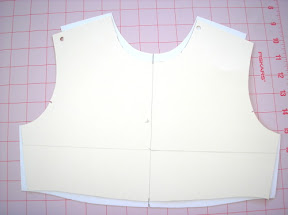
Originally, I broke up my sizes into these ranges:
3M, 6M, 9M, 12M, 18M, 24M - sample size 12M
2T, 3T, 4T - sample size 3T
4, 5, 6, 6x - sample size 5
These ranges are rather typical of what you will find in retail stores. When developing my patterns, I have to make and grade the patterns for each size range separately. You cannot make one set of patterns in one size and grade them up and down all the way. It won't work because that many sizes will cause minute grading errors and strange fit, especially on the smallest and largest sizes. As you define your grading and size measurements, you will find that the 24M and 2T and the 4T and 4 overlap. I followed the Jack Handford grading rules, which are pretty darn good, but end up with a result like this:
In the picture above, the size 4 is laying on top of the size 4T. The size 4T is actually too long in length and too wide. I double checked all of my grading and there was no mistake. The size 4T was graded off my 3T and the size 4 off of the 5. The shaping of the sample size pattern pieces varied a little. The toddler was a little boxier because toddlers don't have any waist shaping, whereas a 5 year old does. If I were to leave my patterns this way, someone will eventually hang the two sizes next to each other and think there was some kind of manufacturing mistake. I needed to fix my patterns so that each size is incrementally bigger.
To do this, I rearranged my size ranges, combining some sizes:
3M, 6M, 9M, 12M, 18M - sample size 12M
24M/2T, 3T, 4T/4 - sample size 3T
5, 6, 6x - sample size 5
The next thing I did was reworked the shaping of my toddler sizes to look more like the 4-6x range. I pulled the waist in some and made the armhole smaller. I made these shaping changes because I found that my toddler patterns were just a little too big. Now, I can lay all of my bodice pattern pieces in order and they get incrementally larger from the 3M to the 6x. Your patterns may look different, but it is worth comparing the sizes on the outside edges of your ranges to make sure you don't have something weird show up like I did.
Even though I combined some sizes, I kept this behind the scenes. My customers still saw all of the sizes separated out. If someone ordered a size 24M and another ordered a 2T, the dress would be exactly the same except for the size tag. I offered all of the sizes on my website so that customers would see something familiar. Perhaps it seems a little dishonest? I don't think so because in the real world a 24M child is the same size as a 2T and I was willing to take the chance. For what its worth, no one ever complained or returned those sizes for fit issues.
Now, I don't know that what I did is "the way it should be done". In the past though, I have had people question why the 24M was larger than the 2T and I had no explanation. Once I worked through grading all of my patterns by hand, it started to click in my head. The relationship of the shape of the pattern pieces, the grade, and body measurements are all connected.
To do this, I rearranged my size ranges, combining some sizes:
3M, 6M, 9M, 12M, 18M - sample size 12M
24M/2T, 3T, 4T/4 - sample size 3T
5, 6, 6x - sample size 5
The next thing I did was reworked the shaping of my toddler sizes to look more like the 4-6x range. I pulled the waist in some and made the armhole smaller. I made these shaping changes because I found that my toddler patterns were just a little too big. Now, I can lay all of my bodice pattern pieces in order and they get incrementally larger from the 3M to the 6x. Your patterns may look different, but it is worth comparing the sizes on the outside edges of your ranges to make sure you don't have something weird show up like I did.
Even though I combined some sizes, I kept this behind the scenes. My customers still saw all of the sizes separated out. If someone ordered a size 24M and another ordered a 2T, the dress would be exactly the same except for the size tag. I offered all of the sizes on my website so that customers would see something familiar. Perhaps it seems a little dishonest? I don't think so because in the real world a 24M child is the same size as a 2T and I was willing to take the chance. For what its worth, no one ever complained or returned those sizes for fit issues.
Now, I don't know that what I did is "the way it should be done". In the past though, I have had people question why the 24M was larger than the 2T and I had no explanation. Once I worked through grading all of my patterns by hand, it started to click in my head. The relationship of the shape of the pattern pieces, the grade, and body measurements are all connected.
Subscribe to:
Posts (Atom)