December 20, 2010

Tutorial: Reduce or Remove Sleeve Cap Ease pt. 2

I received a really great question on my previous tutorial on how to remove or reduce sleeve cap ease. Gina's question deserves it's own blog post.

Well, what do you do if you have big arms but too much ease? If I move it over I will lose bicep room. I am working with a dress right now and everything fits but the sleeves are tight and the have too much ease. How do I widen the sleeve get rid of ease and fit it to the armhole?
Thanks
This is a really great question and may require me to consider re-writing my tutorial. My previous tutorial is based off my experience drafting patterns for children's clothing. Usually it is not a problem to reduce the bicep line because it's usually too big anyway. My overall changes are small because I am perfecting patterns that I have drafted myself.

If you are working with a commercial pattern for adults, the approach will be similar. You can't always reduce the bicep line and the overall changes may be quite significant. Patterns from the Big 4 notoriously have too much sleeve cap ease. To be fair, if you follow the drafting instructions in some pattern drafting books, you end up adding in a fair amount of ease too. One pattern making book has instructions that result in as much as 1.5 inches of ease in a set-in toddler sleeve. Way too much. Such a practice is not common in the fashion industry and the production sewers will refuse to set-in the sleeves.

I had difficulty coming up with a solution and so I had to ask my pattern making friends at the Fashion Incubator Forum. We have to assume that everything fits Gina as it should, though it's possible there is some other fit issue that is contributing to the bicep width problem to begin with.(1) There are two possible solutions and neither is quick nor easy. Both will require testing. To add bicep width, slash and spread or slash and pivot the sleeve to the desired measurement. This alteration will require fixing the sleeve cap anyway.

1. Draft a new sleeve from scratch. (My solution)

2. Reduce the sleeve cap height equal to the amount of ease to be removed. (From Nora of the Fashion Incubator Forum).

Sometimes it's just easier to start over. It may save time in the long run and you will get exactly the sleeve you want.

If you would rather fix the sleeve, you can try Nora's suggestion. Nora's suggestion leaves the bicep width alone and only adjusts the sleeve cap height.

Walking a sleeve along an armscye
1. Begin by walking the sleeve along the armhole in a similar manner to my previous tutorial. In this case, start at the bottom and walk the armhole toward the shoulder. You will need to walk the sleeve on both the front and back armholes matching up the front of the sleeve with the front bodice and the back bodice with the back sleeve. Your sleeve should not be symmetrical and you will need to check the entire armhole. As you work, you may want to check the entire armhole and sleeve cap.

Measurement length difference

2. Measure from the seam line of the shoulder on the bodice to the center notch of the sleeve. This will be equal to the amount of ease on one side of your sleeve. Repeat for the back armhole. Total up the ease for the front and the back of the sleeve. This will equal the total sleeve cap ease.

Reduce ease by lowering cap height

3. Reduce the sleeve cap height equal to the amount of ease that needs to be removed and redraw the sleeve cap. You will need to repeat these steps until you get exactly the amount of ease needed to set the sleeve and no more.


Neither Nora nor I can guarantee that this method is the answer. This method will require lots of back and forth testing and iteration. The method is similar enough to my previous tutorial that I think it will work eventually. If you have the patience for lots of testing, then go for it. Also remember that you may still need *some* ease. When we say zero ease, we don't really mean zero ease. You may need some to help set the sleeve in. The only way to know is to sew up a few samples. 1/4" to 1/2" of total ease is not unusual. This ease is required to help sew opposing curves together. The sleeve should be against the feed dogs as it moves under the foot and the action of the feed dogs may require a little bit of ease so that the sleeve cap and armscye meet up in the end.

1. The armhole could be too small or too big. It may be in the wrong location or scooped wrong under the arms.


Thanks to Nora for her suggestion.

July 15, 2010

Potato Sack Dress

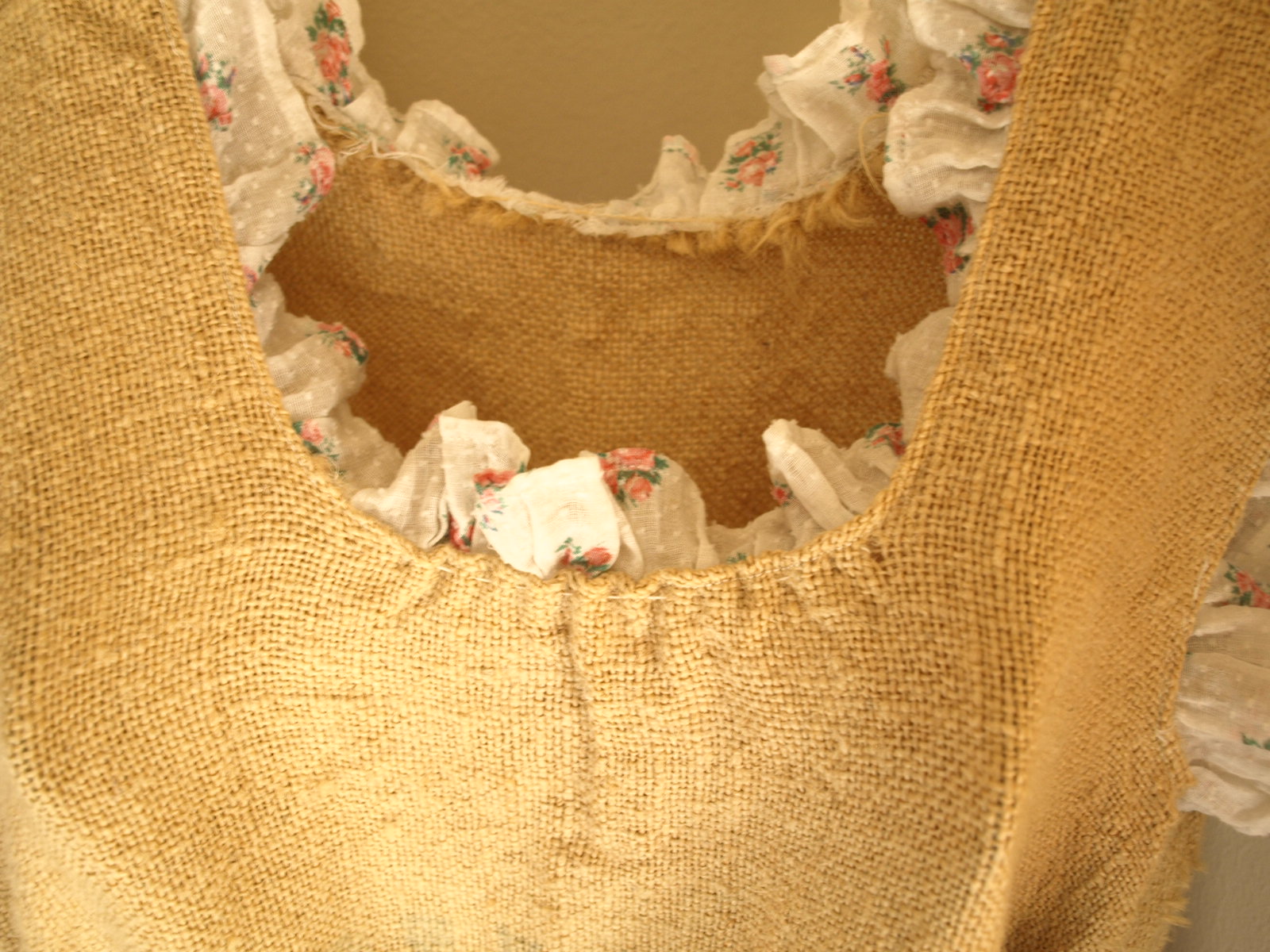
My local town in Idaho has a little museum and this dress was on display with a fun story. The story is that high school freshman girls had to wear a potato sack dress for a full day as part of their initiation in the 1950's. Back then potatoes were bagged in burlap sacks. I couldn't imagine wearing this dress for a full day. One girl felt sorry for a freshman and sewed ruffles on one of the dresses to pretty it up.

Dress made from a potato sack.

Potato sack dress with the addition of ruffles at the neck.

The tradition has long since disappeared as potatoes are now packed in paper sacks. Some local resident donated this to the town museum along with a picture of the girls in the dress.

April 14, 2010

Crochet Dish Scrubbie and knit dishcloth

I have had a flare up of carpal tunnel and possibly arthritis. I know I am too young for the arthritis, but this flare up was different from years ago. Many years ago I found that knitting and crocheting actually helped my carpal tunnel. Of course it can actually make it worse if you do too much. It must be something about strengthening the muscles in your fingers and hands...
Anyway, I am working through my meager yarn stash and making practical stuff. First up is a dish scrubbie or tawashi. I love this and have made several. There are many different styles and I may try other versions.

Crocheted dish scrubbie

I am also making dishcloths. I like the texture of this one.

Knitted dish cloth

The pattern is called Double Bump and is available as a free Ravelry download.

April 10, 2010

Bookbinding tools from book board

I have been meaning to post about some easy to make bookbinding tools made from book board. Right now my book board comes from upcycled notebooks from the thrift store - if I can find some in good shape. For just a couple of dollars you can make these essential tools. I can't take credit for the design as these are copies of what I remember using in the conservation lab at BYU-Provo.

Cutting guide with finger guard for book binding

First up is a cutting guide with finger guard. It is about 3/4" wide and is ideal for trimming book cloth. This design is not ideal - the ones I remember had a built up section in the middle that made it easier to grab and hold on to. Still, this works pretty good and I may get around to fixing it. The upright end goes to the outside, facing away from the book to protect your fingers from the blade as you cut.

Punching cradle made from book board for book binding

This is a punching cradle bought as a kit from a book binding/paper store. It is fairly simple and could easily be reproduced. (The kits are no longer available). The white section is tyvek, but could also be cardstock. Over time you have to glue additional tyvek or paper because lots of punching will weaken the join.

Corner trimming tool to trim book cloth in book binding

Finally, this is what was fondly called the corner-matic in the conservation lab. It is used to cut the corners of book cloth when making up the cover. I think the Banister book has instructions for something similar, but I much prefer this design. This pictures shows the corner-matic face up so you can see how it is put together. To use it, place it face down over the corner you want to trim and you will get a nice 45 degree cut the right distance from the board corner.

March 16, 2010

Dress Design by Hillhouse and Mansfield


I have been looking for Dress Design by Hillhouse and Mansfield (1948) for years. It was a hot item on Ebay at one time and sold for much, much more than it was probably worth. This book has become highly collectible because it contains detailed pattern draping and drafting instructions for 1940's women's clothing design.  I found a very nice copy of this book for a mere $2 at a thrift store. I knew if I kept my eyes open at the thrift store, it would eventually show up and I checked the used books every time I was there. Yep, I was quite excited to finally find this!

This book came to my attention in design school. There was an advanced pattern making/theater class that utilized this book as a textbook. The book was, of course, long out of print and the college gained special permission to print special spiral bound copies. Word spread among the design students about this book and copies of the book would sell out before some of the students of that class could even buy their copies. I was never able to grab a copy when I was in school.

Dress Design by Hillhouse 1940's waist styles Dress Design by Hillhouse 1940's complex dress design

You can see from these two pages that the designs are iconic and also complex. It's these two characteristics that makes the books so highly desireable and collectible to people who wish to reproduce a 1940's vintage style. Many of these styles would be difficult, if not impossible, to replicate in a modern factory. The labor charges would be enormous. Regardless, this pattern drafting manual would be a great resource to study and learn from. I have not yet attempted any of the drafting instructions, so I can't comment on the difficulty. For me the book is for inspiration.