April 09, 2012

T-shirt pattern quest pt. 5 : Evaluating the fit of the armhole


I sewed up two more samples of my t-shirt pattern. I was still not satisfied with the fit. There were wrinkles around the armhole and elsewhere. I spent a bit of time studying the pictures below to try understand the fitting problem and how to solve it.

The back armhole is too short and pulling the t-shirt toward the back

It finally occurred to me why the armhole was giving me so many problems. The back armhole was too short. You can actually see in the picture that the front of the t-shirt is being pulled toward the back at the shoulder seam and underarm. The fix was rather simple - make the back armhole longer.

The back armhole has been lengthened
What a difference, don't you think? There are some other fit problems. I'm still debating the amount that I scooped out on the front armhole. I think I may need some extra width across the front. And then there is the sleeve that wants to twist. But overall, this is pretty good and those complaints are minor. Will there be a version 5.0? Probably.

April 03, 2012

More on copyrights - this time on fabric

Printed fabric

I've wanted to write a blog entry on the latest state of copyright and intellectual property issues in the fashion and sewn products business for a while. I've been watching the assertions of copyright restrictions by indie pattern designers (sewing and knitting) and the appearance of copyright restriction on fabric selvages. I've struggled with how to approach the topic because it can become quite heated very quickly.

As a fashion designer, I like to use printed cotton fabrics in my girls dresses. Over the last several years, I've been watching the rise and popularity of certain fabric print lines and their designers. I've loved the prints they are producing because they have hit upon a formula which is constantly fresh and inspiring. Long gone are the sweet floral rose buds that were so typical for infant clothing. Now there is an explosion of modern, colorful designs that are mixed and matched like crazy.

In the fashion industry there is an assumption that fabric available for sale can be used to make commercially sold products*. We don't usually take the time to ask for permission from every vendor and copyright holder before we design a season. To do so would bog down the process considerably. And let's not forget the concept of the first sale doctrine, which in the United States says the creator of an object loses control of it once the item has been sold**. Even so, I went so far as to ask permission on one fabric design a few years ago because it was designed by a well known scrapbook paper designer. This designer was known to go after individuals who used her scrapbook products to make new products to sell. But when I asked the fabric vendor, they thought I was crazy - of course I could use the fabric for a commercial product.

Well it appears with the rise of celebrity fabric designers***, that is changing. I've been reading of the recent case involving Kate Spain and C&T Publishing/Emily Cier. I won't rehash the whole thing but you can read a good analysis at The Free Motion Quilting Project. With the resulting chaos and ill will that is now floating around the quilting industry, you can see how quickly creativity can be curtailed.

This one situation throws chaos into more than just quilts. There are many childrens clothing designers, accessory makers, and manufacturers who use fabrics from celebrity fabric designers. What's to be done there? I can assure you that the fashion industry as a whole will not stand for it. There is a cost associated with printing up fabric, but it is not as hard to come up with our own designs and print our own fabric as it has been in the past. Those fabric designers need to be careful that they don't alienate the very customers they seek to serve by limiting what can done with the fabric they create. They may loose the very income they seek to protect.


*Generally speaking, it is suggested that a fashion designer not use a fabric print that contains a licensed character such as Mickey Mouse. Doing so crosses into trademark territory and Disney will come after you. There are some designs which are so distinctive that there can be no doubt that the design refers to another brand. So while the first sale doctrine may apply, why would you want to go there? In addition, it is copyright infringement to copy an existing fabric design and print it yourself. Though that gets into murky water because there are many, many fabric designs which are technically in the public domain, though which is and is not public domain is difficult to determine.

**Those statements printed on fabric selvages that limit usage to personal use are probably not legally binding due to the first sale doctrine. Though I'm certain some individuals may actually try to enforce it with lawsuits and threats anyway. If you see it and you have a concern, then just don't buy it. And as mentioned above, some companies will actually come after you.

***Please don't think that the usage of the terms celebrity fabric designers is disparaging. On the contrary, these fabric designers deserve the recognition that comes with their talent. The term celebrity simply refers to their popularity and the expansion of their brand across multiple product lines. Just as there are celebrity chefs, actors, and what not, there can be celebrity fabric designers.

March 29, 2012

Book Review : Sew Serendipity


There seems to be a trend in new sewing books for the home sewing market. Some are written by fabric or textile surface designers as a way to expand their personal brand, others are written by indie pattern makers. Usually, they include basic how-to sew information and patterns. My local library received two of the Sew Serendipity sewing books written by Kay Whitt, an indie pattern maker (though she does sell to McCall's). The first book I brought home was the book featuring skirts and coats.

The book is organized with basic sewing how-to first followed by common instructions on how to sew the designs featured in the book. Finally, the designs are featured with beautiful photography. I have to admit I skimmed most of the how-to sewing instruction as I am probably a bit more advanced. There are some photo step-by-step instructions and each design has additional illustrated step-by-step instructions. A beginning sewist would have to flip back and forth several times to get complete instructions.

There are three basic designs, a skirt, a tunic/dress, and two jackets. Variations are presented for each design with changes in embellishment, design details, and fabric prints while the basic pattern pieces do not change. I do like the basic shapes of the styles presented, though some of the design details are just not my taste. The patterns are sized XXS to XXL and her measurement chart seems to follow a regular grade, which is nice.

As a pattern maker, I was very pleased when looking at the actual pattern pieces. The line width used on the pattern pieces is very fine, which is so much better than the Big 4. Also, the notches were not the traditional outward V notches but rather slit style notches. I did trace off the tunic pattern and walked some of the pattern pieces and they matched up really well. It is important to read the pattern sheet carefully because there are not a lot of markings other than notches and the piece name. Seam allowances are 1/2 inch unless otherwise noted. In addition, you have to read the instructions for the selected design and the basic how-to for the section. As an example, there is no sleeve cuff pattern piece because it is just a rectangle, but the dimensions are given in the basic how-to section.

A few of the seams needed a bit of refinement, but should not bother most home sewists. One area that will probably cause difficulty is the coat facing. I recommend redrawing the outer facing edge just to make it easier to sew. I think the facing has a sharp inward corner to make it easier when topstitching the facing down, so the facing shape is probably intentional. As an option you can use some other guide while topstitching and still smooth out that shape to make it easier to edge finish. Just my personal preference.


Overall, the book has a nice presentation and the designs are generally appealing. As I mentioned, I did trace off the tunic blouse to sew up but I have to put it off until I get a zipper. So the review is a bit incomplete but I think a beginning sewist will enjoy it.

January 09, 2012

T-shirt pattern quest pt. 4 : Analysis of fit and construction

T-shirt test samples for construction and fit

Here are the results of my first and second pattern test. I had enough fabric to make two shirts. Each shirt revealed problems with my construction and fit. I had added about 1" of extra wearing ease to shirt 1 and that was reduced to 1/2" of extra ease in shirt 2. The pattern was designed with 3/8" seam allowances. This allowed for an 1/8" cut off on the seam edges so that the seams finish at 1/4". I had difficulty in shirt 1 maintaining that cut off allowance, improving on the second.

One thing I did not notice is that this fabric is directional. With napped fabrics, the fabric can look darker or lighter depending on which direction the fabric lays. This interlock is not napped but it definitely looks different in different directions. I had switched the direction of the sleeves on shirt 2 and so there is a color variation. It is subtle and hardly noticeable except in certain light.

Finally, there is an issue with the fit of the armhole, which is just a bit too tight. This creates unsightly wrinkles in the underarm area. I guess I never noticed on the original shirt, but the problem exists there too. So, a bit of adjustment has to happen. I need to lower the armhole a bit and scoop out the front. This means the sleeve will need a bit of adjustment as well. The armholes will no longer be symmetrical front to back, which is how it should be. Anyway, more on that as progress is made.

The shirts are fine and comfortable enough to wear, but a modeled shot may or may not appear on the blog

January 03, 2012

T-shirt pattern quest pt. 3 : Sewing up the first sample


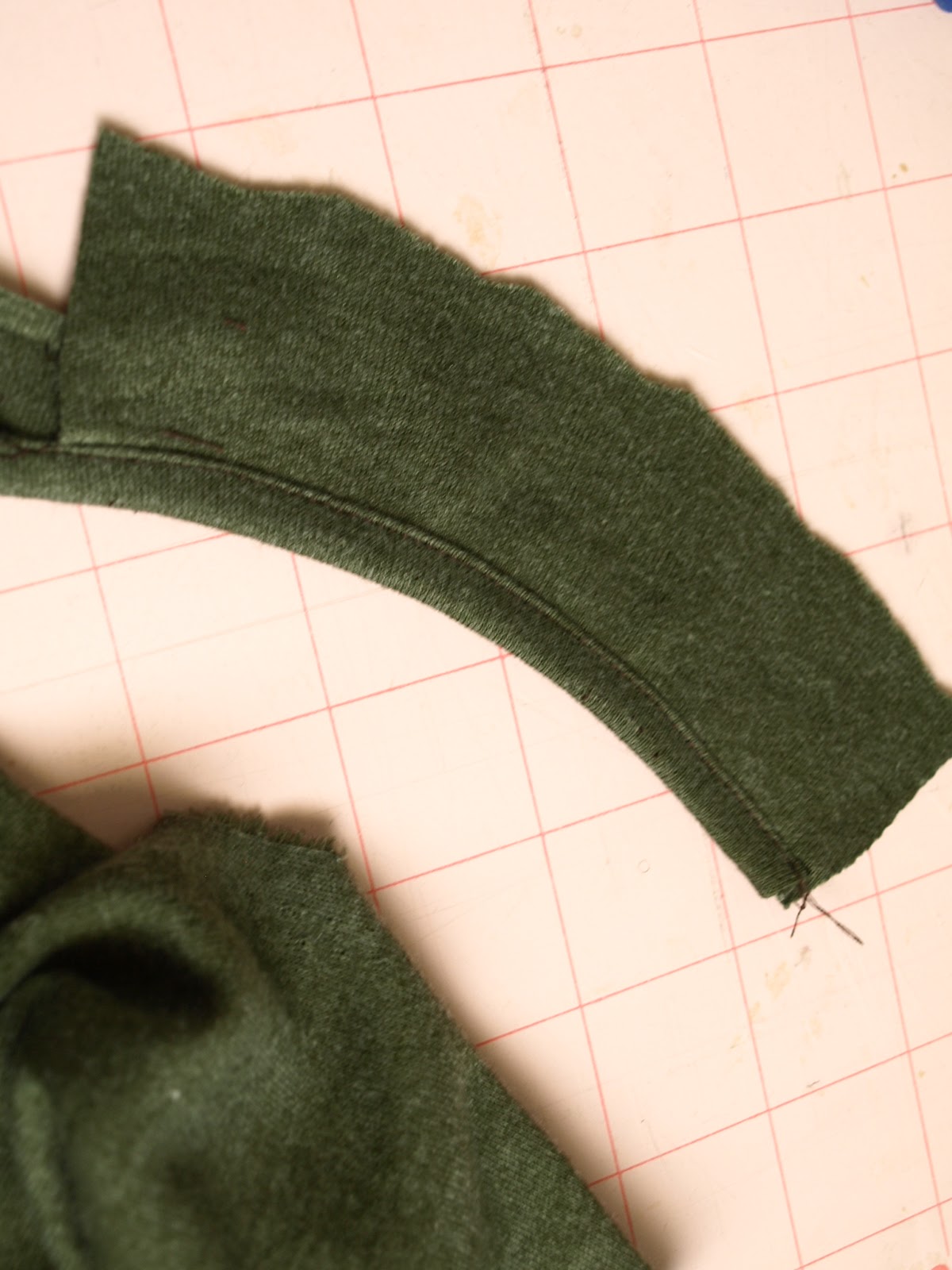
The next step in recreating my favorite t-shirt pattern is to test out some different construction options by sewing up a sample. This sample will also be used to double check fit. I began by testing some binding options on some scraps. I eventually discovered the best method for my machines that gave the best looking results.

Testing binding options for knits

Before stitching the neckbinding to the t-shirt, I stitched one shoulder and overedged one edge of the neck binding.
Sewing a should seam on a t-shirt
In the picture below I am stitching the binding strip to the neck. The binding strip is on top so that I can stretch it as it goes through the machine. The shirt is supported by the table. Don't let it hang down in front of the machine or gravity will do more stretching of the shirt than you intend. I did edge finish one edge of the binding strip by serging. I didn't have enough green thread, so some of it is in black.
Stitching a neck binding to a t-shirt
Next, I followed the same steps in stitching the binding to the sleeve hem edge. These sleeves show about how much I stretch the binding as it went through the machine.

Attaching the sleeve binding

I then stitched the remaining shoulder seam closed through the neckbinding. This means there is a visible seam at the shoulder. This type of shoulder - neckline construction is also visible on the original t-shirt.
Neck and shoulder seam construction
After closing up the second shoulder, attach the sleeves and sew up the side seams. This is the shirt just prior to topstitching. Just fold the binding strip to the inside and topstitch carefully from the right. You can see an example in the first picture of how it turned out, but I'll post a picture of the finished shirt later. I used a regular straight stitch for topstitching. I don't need the neck to stretch to pull it over my head, so it actually turned out fine. My Babylock Evolve does have a chain stitch option, and that is how it should be done. BUT, it takes a good amount of time to switch it over and because of the overly large presser foot, you can't easily see where you are stitching - too much bother. Industrial chain stitch machines look a lot like regular machines. I believe some vintage domestic Singers also have the ability to do a chain stitch, so if you have that option, than use that.

A few last words on the binding. The original shirt had a double fold binding, which is difficult to reproduce at home without the proper folders and adjustments to your machines. The binding I did is less bulky and easier to execute with home sewing equipment and it turned out just fine.