I have posted previously about Taggies brand blankets and related products. They are known for aggressively enforcing and protecting their patent on their security blankets. I have previously talked about how this kind of patent is ridiculous, but there is not much that can be done unless someone wants to be a test case in a patent infringement lawsuit.
Anyway, the company Rashti and Rashti (They are listed as the importer and official licensee) has issued a recall for Taggies infant sleepers. The sleepers are being recalled for snaps that can detach. The sleepers were sold in several big box retailers. This kind of recall is not unusual. Improperly applied snaps can easily fall or pull out. Painted snaps should be tested for lead.
I would post the pictures of the sleepers here, but the Taggies people are so aggressive about sending out cease and desists, I don't want any trouble (even though the images are technically in the public domain). Just follow the links to the official recall notice. There is a small link on the main Taggies page about the recall.
BTW, if you visit the What's New page at the Taggies website, you can see the types of products they will attempt to protect with their patent. The patent is supposed to protect related products and you can see their version of related products is extensive. All they've done is add ribbon loops to various products. To me this is not a question of protecting a unique product worthy of a patent. Instead it is a form of brand protection over a certain look. I am still flummoxed on how they achieved patent protection over the simple idea of inserting a ribbon loop into a seam. Maybe I should try to patent shoelaces?

July 14, 2008

July 10, 2008
Product Review: Corduroy Pants for a toddler
I haven't done a product review in a long time. This is an item randomly pulled from my stash, a pair of elastic waist corduroy pants in size 18 months.
There was a time when this heavy-weight corduroy was popular. Is it still popular for boys? Even though this is a heavy weight corduroy, I don't know that this would be very durable. 18 month old kids spend a lot of time on their knees and bums crawling and scooting around. Most are probably walking, but not all the time. Anyway, you can see it has a pieced front leg with a bias piece over the knee. The waist has tunneled elastic.

Here is a close-up of the knee. Stitching this fabric can pose challenges because it is a thick fabric. BTW, the fabric is cut nap up (smooth toward the waist). Doing this gives a richer, more luxurious look, but also turns the clothing into a giant lint trap.

Here is the inside view of the front leg. One thing you could do to add extra value is to line, possibly interface, the knee piece. It would add some extra durability. But maybe people don't care about that when the pants are $5.

This last picture shows the elastic. I imagine the pattern maker and sample sewer spent a lot of time figuring out the correct cut elastic measurement. The fabric weight and tunnel stitching can cause the elastic to stretch out and not recover properly unless you compensate. The elastic is attached to the waist with an overlock stitch, turned to the inside and topstitched. I don't think there is any other way to do an elastic waist in this fabric. Too bulky otherwise.

May 15, 2008
Does your fashion clothing line tell a story?

In a previous blog entry I answered, "What is a line?". That recent blog and other things I have been reading have led me to the next logical question. Does your line tell a story? I partially addressed it in the previous blog.
Some say a line tells a story. That is the more difficult thing to interpret or even observe. Not too many customers care about your source of inspiration unless it is an integral value that they share.
There is a line story and a company story/history/values and some people confuse the two. Does the line story have to reflect the company story? Does each piece have to reflect the company values? How much do the two overlap? Or should they?
A story or narrative describes a sequence of events or parts through the written word or visual depiction. The story contains clues, pieces, or parts that the reader or observer can put together to make a whole picture or concept. At least this is the dictionary definition.
How does this apply to a line of clothes or even a clothing business? You will hear on tv shows like Project Runway that a line should tell a "story". Each piece should be part of a whole. There should be a beginning, middle, and end. If you watch a runway show, the storytelling becomes even more important because a runway show is part entertainment. The runway show of a high-end designer is an easy, not necessarily the best, example. They may start with a strong day piece, maybe some office wear, and usually end on an evening gown. It's as though their customer will be able to visualize wearing each piece as they go through their day.
In the regular old fashion business, the concept becomes more abstract. Still, each piece of your line should look like it belongs to the whole. A sales rep will merchandise your line as though it has a story. They will start with a beginning piece and end with the logical ending piece. They may start with the strongest piece, weakest, or maybe the middle and put it all together so it is most appealing to the buyer. Each buyer may get a different story. A skilled sales rep will know what will appeal best to get the buyer to buy. The entertainment value is overshadowed by the business side of buying and selling.
This why I stated above that the buyer, and even the end consumer, doesn't really care about your source of inspiration or all the blood, sweat, and tears that were shed to complete the line. You shouldn't have to tell them any of that. It isn't relevant. A customer should look at your line and pick out the pieces they like well enough to buy. The story should be subconscious.
A line sometimes has a theme, inspiration, color, style, mood that ties each piece together. If you look at Tea Collection again, you can see an apparent theme. I see beach, sand, and casual. There is a beginning, middle, and end. Do you see it too?
This is not to be confused with your company values, history or story. Now there are some design companies out there that mix their company values and history into each piece. Their story lies on the surface. It is apparent what their clothing stands for, how it was made, and why. There is nothing wrong with doing that, if you choose. But ask yourself, "How long will my story be relevant? How long will the customers care? Will they care?"
What if you create an organic cotton line of screen printed t-shirts for baby with rock star sayings made in a sweatshop free factory? Perhaps those things are part of your core company values or history. How long will this story last before it becomes stale or passe. By mixing your brand, line, and company philosophy too closely, you will limit your company's growth and creativity. If you wear your story on your shirt sleeves, people will eventually tire of you. Such a story can and should be an integral part of you as a designer, not something blasted in their face.
What do you think? How much should your line story and company values overlap?
May 05, 2008
What is a clothing line?

In terms of fashion, a line is a group or collection of 5-7 related pieces. Sometimes it is more. Sometimes the pieces are actually sets because children's lines tend to be sold as sets (bringing the total pieces to around 10-20). The point is that the pieces are related. The pieces have similar colors, tones, mood, feel. From a manufacturing end, the pieces repeat fabrics to minimize and utilize fabric purchases. The clothes have a consistent fit.
Some say a line tells a story. That is the more difficult thing to interpret or even observe. Not too many customers care about your source of inspiration unless it is an integral value that they share. Usually customers care about price, fit, comfort, and finally, "Does it look good?".
To muddy the waters, newer children's designers on Ebay and Etsy do collections based around a fabric grouping. They offer up one of a kind outfits that utilize a particular theme or fabric print. They will call that one outfit or piece a collection. Some of these designers evolve and manage to present a true line. In any event, they are inspiring some RTW collections.
A good example of a well merchandised line can be found at Tea Collection. They do some things really well. They have repeated fabrics. The pieces can be mixed and matched. It has a consistent feel, colors, and look. Each piece looks like it belongs. You could even say it tells a story. Can anyone else see it?
What lines are out there that you like? Post links in comments.
April 18, 2008
Grading Complex Styles pt. 2
Part 2 of this series continues the discussion of how to grade complex styles. It is not necessary to have the Handford book to understand the concept, but some experience with grading would be helpful.
This part of the series was going to contain a lot of explanation with lots of examples. There are two reasons that I held off on that. The first is I am considering writing a book on the subject. I am sure it will be a best seller and I will be able to retire early [eye-roll]. The second is that it would be impossible to discuss every possible scenario. It would be best to explain the principle and let you work out your specific grading problem on your own. You will benefit with having to struggle with the material and learn lots in the process.
Just a side note, these pieces have been simplified, no darts or extra gathers. I am also ignoring the seam allowances. The grading is done the same way regardless. This demonstration only shows how to figure out a length grade. The same principle works for widths.
Anyway, let's move on to the examples....


In order to grade a complex style, you need to have basic blocks that are already graded. On top I have a basic block that is already graded. Below that is my ungraded pattern pieces for a bodice with a mid-riff.
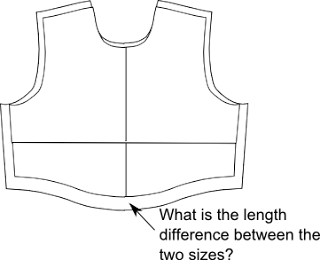
There are many ways to determine the total length grade. In this case, I just want to know what the length difference is between the graded basic block and the ungraded pieces. I want to grade my pieces up to the next larger size. To do this, I just lay the ungraded pattern pieces on top of the next size and align the pieces along the horizontal and vertical axis. My drawings are missing the horizontal, but you can pretend there is a line that runs from the side-seam/armscye points across the pieces. BTW if you would rather, you can figure all this out mathematically....
Once you know the length grade difference, you can then decide where you want that length growth to occur on your ungraded pattern pieces. In the examples below, you can have that length split between the two pieces or all of it in one piece or the other (shown in red).


The question you have to ask is:

This is where the beauty of computerized grading happens. I can play with the grade as much as I want - plugging in different numbers until the proportions look the way I want for each size. Hand grading would be a little more complex. The more complex the style, the more difficult the grade can become when doing it by hand. Handford's suggestion to tape the pieces together with long strips of tagboard can work in hand grading. The grader will have to determine if additional grade points should be added and how much movement should occur. This can be done by using Handford's red lines of distribution. Sophisticated manipulation at each grade point can only occur in CAD.
Still the principle works the same regardless of how complex the style or method.
1. Determine your total length/width grades.
2. Calculate the length/width difference between sizes at the grade points.
3. Decide where the growth should occur by comparing the total grade and the difference between each size at the needed grade points. What proportionally looks correct? How is my fit affected?
This part of the series was going to contain a lot of explanation with lots of examples. There are two reasons that I held off on that. The first is I am considering writing a book on the subject. I am sure it will be a best seller and I will be able to retire early [eye-roll]. The second is that it would be impossible to discuss every possible scenario. It would be best to explain the principle and let you work out your specific grading problem on your own. You will benefit with having to struggle with the material and learn lots in the process.
Just a side note, these pieces have been simplified, no darts or extra gathers. I am also ignoring the seam allowances. The grading is done the same way regardless. This demonstration only shows how to figure out a length grade. The same principle works for widths.
Anyway, let's move on to the examples....
In order to grade a complex style, you need to have basic blocks that are already graded. On top I have a basic block that is already graded. Below that is my ungraded pattern pieces for a bodice with a mid-riff.

There are many ways to determine the total length grade. In this case, I just want to know what the length difference is between the graded basic block and the ungraded pieces. I want to grade my pieces up to the next larger size. To do this, I just lay the ungraded pattern pieces on top of the next size and align the pieces along the horizontal and vertical axis. My drawings are missing the horizontal, but you can pretend there is a line that runs from the side-seam/armscye points across the pieces. BTW if you would rather, you can figure all this out mathematically....
Once you know the length grade difference, you can then decide where you want that length growth to occur on your ungraded pattern pieces. In the examples below, you can have that length split between the two pieces or all of it in one piece or the other (shown in red).
The question you have to ask is:
This is where the beauty of computerized grading happens. I can play with the grade as much as I want - plugging in different numbers until the proportions look the way I want for each size. Hand grading would be a little more complex. The more complex the style, the more difficult the grade can become when doing it by hand. Handford's suggestion to tape the pieces together with long strips of tagboard can work in hand grading. The grader will have to determine if additional grade points should be added and how much movement should occur. This can be done by using Handford's red lines of distribution. Sophisticated manipulation at each grade point can only occur in CAD.
Still the principle works the same regardless of how complex the style or method.
1. Determine your total length/width grades.
2. Calculate the length/width difference between sizes at the grade points.
3. Decide where the growth should occur by comparing the total grade and the difference between each size at the needed grade points. What proportionally looks correct? How is my fit affected?
Subscribe to:
Comments (Atom)