May 07, 2013

Stuffed Toy Floor Bag

My kids stuff toy collection is getting out of control, mostly due to grandparents but we are just as guilty. And since they are young, I have all their toys in the family room so I can watch them from the kitchen and the pile was becoming unsightly, overflowing their corner. One evening while on Pinterest, I came across an idea to use a bean bag as storage for soft toys. I also found a company that makes a bag but charges more than I wanted to spend. I mean it is just a giant bag.

My version is a giant floor bag, large enough for 2-3 little ones to sit on.

Stuffed toy bag storage solution - the kids love it
The girls love it.


Diameter of top and bottom circle pieces is 36". Side panel (in grey) measures 15"x 120".

Stuffed toy bag storage solution
Fabric is a double sided fur fleece.

I cut a 24" diameter inner circle in the top to create a mesh fabric window and zipper opening. The mesh fabric is an old laundry bag but you can buy mesh fabric like this from Seattle Fabrics. I used the small inner circle as a pattern for the mesh window adding 1" more for seam allowance. 
A 1/2" binding strip of sheer tricot was applied to the cut edge of the mesh so one side of the zipper could be sewn on to it. The fur fleece was overlapped to finish the other side of the zipper.


March 29, 2013

Blouses - yes, they need ironing

One of the consequences of my blouse buying spree is the sad fact that cotton blouses wrinkle when washed. The fabric will look worn and tired (see the picture below). This is true of just about any woven cotton fabric unless they are pre-treated with nasty chemicals. My blouses were getting little rotation in my wardrobe because they would hang, wrinkled, in the closet bypassed for easy wearing knits. In order for my blouses to get worn, I had to develop a new habit and like it. I've never been opposed to ironing, but standing at the ironing board for a long time is something I've never liked much.
Wrinkled blouse
So back in December, I pulled out all of my wrinkled clothes and and spent about 5 hours ironing. Adding DH's shirts to the mix would have been a bit over the top, I think. The goal was to catch up. Now, about once a week I pull out just the 3-4 wrinkled items and give them a good ironing. My blouses are back in rotation and not merely taking up space.

One thing that helps tremendously is that I pop in my earbuds and listen to my favorite audio podcasts. Time passes quickly and that chore is not a chore any longer.

I've also rediscovered starch. Cottons will look almost new with some light starching (photo above). I used to buy starch in aerosol cans. Not only was it more expensive, but who knows what nasty chemicals are released when you spray that starch. I invested in a concentrated 1/2 gallon of Sta-Flo starch. It has a few simple ingredients - water, cornstarch, borax, and a few unnamed ingredients. I suppose I could make my own, but I have not ventured down that path. The bottle contains directions of how to dilute it and it's a snap with spray bottles that have a dilution guide. This 1/2 gallon bottle will last a looong time.


Anyway, what say you about ironing? Any favorite tips, irons, starch recipes?

March 19, 2013

Blouse refashion : shortening sleeves

This was another lucky thrift store find. This is an Eddie Bauer blouse with a print and interesting yoke detail. The yoke has narrow tucks and a narrow double fold ruffle that measures about 3/8 inch. The button band extends below the yoke at the bottom. (click on the picture for a better view of the yoke details. The buttons are fabric covered. The attention to detail and the construction make this a high quality blouse. There are 6 separate pattern pieces resulting in 12 cut pieces just to make this yoke! I'm still not sure how the seam with the ruffle is not bulky considering it is a folded ruffle.
Eddie Bauer blouse with long sleeves
As much as I liked the blouse, the combination of the print and long sleeves made the blouse feel like I was wearing pajamas. So, I closed my eyes (not really) and chopped the sleeves off. The new shorter sleeves were a bit wide, so I added elastic to pull it in.
Shorter sleeves on an Eddie Bauer blouse
I like this version much better - a fun new top for Spring.

March 08, 2013

Natalie Christening Gown pt. 2 : Heirloom sewing details

I finished the gown a few weeks ago but have been busy with other projects; Chinese New Year, Valentine and DD2 second birthday. The gown came out very well for being my first heirloom project and would recommend this pattern (Natalie in Sew Beautiful issue 135 March/April 2011) to anyone else looking for a beginner project.

There was no lace insertion but strips of lace were sewn together to create a wide lace border at the bottom of the skirt. I used this website for tips and hints on how to do this.

Heirloom lace on Christening gown skirt


I didn't have an edger foot for my machine and so I tried my blindstitch foot. It worked ok but in the end found I had better or more control with my regular foot. Decreasing upper thread tension is a must otherwise the lace will become puckery. The hardest row was the last one which was sewing a gathered lace edge to entredeux. I gathered the lace by pulling one of top header threads in the lace. I had to sew really slow and adjust the gathers as I went with a straight pin. The presser foot wanted to keep pulling out the gathers but it worked out in the end just lots of patience.

One change I made to the construction was finishing the edge of the dupioni skirt before adding the lace band. According to heirloom sewing, the lace would be attached using a narrow zigzag roll described here as flat lace to flat fabric technique. This method rolls the fabric very narrowly while attaching the lace. I have worked with dupioni and feared the unraveling would cause some problems with this, at least to my inexperience heirloom sewing skills. I instead opted to serge the bottom edge first and then overlap the top lace edge over the serger stitching with a narrow zigzag. I don't think anyone will notice.

Here is the end result, enjoy.

Christening gown with lace and embroidery

Update: Baby was blessed this last Sunday, June 2, 2013

Baby in silk christening gown
Maria in her dress

February 25, 2013

A blouse refashion and study

I seem to be a woman obsessed with blouses. Ever since I set out to create a basic blouse pattern for myself, I've kept my eyes open to study many RTW blouses. I've made many purchases from the thrift store with varying types of details and construction. I purchased this blouse a few months ago. As it usually goes, there were many things I liked about this blouse while I tried it on in the fitting room but I did note it was a little too big.

Plaid blouse with front ruffle detail
The refashion part of this post is probably the least interesting and so I don't have any before photos. I pulled out my basic blouse pattern and measured across the back at the base of the armholes. I compared that measurement with the blouse and did some math. The blouse needed to come in 1.5 inches on each side seam. Hmmm. The blouse was much bigger than I realized and made me recognize that our perceptions of body shape and size are definitely skewed when in a store fitting room. Anyway, the sleeves are set in flat so I just sewed up each side, taking it in the needed amount.

Detail of ruffle along shirt button band.
As I worked on the alterations, I took some construction notes. The front button band is a cut 2 (or 4, 2 for each side). A ruffle is gathered to the band that faces out on the long inner edge. The bands are sewn together on the outside edge and then stitched to the front bodice on the reverse side. The band is then turned to the front and topstitched down. I suspect the ruffle is not pressed down prior to topstitching. I think the operator used the ruffle to pull the band flat, turning the seam allowance to the inside. There is probably some interfacing on the band piece with the ruffle. The whole operation leads to a neat, clean finished button band. The operator who made this is probably very skilled, especially with dealing the bias area near the neck band. Still, this process is easier than it looks.
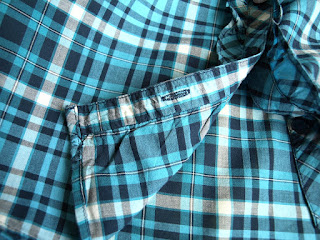
Inside view of front button band
The only problem with this style is the ruffle. Despite a good ironing with some starch, the ruffle wants to stand up and fall over the buttons. The blouse is still cute, but perhaps a narrower ruffle would solve that problem?
Shirt sleeve cuff with a band
While the sleeves were set in flat, the sleeve cuff was set in the round. The cuff was attached from the reverse side and turned out and topstitched down. I don't believe there was any pre-pressing because you can see the operator used a stripe of the fabric as a guide to turn the seam allowances in. If I were making this, I probably would pre-press just because I don't have the practice. The collar neckband was constructed in the same manner.