January 02, 2013

Creating fabric repeats with Gimp

This tutorial, such as it is, could easily be called How to create seamless tile repeats with Gimp. If you do a google search for Gimp seamless, you will find lots of tutorials. Because of that, I won't do a detailed tutorial. This is a follow-up of my review of A Field Guide to Fabric Design.

The main difficulty I had with Gimp and creating a seamless repeat is a problem filter*.

Don't use this filter:

Filters - Map - Make Seamless

The resulting image doesn't make an attractive repeat. It overlaps the repeat with transparencies.

Instead the offset tool, which is similar to Photoshop, is located:

Layers - Transform - Offset

Finding this tool made all the difference. Conversely, I played around with the select tool and moving layers around to accomplish the same thing. The offset tool works best with the design repeat located far from the image borders and in the center of your image. For more complex repeats, manually selecting parts of the image, copy-paste into a new image and moving them in layers works better.**

I started my experiment with a vector line drawing made in Inkscape and exported as a PNG file.

A vector line drawing of circles created with Inkscape
Next I pulled the line drawing into Gimp, added a background color, and then applied the offset tool. After that, I filled in the blank areas. Again, detailed instructions in the book for a simple repeat and more complex repeats.

A repeat pattern design created with Gimp

Gimp has a handy tool that allows you to test your repeat located here.

Filters - Map - Small tiles

This is how my repeat looks now.

Testing a pattern repeat with Gimp


The repeat could use a bit more work, but I think you get the idea. A Field Guide to Fabric Design has information on how to improve your repeat and also how to create a whole collection around this one design.


Of course, the real challenge is matching up the colors with Pantone.

* I tried to take screenshots of all of this but my print screen button wasn't cooperating.

** One of these days I may create a tutorial for this, but it is a bit more involved. My trial video demo took about 20 minutes.

December 27, 2012

Review : A field guide to fabric design


I hope all had a wonderful Christmas. It is during this time, the week between Christmas and New Year's, that I spend time cleaning off my desk and sorting my papers in preparation for the tax man. As depressing as it is to know that we will probably owe taxes this April, it is strangely cathartic to clear off the desk and start fresh for next year. Among the piles of papers is the book A field guide to fabric design by Kimberly Kight of the True Up blog.

Fabric design, or textile surface design, has long fascinated me. The ability to play with the color, proportion, and spacing of a design through a repeat is very intriguing. Kight briefly explores different styles, design and color fundamentals as applied to textiles. This includes a look at both digital and traditional design techniques. The meat of the book is the explanation of how repeats are created, including different repeat styles. Both digital and traditional (hand drawn) techniques are explained. Interspersed throughout the book are comments from fabric designers, both established and just starting out, from which the reader can draw inspiration. Finally, Kight presents ideas of how to print and sell your own fabric. What quickly becomes clear is that textiles fabric designing is a competitive and difficult market.

There are several instructional overviews including hand block printing, screen printing, designing a collection, and textile basics. All are comprehensive and a good foundation for further study and exploration.

The book is laid out well and is easy to read and follow. The instructions for designing repeats are clear and easy to understand. Kight strongly encourages the use of Adobe Illustrator and Photoshop because of their common usage in design work. She discourages the use of open source programs such as Gimp and Inkscape, which is unfortunate. Her primary objections to Gimp and Inkscape are the lack of Pantone color palettes*. The objection is valid because Pantone is used to ensure proper color matching. But anyone that has printed fabric knows that colors don't always work out as expected even when using Pantone**. Pantone color palettes are proprietary and that is the reason Gimp and Inkscape do not include them by default. In other words, their exclusion is entirely a legal and financial matter and not anything lacking in the software itself. But the palettes can be acquired (not easily) and added. Also, Pantone has CMYK and RGB equivalents (here is one tutorial) and if you are serious, you can buy a set of color chips and match things up. There will probably be a lot of back and forth until the correct colors are obtained, and that is probably why most designers use Illustrator and Photoshop (because there will be less of that). At the end of the day though, Gimp and Inkscape are just as robust as their commercial counterparts. In a separate blog article, I'll show how easy it is to design repeats using Gimp.

I liked this book a lot and I will reference it when I play around with designs, whether for a desktop wallpaper or for fabric I intend on printing.


*For more information google Gimp and Pantone.

**I managed to design a book cover using only free software and have it printed exactly as expected at one printer and not at another. There are a lot of variables between designing on a screen and a printer's capabilities that can't be completely solved by the use of one color matching system.

November 16, 2012

Question on fabric copyrights.

Fabric prints

I've received some questions and thought I would take some time to answer them in a series of short blog entries.

Lara asked a question on fabric copyrights.
I wonder if you can help!?  I came across your blog and a similar thing happened to me - I make bags and was sold fabric for the bags that infringe on a large company's design rights.  I have now found some different fabric and am wondering how I can double check that it is not copyrighted to anyone - do you know how I can check this?
In the US, fabric that is sold is subject to the First Sale Doctrine, meaning you can use it as you choose. The exception to this is if the image contains licensed images or trademarks. An example of this would be a team logo or recognized cartoon character. Though even the use of fabric with licensed images is up for debate.* This right is currently being challenged as we speak at the US Supreme Court, which if the judges rule a certain way threatens this right. It would probably upend business as we know it.

Anyway, the current trend among textile surface designers is to license their designs to fabric converters (such as Michael Miller, as an example) while retaining all their copyrights. They seem to be ok with personal, home use of the fabric printed with their designs, but they don't like their designs being used on commercially made products without their permission. The idea is certainly in conflict with the First Sale Doctrine.

There have been instances of copyright and trademark infringement on fabric in the US. In those cases, the design on the fabric was copied and printed outside the distribution and control of the original designer and/or fabric manufacturer.

I think the situation presented in this question is a bit complex and I don't know enough of the details to offer much help. I think Lara may be from the UK? In which case there are different issues at play. The UK and European Union have seized on the idea of design rights and patents. In that case, a fabric print in combination with a specific product can be protected. I don't know how you can check on the copyright status or design rights of a particular print. You would probably have to rely on the integrity of the fabric supplier. In any event I think it would be difficult to ever know for sure if something was ok to use.

In the US, the answer is similar. Fabric prints have traditionally not been registered with the US copyright office. Designs, as in completed items like a dress, are not protected. So, you must rely on the integrity of the fabric supplier to supply fabric that is available for the use you intend. Intellectual property lawyers may be able to help, but I don't how many are versed on the complexities of the textile and fashion industries. Unfortunately, if the above trends continue (and if certain legislation is passed) the need for an IP lawyer will become a requirement for designers.

*If you can look past the hyperbole of the Tabberone site, they do make some interesting points.

November 12, 2012

The blouse pattern revisited : recutting tagboard pieces

Bodice pattern pieces cut out of tag board
About a year ago I cut my blouse pattern out of tag board. I had cut the interior of the darts out because I thought it would be more convenient to just trace the dart onto the fabric. Sometimes this is done in the industry, but there is a better way. Anyway, this didn't work out very well.

Recutting blouse pattern pieces out of tagboard

So after I had made my most recent modifications, I recut the front and back blouse pattern pieces. This time I drew the darts in with the addition of drill holes. You can't really see them in the photo, but I used an awl to poke holes into the tag board. A pencil tip fits into the holes to mark the dart on the fabric. This should work better

Now I'm finally ready to buy some more fabric for blouses.

October 10, 2012

Book Reviews : Dressmaking, Collette Sewing Handbook, and Burdastyle

Our library recently acquired three new how-to-sew books. Sewing is picking up in popularity and the numbers of books coming out about sewing reflect that. I took some time to flip through them and here are my thoughts. All of these books give the impression of being exhaustive in their subject. They are also project based meaning the how to sections are emphasized by the included projects.

Dressmaking


Published by DK, Dressmaking has the fantastic photography one comes to expect from DK. The book is written by Allison Smith who previously penned The Sewing Book: An Encyclopedic Resource of Step-by-Step Techniques also put out by DK. The layout and organization of Dressmaking is above average. The how-to photography is clear and easy to understand.

The projects are in the back of the book with additional instructions to complete each project. This means the how to section is designed to support the projects. So, you will have to flip back and forth to get a complete how-to. It also means that the how-to section is not comprehensive. You will likely need a more comprehensive how-to sew book such as the Reader's Digest Guide to Sewing to supplement what is missing. What is missing is the info to complete some other project not included in the book. Much of the information can be applied to other styles. But you may want to do a project with some design feature that requires a different technique, which is not included in this book. Thus the need for some other sewing manual. For advanced sewists, this is not a big deal, but then again an advanced sewist probably wouldn't need the how-to section anyway.

The styles are pretty basic. The graded patterns are printed on grids at the back of the book. This means you would have to enlarge them yourself. Since I didn't make up any of the styles, I can't tell you how accurately the patterns are drafted. I also can't comment on fit. You will almost certainly have to spend time testing the pattern in muslin. The process would be time consuming.

The biggest problem with this book is the binding. It is a large book and while the binding is sewn, it is cheap. Many DK books of this size fall apart with semi-regular use. In the library, we have replaced one very popular DK book several times, which begins to fall apart after only two circulations.

The Collette Sewing Handbook

Written by Sarai Mitnick, the book was written to support Mitnick's indie sewing pattern company Collette Patterns. The book is spiral bound, so it will lay flat when open. The layout and photography is also pretty good.

Mitnick spends time explaining her five basic principles: a thoughtful plan, a precise pattern, a fantastic fit, a beautiful fabric, and a fine finish. I only spent a few minutes reviewing the sections on fit and sewing. The information presented is pretty basic and you will need supplemental resources if you do not have the fit issues described. The sewing information is also basic but will at least help you sew the projects in the book. The patterns are apparently drafted for a C-cup, which means that if that is not you, expect alterations. The patterns are printed on tissue and included in the back of the book. I didn't take the time to check the patterns or sew them up as the styles didn't appeal to me.

Burdastyle

This sewing manual is written by Nora Abousteit, a Hurbert Burda employee and Alison Kelly, a Project Runway alum. The book is designed to support the Burdastyle website and Burda sewing patterns. The book is spiral bound so that it will lay flat when open with the patterns included in the back.

I have an admitted preference for Burda patterns because I have used some of them from the magazine. They are usually drafted pretty well, though the instructions are very anemic, which is a challenge for beginners. This book explains how to use the Burda patterns from the magazine. It explains the pattern notations, how to trace off the patterns, and how to add seam allowances. Burda patterns are based off a European sizing system. It is important to measure yourself to find the appropriate size on the Burda size chart. Unfortunately, the how to measure instructions are pretty pathetic with simple, flat line drawings. The sewing instructions are pretty basic.

There is one thing that I really liked about this book. The book encourages the reader to experiment and redesign the styles. There are only four projects in the book, but the reader is shown several variations. There are instructions for a project with no alterations and then there are instructions for a variation. Additional variations are show in a photograph with no additional instructions in the hope the reader can figure them out on their own. The variation with instructions demonstrates how to alter the patterns to achieve the desired effect. I like how the authors encourage their readers to experiment and play because I feel that is the best way to learn. I think this may be a challenge for beginning or brand new sewists.

I think most of the projects are pretty achievable. I didn't sew any of them up because the styles didn't appeal to me. The jacket would be the most challenging project, especially the variation.

A few final thoughts

All of these books will help either a beginning or intermediate sewist with lots of hand holding for the included projects. Though, I expect there will be some frustration with the patterns and some of the instructions. Additional support material is definitely required for more complete coverage of the subject. The Reader's Digest book is still a gold standard due to it's comprehensive nature. Older how-to sewing books are also better. There really isn't anything new presented with the exception of the included patterns.

There is one popular book that I have not reviewed and that is Gertie's New Book for Better Sewing. The primary reason is that I don't have access to a copy and a full review would be unfair. But, I am admittedly biased against the book already. The content is just an updated version of previously available information. Gertie got her start by working her way through a Vogue sewing manual, and that is the primary source for her book. Some of her tutorials found on her blog have been lifted off of at least one other website. Also, from what I have heard, Gertie is the fit model for the included patterns, which are then graded up and down. If you aren't Gertie, then expect needing to make adjustments.

July 30, 2012

A question on newborn sewing patterns

Pam had this question
Supposedly the XXS size on commercial patterns (McCalls, Simplicity, 
Butterick) is supposed to be for babies 7 lbs or less, but they swallow 
newborns up.  If you read around the Internet, there are lots of frustrated 
grandmothers and mothers-to-be that want to sew for their new or expected  baby, but can't find a pattern that will fit.  I read that doll clothing  patterns don't work because the neck is wrong for a human infant. I tried buying vintage layette patterns from Etsy and they were just as bad.  I  want to know how to downsize a commercial XXS dress or romper pattern so it fits a NEW 7-8 lb baby.
I had similar challenges sewing an infant shirt from a Butterick pattern. You are right that the sizing is just not right. You are also right that doll clothing patterns are not proportionally correct either.

There really is no easy way to fix the sizing issue. Perhaps the easiest would be to fold out some of the extra width and length to make the pattern smaller? Maybe try grading the pattern smaller -- though that won't solve the other problems that probably exist in your pattern. I can't really tell you how much to reduce the pattern because I don't know what pattern you are using. Even then, it would hard to advise you because I ended up redrafting the pattern I used above to even get it to work right.

One suggestion is to go to a thrift store and buy clothing in the size you want, take it apart and trace it off. Don't forget to add in proper seam allowances - as the existing seams have probably been trimmed off.

July 19, 2012

Some more grading questions

I received some more grading questions.

Grading by Pattern Shifting

I am wondering what you think of the section in Aldrich's book about grading?  It seems like a simplified method in some ways and so I am wondering if for someone simply making the patterns (instead of the clothes) might this method do just fine?

 There are different approaches to grading. Aldrich's "method" is similar to Handford, just presented in a different way. The movements of the pattern pieces is done in basically the same way as Handford. I have not graded a pattern using Aldrich's method, but I don't see that it would be a problem. Just keep in mind that her grade rules are based off her own sizing study of a British demographic. It may or may not work for your customer profile.

DIY or hire a pattern grader

Its not that I am adverse to putting in the extra time, but sometimes I wonder to myself if I am doing way more work than necessary in order to avoid "cutting corners" and making a product that in the end is below par.
I've been grading patterns for over 15 years. I'm still learning. If you want a superior product, you will have to spend the time learning how it's done and gain necessary experience. People in business either hire someone to fill a knowledge or time gap or they spend a lot of time learning in the school of hard knocks. Grading is not especially difficult, but it does take time and effort to learn it. The best way to learn is by trying and doing. I don't mean to sound harsh, but there is no magic book or trick that will help you get what you want faster.

Can I grade patterns with Adobe Illustrator?

I am not drafting/grading using a cad program but am doing all my work by hand and in Adobe Illustrator if that helps you answer my question better.
A lot of people ask me if they can use Adobe Illustrator for pattern making and grading. I suppose you could but to be honest, it's not for the faint of heart. I know there are indie pattern makers using Illustrator to do what you describe. But as a professional pattern maker and grader, Illustrator does not provide the level of accuracy and control that is needed for superior results. If given a choice, I would do all of my pattern making and grading by hand, or in other words with a pencil and paper.

Now there are pattern companies that draft their patterns either in CAD or scan in hand drafted patterns and add all the extra notations in Illustrator. The Big 4 do it that way. No problems there.

July 08, 2012

Designing and grading for a large size range

I get the following question from time to time:

I am a self taught pattern drafter, drafting patterns for myself and my 
kids for years.  I decided to turn this into a business recently and am 
creating a line of children's patterns for the home sewer.  My size range 
is 6m-10 and this is where my question is... Can you help me understand the process of redrafting the SAME style/pattern in my different base sizes?  I  get that I can't just take a size 5 and grade all the other sizes from 
there.  I own several popular pattern drafting books as well as 2 different 
grading books and I can't seem to find this information anywhere.  Any 
information you can provide me would be SO HELPFUL.  I am guessing there is some precise way to redraft my base sizes so the design doesn't change much.  Can you shed some light on how they do this in the business?  THANK YOU!
There are several things. First, it is not unusual when designing children's clothing to cover a large size range. The reality is it is much more work than you would think. I would recommend reviewing my previous blog entries on grading, especially Creating a Grading Standard (also read the other grading tutorials, they'll be helpful).

Unfortunately, there is no other precise way to redraft your sample or base sizes except good old-fashioned pattern drafting. If you have some basic pattern blocks for each size range, then it is no big deal. Just starting out, though, it is a lot of work. It will take less time and become easier over time, so no worries. One thing to pay attention to are proportions. You may need to alter the design to accommodate the size while still giving the impression of the same overall design idea.

May 24, 2012

Spinning - fibery goodness stash enhancement

Over the weekend I attended the Snake River Fiber Fair 2012 in Idaho Falls. My main goal was to stock up on fiber for spinning. The fair had vendors from the Intermountain and Pacific Northwest. There were hand dyers and ranchers selling fleeces. I had never been to a fiber fair before so I wasn't entirely sure of what to expect. I was pleasantly surprised, especially with the friendliness of the fiber guild staff and vendors. I am definitely planning on going next year and maybe even take a few classes.

So here is what I bought:

1 oz. of undyed, natural Cormo top from Bennyhill fibers out of Montana. It is amazingly soft. I just wanted to test out a new fiber and I will probably practicing dying it as well. The vendor recommended dying the spun yarn rather than the roving.


8 oz of hand dyed corriedale from The Fiber Addict out of Donnelly, Idaho. The fiber prep on this is amazing and so much better than the fiber I purchased a few months ago. It was so pretty that I had to start spinning it right away. It will take me a long time to spin 8 oz of fiber, but it is such fun to watch the colors blend. I will probably buy from this vendor again.

It was really fun to meet Carolyn Greenwood from Greenwood Fiberworks. She is incredibly nice and enthusiastic about fiber. This braid was definitely the splurge of the day. 4 oz of merino/bamboo/silk. It is gorgeous. I haven't decided how to spin this up yet, but for now it's enough just to feel it's softness.


Finally, I purchased a new spindle from Irish Rose Rabbitry. She has beautiful spindles with stone whirls. I wanted a lighter weight spindle so I could spin finer yarn. The shaft is a beautiful hand carved glossy black. The spindle is a bit fast for me, but I love it. The prices on her spindles were really great. Only $10 for this gem.
The vendor also sales angora fiber.


I was able to test drive the Schacht Lady Bug and Sidekick spinning wheels. I definitely had a preference for the Lady Bug. I really need to try out a single versus a double treadle. One vendor says I picked up the treadling really fast (from all those years of sewing?).  I know that I need a lot more practice. There are many more things you have to pay attention to with a spinning wheel. The transition from spindling to spinning wheel was hard because I had a harder time controlling the spin and winding on at the same time, which are two different actions with spindling. In any event, it was fun to try. Is a wheel in my future? Maybe. But for now, I really do love spindling.

May 02, 2012

Grading a skirt pattern

I sewed a skirt from a Burda pattern 2 years ago in desperation. I had gained weight and none of my skirts fit me anymore. 6 months later, I dropped all that weight and the skirt was simply too big. I liked the skirt pattern and it fit really well, but I had to grade the skirt pattern down in order to use it again.

In order to grade the skirt, I had to figure out the grade for Burda's patterns. I did this by looking at their measurement charts and comparing the sizes. With a little math I determined that Burda was using a 1.5 inch grade in the waist and hips. After comparing my measurements with the chart, I learned I only needed to go down one size.

So I pulled out my handy Jack Handford grading book and followed the instructions for grading a woman's skirt one size down. There are charts and instructions for a 1, 1.5, and 2 inch grade. It was so much easier to do than I expected. I knocked this out pretty quick. This book is now out of print, but if you can find it, buy it.

Graded skirt pattern pieces

And I may be too much of a nerd, but I assigned a style number and created my own cutting spec for future reference. Now all I have to decide is which fabric to use to make up my next skirt.

April 11, 2012

T-shirt pattern quest pt. 6 : How to correct the fit of the armhole of a fitted t-shirt

I created some drawings to further explain the armhole problem on my t-shirt pattern. Nearly all drafting instructions that I've seen for t-shirts are pretty much the same. First you enlarge the armhole and drop the shoulder. Then the front and back bodice are traced off with identical bodice shaping and armhole shaping. The only difference might be the neck. If you lay the pattern pieces on top of each other, you will get something like this.

Typical t-shirt pattern shaping
This kind of pattern works ok for a boxy, loose fitting t-shirt. If you want a more fitted t-shirt, then it simply won't work. In my case, the symmetrical armholes caused the front of the shirt to be pulled toward the back. The closer the fit, the less symmetry in general. When you look at the human body, you can see there is no symmetry between the front and back so patterns should reflect this. (Most people are not truly symmetrical left to right either). Children generally are more symmetrical than adults and the patterns for them reflect this. But, even there, the more fitted the style, the less symmetry though the differences are smaller. Anyway, the patterns above resulted in a fit that looked like below. The red arrows help emphasize the shape and length differences of the front and back armholes.

Fitted t-shirt with symmetric front and back pieces
To correct this problem, I needed to lengthen the back armhole. I compared the armhole of my blouse pattern, which was not symmetrical, to the t-shirt armhole to determine how much longer it should be. Slash and spread and the pattern should look like something below.
Pattern adjustment for a fitted t-shirt
 With a result that looks much improved.
The proper fit for a close-fitting t-shirt
The next thing on my list is to make adjustments for front versus back body width.

April 09, 2012

T-shirt pattern quest pt. 5 : Evaluating the fit of the armhole


I sewed up two more samples of my t-shirt pattern. I was still not satisfied with the fit. There were wrinkles around the armhole and elsewhere. I spent a bit of time studying the pictures below to try understand the fitting problem and how to solve it.

The back armhole is too short and pulling the t-shirt toward the back

It finally occurred to me why the armhole was giving me so many problems. The back armhole was too short. You can actually see in the picture that the front of the t-shirt is being pulled toward the back at the shoulder seam and underarm. The fix was rather simple - make the back armhole longer.

The back armhole has been lengthened
What a difference, don't you think? There are some other fit problems. I'm still debating the amount that I scooped out on the front armhole. I think I may need some extra width across the front. And then there is the sleeve that wants to twist. But overall, this is pretty good and those complaints are minor. Will there be a version 5.0? Probably.

April 03, 2012

More on copyrights - this time on fabric

Printed fabric

I've wanted to write a blog entry on the latest state of copyright and intellectual property issues in the fashion and sewn products business for a while. I've been watching the assertions of copyright restrictions by indie pattern designers (sewing and knitting) and the appearance of copyright restriction on fabric selvages. I've struggled with how to approach the topic because it can become quite heated very quickly.

As a fashion designer, I like to use printed cotton fabrics in my girls dresses. Over the last several years, I've been watching the rise and popularity of certain fabric print lines and their designers. I've loved the prints they are producing because they have hit upon a formula which is constantly fresh and inspiring. Long gone are the sweet floral rose buds that were so typical for infant clothing. Now there is an explosion of modern, colorful designs that are mixed and matched like crazy.

In the fashion industry there is an assumption that fabric available for sale can be used to make commercially sold products*. We don't usually take the time to ask for permission from every vendor and copyright holder before we design a season. To do so would bog down the process considerably. And let's not forget the concept of the first sale doctrine, which in the United States says the creator of an object loses control of it once the item has been sold**. Even so, I went so far as to ask permission on one fabric design a few years ago because it was designed by a well known scrapbook paper designer. This designer was known to go after individuals who used her scrapbook products to make new products to sell. But when I asked the fabric vendor, they thought I was crazy - of course I could use the fabric for a commercial product.

Well it appears with the rise of celebrity fabric designers***, that is changing. I've been reading of the recent case involving Kate Spain and C&T Publishing/Emily Cier. I won't rehash the whole thing but you can read a good analysis at The Free Motion Quilting Project. With the resulting chaos and ill will that is now floating around the quilting industry, you can see how quickly creativity can be curtailed.

This one situation throws chaos into more than just quilts. There are many childrens clothing designers, accessory makers, and manufacturers who use fabrics from celebrity fabric designers. What's to be done there? I can assure you that the fashion industry as a whole will not stand for it. There is a cost associated with printing up fabric, but it is not as hard to come up with our own designs and print our own fabric as it has been in the past. Those fabric designers need to be careful that they don't alienate the very customers they seek to serve by limiting what can done with the fabric they create. They may loose the very income they seek to protect.


*Generally speaking, it is suggested that a fashion designer not use a fabric print that contains a licensed character such as Mickey Mouse. Doing so crosses into trademark territory and Disney will come after you. There are some designs which are so distinctive that there can be no doubt that the design refers to another brand. So while the first sale doctrine may apply, why would you want to go there? In addition, it is copyright infringement to copy an existing fabric design and print it yourself. Though that gets into murky water because there are many, many fabric designs which are technically in the public domain, though which is and is not public domain is difficult to determine.

**Those statements printed on fabric selvages that limit usage to personal use are probably not legally binding due to the first sale doctrine. Though I'm certain some individuals may actually try to enforce it with lawsuits and threats anyway. If you see it and you have a concern, then just don't buy it. And as mentioned above, some companies will actually come after you.

***Please don't think that the usage of the terms celebrity fabric designers is disparaging. On the contrary, these fabric designers deserve the recognition that comes with their talent. The term celebrity simply refers to their popularity and the expansion of their brand across multiple product lines. Just as there are celebrity chefs, actors, and what not, there can be celebrity fabric designers.

March 29, 2012

Book Review : Sew Serendipity


There seems to be a trend in new sewing books for the home sewing market. Some are written by fabric or textile surface designers as a way to expand their personal brand, others are written by indie pattern makers. Usually, they include basic how-to sew information and patterns. My local library received two of the Sew Serendipity sewing books written by Kay Whitt, an indie pattern maker (though she does sell to McCall's). The first book I brought home was the book featuring skirts and coats.

The book is organized with basic sewing how-to first followed by common instructions on how to sew the designs featured in the book. Finally, the designs are featured with beautiful photography. I have to admit I skimmed most of the how-to sewing instruction as I am probably a bit more advanced. There are some photo step-by-step instructions and each design has additional illustrated step-by-step instructions. A beginning sewist would have to flip back and forth several times to get complete instructions.

There are three basic designs, a skirt, a tunic/dress, and two jackets. Variations are presented for each design with changes in embellishment, design details, and fabric prints while the basic pattern pieces do not change. I do like the basic shapes of the styles presented, though some of the design details are just not my taste. The patterns are sized XXS to XXL and her measurement chart seems to follow a regular grade, which is nice.

As a pattern maker, I was very pleased when looking at the actual pattern pieces. The line width used on the pattern pieces is very fine, which is so much better than the Big 4. Also, the notches were not the traditional outward V notches but rather slit style notches. I did trace off the tunic pattern and walked some of the pattern pieces and they matched up really well. It is important to read the pattern sheet carefully because there are not a lot of markings other than notches and the piece name. Seam allowances are 1/2 inch unless otherwise noted. In addition, you have to read the instructions for the selected design and the basic how-to for the section. As an example, there is no sleeve cuff pattern piece because it is just a rectangle, but the dimensions are given in the basic how-to section.

A few of the seams needed a bit of refinement, but should not bother most home sewists. One area that will probably cause difficulty is the coat facing. I recommend redrawing the outer facing edge just to make it easier to sew. I think the facing has a sharp inward corner to make it easier when topstitching the facing down, so the facing shape is probably intentional. As an option you can use some other guide while topstitching and still smooth out that shape to make it easier to edge finish. Just my personal preference.


Overall, the book has a nice presentation and the designs are generally appealing. As I mentioned, I did trace off the tunic blouse to sew up but I have to put it off until I get a zipper. So the review is a bit incomplete but I think a beginning sewist will enjoy it.

January 09, 2012

T-shirt pattern quest pt. 4 : Analysis of fit and construction

T-shirt test samples for construction and fit

Here are the results of my first and second pattern test. I had enough fabric to make two shirts. Each shirt revealed problems with my construction and fit. I had added about 1" of extra wearing ease to shirt 1 and that was reduced to 1/2" of extra ease in shirt 2. The pattern was designed with 3/8" seam allowances. This allowed for an 1/8" cut off on the seam edges so that the seams finish at 1/4". I had difficulty in shirt 1 maintaining that cut off allowance, improving on the second.

One thing I did not notice is that this fabric is directional. With napped fabrics, the fabric can look darker or lighter depending on which direction the fabric lays. This interlock is not napped but it definitely looks different in different directions. I had switched the direction of the sleeves on shirt 2 and so there is a color variation. It is subtle and hardly noticeable except in certain light.

Finally, there is an issue with the fit of the armhole, which is just a bit too tight. This creates unsightly wrinkles in the underarm area. I guess I never noticed on the original shirt, but the problem exists there too. So, a bit of adjustment has to happen. I need to lower the armhole a bit and scoop out the front. This means the sleeve will need a bit of adjustment as well. The armholes will no longer be symmetrical front to back, which is how it should be. Anyway, more on that as progress is made.

The shirts are fine and comfortable enough to wear, but a modeled shot may or may not appear on the blog

January 03, 2012

T-shirt pattern quest pt. 3 : Sewing up the first sample


The next step in recreating my favorite t-shirt pattern is to test out some different construction options by sewing up a sample. This sample will also be used to double check fit. I began by testing some binding options on some scraps. I eventually discovered the best method for my machines that gave the best looking results.

Testing binding options for knits

Before stitching the neckbinding to the t-shirt, I stitched one shoulder and overedged one edge of the neck binding.
Sewing a should seam on a t-shirt
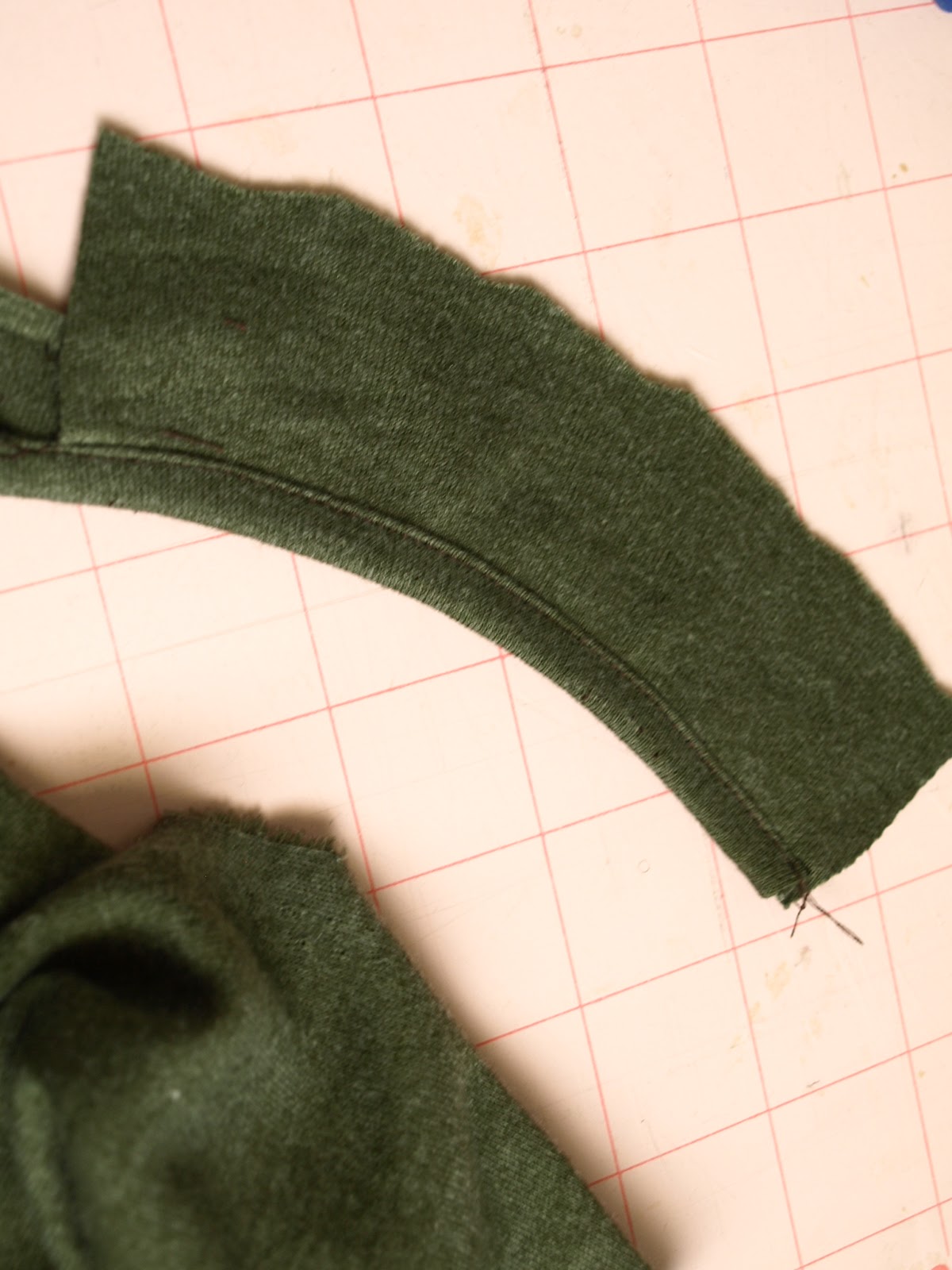
In the picture below I am stitching the binding strip to the neck. The binding strip is on top so that I can stretch it as it goes through the machine. The shirt is supported by the table. Don't let it hang down in front of the machine or gravity will do more stretching of the shirt than you intend. I did edge finish one edge of the binding strip by serging. I didn't have enough green thread, so some of it is in black.
Stitching a neck binding to a t-shirt
Next, I followed the same steps in stitching the binding to the sleeve hem edge. These sleeves show about how much I stretch the binding as it went through the machine.

Attaching the sleeve binding

I then stitched the remaining shoulder seam closed through the neckbinding. This means there is a visible seam at the shoulder. This type of shoulder - neckline construction is also visible on the original t-shirt.
Neck and shoulder seam construction
After closing up the second shoulder, attach the sleeves and sew up the side seams. This is the shirt just prior to topstitching. Just fold the binding strip to the inside and topstitch carefully from the right. You can see an example in the first picture of how it turned out, but I'll post a picture of the finished shirt later. I used a regular straight stitch for topstitching. I don't need the neck to stretch to pull it over my head, so it actually turned out fine. My Babylock Evolve does have a chain stitch option, and that is how it should be done. BUT, it takes a good amount of time to switch it over and because of the overly large presser foot, you can't easily see where you are stitching - too much bother. Industrial chain stitch machines look a lot like regular machines. I believe some vintage domestic Singers also have the ability to do a chain stitch, so if you have that option, than use that.

A few last words on the binding. The original shirt had a double fold binding, which is difficult to reproduce at home without the proper folders and adjustments to your machines. The binding I did is less bulky and easier to execute with home sewing equipment and it turned out just fine.

December 15, 2011

T-shirt pattern quest pt. 2 : Calculating the amount stretch in a knit fabric


Patterns for styles made out of a knit fabric need to include the amount of wearing ease for the desired fit. In some cases the wearing ease is actually negative ease. Negative ease means the pattern measurement is smaller than the actual corresponding body measurement. A good example of this would be yoga pants in which the pants stretch to fit a particular size. In some cases the pattern has positive wearing ease because the style is larger than the corresponding body measurements, such as an oversized sweatshirt. Determining how much to reduce a pattern for a desired type of fit requires first determining a knit fabrics stretch factor.

Note - My pattern is intended for knits that have already been pre-washed and shrunk from retail store knits. So no extra allowance is included for shrinkage.

At this point I needed to check the amount of stretch in this fabric. Fold the fabric so that you are not testing on the edge of the fabric. Place two pins 5 inches apart.

Step one of figuring out a fabric stretch factor
Pick up the fabric and hold the left pin in your left hand at the zero mark and then stretch the fabric as far as it will go with your right hand. Watch where the right pin stretches on the stretch ruler. In this case, my fabric stretches about 30%. Only stretch the fabric as far as it will reasonably go without overly stressing the fabric.
Stretching a knit fabric to determine the amount of stretch

Let go of the fabric with your right hand and watch to see if the fabric returns to it's original position. Knits that do not return at all, have no recovery. In this case, my fabric returned to the 10% mark, which isn't great, but probably ok for a top.

I had forgotten, but this particular fabric is an interlock rather than a jersey. Interlocks do not stretch nearly as much as a jersey. I had originally planned on adding about 1 inch of extra wearing ease because I wanted a bit looser fit. Now I wonder if I should add a bit of extra? Once I work that out, I will modify my pattern and cut it out.

December 12, 2011

T-shirt pattern quest pt. 1 : Create a rub-off of an existing t-shirt

Pattern rub-off from an existing t-shirt
My favorite t-shirt company went out of business and I really loved the fit of their t-shirts. The best solution I could come up with was to recreate the pattern by doing a rub-off of one of the t-shirts. This pattern is for my own personal use, but you will find many pattern makers who do rub-offs of existing styles as a starting point. This is one way to study how another pattern maker developed their pattern. I have done this in the industry too, but the resulting style was not an exact copy and bore no resemblance to the initial style. Copying a style in this way for the sake of reproducing an identical product to sell is another thing entirely.

You can see the resulting shape of the pattern that I rubbed-off or traced. The armhole is symmetrical for the front and back bodices, which is fairly typical for t-shirts. Technically, the armhole should be different front to back and if you have fit issues, this would be one place to adjust. For now, I'm leaving it alone.

The original pattern also had binding on the neck and sleeves. I wasn't sure how to accomplish that and have it look neat on a home sewing machine. I think there may be a way that I'll play with later. At this point, I added seam allowances for a narrow neck ribbing.

Scale to calculate knit stretch
Patterns for knits are designed with the amount of stretch AND recovery. The original t-shirt had some spandex, which means it stretches and recovers a bit better than a 100% cotton jersey. The original t-shirt is pretty slim fitting because of the spandex and because it is meant as a layering t-shirt to wear under other tops. I wanted to have a pattern I could use with 100% cotton jerseys, so I plan on adding a bit of extra wearing ease.

I noted the amount of stretch for the original knit fabric on the pattern. The stretch ruler is found in the Armstrong pattern drafting book. I'll target my knit fabric shopping for between 50-60% stretch - just have to remember to take a copy of the stretch ruler. I do have some stash knits but it has taken me over a week to find it. More on that later...

December 05, 2011

Product Review : Cash wallet sewing pattern

Finally it is done. I started this thing clear back in May and it has taken me this long to locate all of the supplies and get it finished.


The wallet is designed with a fabric cover stiffened by interfacing and held closed by an elastic band. The interior envelopes are closed with magnets, with one zippered pocket for change. The inside of the wallet has slots for cards, though I doubt I will ever use it because I would be afraid of them falling out. It's hard to see the slots in the picture below, but there are three in front and back.


Pros: The pattern is rather clever. There were some things that I didn't expect and I initially liked the approach. I like the removable envelopes so that I don't have to carry the whole wallet if I don't need it. And the wallet does fit into my purse (barely) whereas my cheap plastic coupon file from Walmart did not. I like the zippered coin envelope because I always had change flying about when I was using paper envelopes. I expect the fabric envelopes will last far longer than the paper.

Cons: Let me first start with the supplies list. The hardest thing for me to find were the magnets. My local hardware store did not carry magnets with the right width. You really do need to have magnets that are 1/32 inch in width. You can have a larger diameter, but the thinner the magnet, the thinner your wallet. I ended buying some from babemagnet for a reasonable price. The magnet search delayed the project the longest.

I used a hair elastic for the closure, but I think 1/8" elastic would have been a bit better. The hair elastic is already stretching out of shape.

The pattern is clever, but could use some refinements. This is just my inner pattern making voice. My construction of the zippered envelope ended up being very sloppy, partly my fault, but partly not. I think some of the pieces could have been adjusted to incorporate the turn of cloth concept to accommodate the bulky seams.

There are some time consuming processes such as fusing the interfacing to the envelopes which drove me batty. In any event, the same Etsy seller that sells the patterns also sells finished wallets and envelopes. Considering the cost and time involved, save yourself the trouble and buy one already finished. I can't remember the price on the finished wallets but they should retail for more than she is selling them, considering the labor involved. Her Etsy shop is currently on vacation, so sign up for an email notification when she reopens.

DH still won't use the cash wallet or envelopes. I should have picked something more manly for the fabric. He'll probably still pullout the cash he needs and stuff it in his wallet or pocket.

Cost:  The cost ended up being more than I anticipated. The pattern is a bit expensive to buy ($10), and then add in all the supplies and it ended up costing almost $50. Sure, I can customize the wallet with whatever fabric I choose, but I'm not sure it is worth making yourself.

My Fail: I used an iron-on transfer to label my envelopes. I didn't trim close enough around the transfer (fail) and so I ended up with awful looking labels. And the labels are on dark fabric. Doh! Let's not talk about the zipper pocket.

Would I make this again? No. The cost and time consuming construction just doesn't make it worth it to me. I am not sure that I am entirely satisfied with the results, nor am I sure that I want to buy this style again. There are other Etsy sellers selling cash wallet systems and I may explore those. I will use this wallet until it wears out before replacing it with something else.

December 02, 2011

Understanding basic block patterns : a few definitions

Shari asked me some questions about basic block patterns.
So pleased I stumbled on you blog - wonderful work by the way!  I am keen to start designing kiddies clothing and I am trying to find block patterns and relevant information on using/adapting them, that is not too confusing.

I have got some info on-line and books out of the library but have not 
found anything that I am happy with.  I am wondering if you could give me any pointers on where to start looking and/or even purchasing basic block templates.
The first thing to do is to define the term block pattern. A block pattern is a finished pattern with all seam allowances, notches, notation, etc. The pattern has been tested and approved for fit. It has been used, perhaps, in a style that has proven to be acceptable with customers.

Developing a basic block pattern


A basic block pattern is a pattern from which all other styles are based. Sometimes they are derived from the original drafts created from body measurements with instructions from a pattern making manual. Sometimes not. A basic block pattern can also be the patterns from an approved style as described above.

Just as an example, we can look at my recent blouse making venture. After a bit of testing, the pattern pieces for that blouse have become my basic block patterns for future blouse styles. I cut them out of tag board so I can trace them off, either on fabric for cutting or on paper for drafting a new style. The pieces have seam allowances and notes to help for future construction.

Blouse pattern pieces in tag board
Pattern makers in the industry do not draft from zero every season. We trace off existing pattern pieces (blocks) and modify them. Over time we create a library of pattern pieces that can be mixed and match for a variety of styles.

How to acquire basic block patterns

There is no easy way to acquire basic block patterns. These types of patterns are considered proprietary to the business that developed them so they are rarely for sell. That leaves new designers with a few options and none of them are easy. And perhaps, that is how it should be. I know that sounds harsh, but your patterns will be better if you struggle through the development process yourself. You will come to understand how things should fit and be sewn and know how your patterns work.

So what are the options?

1. Draft your own patterns from body measurements using a pattern making manual. This is the most time consuming option, but ultimately the only way to ensure the fit you want.

2. Hire a pattern maker to do it for you. Probably the most expensive option. You will need to be prepared with a basic style, body measurements, etc. Expect a bit of back and forth as you refine fit.

3. Adapting commercial sewing patterns*. You can buy a commercial sewing pattern for a similar style but it will require a bit of fixing - actually a lot. Commercial patterns are usually sloppy and are not production ready by any stretch. One exception are Burda patterns which do not have seam allowances, so they will be easier to fix and adapt. Burda has even released their patterns as "open source", which is actually a misnomer. In other words, Burda has released their patterns with the license to use the pattern as you wish. And lest you think that I am encouraging the violation of the copyrights of commercial patterns, please know that the copyright status of patterns are in a legal quandry. In other words, in the U.S. no one can stop you from using the patterns you purchase as you wish, even though many believe they can. The only way to avoid that mess and confusion is to draft your own patterns from scratch.

4. Buy block patterns from someone else. I've never seen any production ready patterns available for sale. That doesn't mean it will never happen. I've even considered selling mine, but I haven't done it yet.
BTW, my blouse patterns were adapted from some Burda patterns and it worked well for the most part. The collar pattern pieces required a lot of work and I still don't have them right, IMO.

*If you buy a commercial pattern to take to a professional pattern maker to fix, you will probably be turned down. Commercial patterns require a lot of work to fix and it is honestly easier to draft a pattern from scratch. Some may turn you down for ethical reasons. Others may turn you down because you may give the impression that you are not ready or prepared to be a professional. I probably would turn you down too. The only way I would use a commercial pattern from a client is as a reference to match fit and styling while using my own block patterns or drafting from scratch.