January 08, 2015

The history of standardized sizes for clothing

Do you ever wonder how people came up with the idea of sizing clothes? The creation of sizes allowed for the mass production of ready-to-wear garments. It was not created at a meeting of industry professionals, but evolved over time. Great leaps in sizing occurred because of war - somebody had to quickly and efficiently outfit an army.

Winifred Aldrich traces the development of sizes and ready to wear in her article History of Sizing and Ready-to-Wear Garments found in the Sizing in Clothing book*. Aldrich is a British pattern maker, designer, and researcher. I own two of her pattern drafting manuals and consider them among the best drafting manuals available (link in the sidebar to the left for the children's drafting manual). She knows her stuff, and she presents it well.

The understanding of body proportions began slowly with tailors producing clothing for men. They used strips of paper to measure the body and transfer the measurements to cloth. In time tailors devised tape measures and drafting systems. A size was not the beginning of the drafting job, rather the completed garment represented the size of the customer. As the industrial revolution progressed, tailors began to teach and sell their drafting systems. This included some already drafted patterns, sometimes in more than one size.

Tailor taking measurements for a suit A well tailored gentleman

The concept was revolutionary and men began to be able to purchase their clothing ready made. Women, on the other hand, still had most of their clothing custom made into the early 20th century. There were attempts at creating patterns for women with named sizes, but it still required customization. There was a lack of knowledge of women's body measurements most likely because of the Victorian ideals of the time.

Victorian women and their clothes

It is important to understand that our understanding of body measurements and proportions were not formalized until the 1940's. Ruth O'Brien, an employee of the U.S. Department of Home Economics and the Department of Agriculture, was commissioned to conduct a body measurement study of the American population. The purpose was to create a set of size standards based on reliable data that the apparel industry could use. The work involved in this study was enormous and revolutionary. O'Brien and her department created a measurement procedure that is still in existence today (only to be superseded by 3D body scanning). The data from these studies have been study and analyzed around the world.

To put this in perspective, it wasn't until the 1940s that we could finally see and understand human proportions with any clarity. It's easy to pan this early work as outdated and wrong but the 1940's was not that long ago. We still have so much to learn and understand.

A fun little factoid. Grading using the shifting or slide method, a common method still used today, can be traced back to 1908.

Aldrich's article goes into much more depth about the history of sizing. She includes pictures of early patterns and sizing systems. It is well worth a read if you can get a copy of it. This article is a combination and expansion of two previously written articles found in the journal Textile History.

*As I review individual articles from the Sizing in clothing book, I will not give a detailed discussion of each article. Rather, I will summarize and highlight a few key points along with my own thoughts on the subject.

January 06, 2015

Book review : Sizing in clothing


This is one of the books I ran across while working on my own book on grading. Sizing in Clothing (Woodhead Publishing Series in Textiles) is a collection of scholarly papers edited by S. P. Ashdown on the current (as of 2007) issues related to sizing ready-to-wear clothing. It is a dense read and it took me every bit of time I had with the book to get through it. I'm glad I read it.

The audience for this book is very narrow in scope. This is not a book for someone starting their own apparel line. Do not run out and buy this book unless you have a real interest in sizing theory - it will not help you figure out the sizing for your line. If you did want to buy it, the book runs in the $200-$250 range. I obtained a copy through inter-library loan, which also proved a bit of a challenge. Only a handful of college libraries carry a copy they are willing to loan outside their library system. So I had to read this book on a deadline and handle the book with kid gloves over the holidays.

Some technical designers, pattern makers, and graders may be interested in some of the included articles. Over the next several weeks, I will post a review/discussion on some of the topics covered. My two favorite articles were on the History of sizing systems and ready-to-wear garments by Winifred Aldrich and Military Sizing. There are other really great topics about sizing and target markets, size standardization (a hot topic!), apparel production and sizing, and of course, pattern grading.

Because each chapter is written by different authors, it's hard to give a review of the book as a whole. Some articles were very well written and easy to read, such as my two favorites listed above. Others are written in a formal academic style which is very difficult to read and even more difficult to ferret out what the author is trying to say. As a collection, the articles cover nearly every angle.

Since the articles are written mostly by academics, there is a bit of a disconnect with those working on the front lines (the exception being the Military sizing article). It would be easy to characterize the writers as sitting in their academic ivory towers telling us what to do because they "know better". Embedded in many of the articles is criticism aimed at the industry for assumed sizing problems that the industry either "created" or refuse to solve. While some of the criticism is unfair in my opinion, the information they provide us is still valuable. I'll discuss some of this later in the individual reviews. Despite all of this, I'm glad there are people out there willing to think about these problems, propose solutions, and test them out.

November 17, 2014

Book Review : Better Homes and Gardens Quilting pieces of the past


I've had quilting on the brain lately. I don't really have time for it right now, but I do have plans. Who doesn't when they have other more pressing projects? When I'm in the zone for some other crafty venture, I usually waste time on Pinterest or borrow books from the library. In this case I came home with Quilting Pieces of the Past (Better Homes & Gardens).

This book was published back in 2004, which doesn't seem all that long ago. The book traces the last 175 years of quilting with 54 quilting projects and full size pattern pieces in an attached insert in the back of the book. The book is divided up into distinct historical periods followed by quilts that are reproductions of that time or inspired by that time. Many of the quilts in the book are drawn from previously published Better Homes and Gardens quilting patterns.

The historical information is very interesting but not nearly as in depth as I would have liked. But it does contain full color pictures throughout with fabric swatches representing the color and style of fabric used in quilts for each time period. The biographical information on the early quilt designers was interesting. Each section contains a historical time period showing the major events of the day so that the reader can understand what influenced some of the quilt designs.

Some of the reviewers on Amazon gave the book poor reviews because many of the projects were not updated with contemporary styling or colors. This did not bother me so much because the quilts were meant to be reproductions of older quilts anyway. It would be easy to update the quilts with newer, fresher color schemes and fabrics. The instructions are where the book struggles a bit. Most of the instructions rely on traditional cutting and piecing techniques. This means that some of the quilt blocks are more difficult to put together because of inset seams. This is particular true with the Lemoyne star block, Bride's bouquet, and a few others. More modern techniques have broken down these blocks to make them easier to piece using strips and special rulers. Some of the quilt blocks are quite intricate and would require very precise cutting and sewing. Several of the quilts are applique quilts and the book contains no instructions on applique.

Despite those deficiencies, I still really liked the book. I loved reading the historical sections and seeing the quilts that came from each time period. I do like many of the quilts in the book and I could see myself making some of them one day. If nothing else, the book could be used as a source of inspiration. It would be easy to take some of the more traditional blocks and up date them. This book is not really for beginners because of several difficult to make quilts  and the sketchy instructions. Still, there are a few projects a beginner could probably attempt without too much difficulty.

Book Rating: 4 stars

November 05, 2014

Cutting dimensions for quilting pre-cuts

I've been spending too much time looking at quilting projects on Pinterest and YouTube lately. Perhaps an act of avoidance for other things. Quilters throw around terms like fat quarter and jelly roll, but it took me a bit of time to know what those things mean in terms of actual cutting dimensions. I trolled around Pinterest looking for a printable that explained those terms for me. I found lots of pretty full-color infographics, but I wanted a one page, black & white piece of paper to hang next to my cutting table. I couldn't find anything suitable, so I opened up Inkscape and made exactly what I wanted. I prettied it up with different fonts and a border.

Click on the image below for the full size. It should easily fit onto an 8.5" x 11" piece of paper.

Quilting pre-cuts cutting dimensions printable

I slipped it into a page protector and now it lives with my cutting tools next to my cutting table.

Printable hanging in my sewing room
Spending all this time thinking about quilts and quilting means that I do have plans for projects.

November 03, 2014

Grading rulers and how-to drawings

The set-up for grading a pattern piece
I've been hard at work on my grading book. The first half of the book explains children's sizing. The second half is a how-to manual on grading. I've been stuck on the how-to section for quite a while. I could not decide on whether I should do step-by-step photos or illustrations. I fiddled around in Inkscape and managed to pull together some pretty good how-to drawings. The drawing above is a sneak peak.

Photographs would be great but I didn't think I could pull off photographs that were good enough for print. There are some practical matters too. An eBook filled with as many photographs as I need would be enormous. Too big of a file size to process for print (fingers-crossed they turn out ok) and too big to download easily. There are photos in the book, but just a few. So yes, I am planning on an eBook version, though probably not for Kindle.

So the how-to section will be step-by-step drawings. The drawing above is the set-up for hand grading. It shows the guidelines and grading ruler placement. The shaded area represents tag board. The pattern piece is cut in tag board too, but is white for clarity.

The gridded area represents the grading ruler. My grading ruler is the rectangular gridded ruler in the middle below. I was lucky enough to find it at a thrift store stuck in the book below.

Grading ruler options

This style of hinged grading ruler is no longer available. Never fear, there are options. You can grade with any clear ruler that has 1/16" gradations like the 18 inch ruler in the picture above. You can also buy a grading ruler from Connie Crawford. The price can't be beat! I've been looking at special quilting rulers and those are tremendously over-priced in comparison.

The grading how-to section will cover hand grading in depth and a general overview of grading for CAD. CAD grading depends on the CAD software, so in depth instructions would be difficult to cover for each major system.

Because things can be lost in translation - meaning my drawings and photographs may not convey the best for everyone - there will be at least one how-to video. I'm not sure what I'm setting myself up for, but I'll give it a try.

October 13, 2014

What makes a second a second in apparel quality standards?

In the fashion industry a second is an item with a few defects that can still be worn or used. If there are seconds, then there are firsts though we don't call them that. We may call them first quality, though I rarely hear that term either. The word quality, all by itself, is a controversial term with various meanings attached to it. If there are firsts and seconds, then there are also thirds.

The goal of any company is to produce goods without any defects for the least amount of money possible. But as we all live in the real world, defects happen. I've worked for three different companies and how each handled defects were roughly the same. Each company came up with a ranking system to evaluate product during production and as it came off the line. Each ranking was called something a little different though they conveyed the same meaning. The qualification for each ranking varied and the product that fell into each ranking was handled differently. Here is a brief break down.

First - top quality goods with no obvious defects

Second - goods with X number of defects that may or may not be repaired, but still wearable or usable and can be sold on a secondary market.

Third - goods with sufficient number of serious defects to render the item unwearable or usable. These goods may be sold for scrap and may be called rejects.

Quality can be subjective and that can cause problems not only in production but in the retail sector. A first quality item can be rendered second or third after it's first wearing and washing. In that case, was the item truly a first quality item? Perhaps not. Likewise, a second can be repaired sufficiently to make it a first quality item. But is it financially feasible to repair a second to make it a first? These are all questions that individual companies must deal with as they develop and sell product. In order to not get too long-winded on this subject, let's look at something I recently purchased at the thrift store.

A shirt with defects that are not obvious
This is a cute knit top that I found at a thrift store for a few dollars. It looked pretty good when I tried it on in the dressing room, but as usual the lighting was bad and I missed some obvious problems. Once home I tried it on again and immediately saw a problem with the gathers on the neckband. I also noticed the brand label and content tag were off center. Also the elastic on one of the sleeve hems was pulling away. It is true that most thrift store clothes are previously worn and I have no doubt this shirt fit that category. But because of the defects, I think this shirt started life as a second and was likely sold at an outlet store or other secondary market.

Defect along the neckline band seam
A closer look reveals the problem on the neckline. There is some fabric caught in the seam. Unfortunately, I did not take any pictures of the problem from the other side, but the fabric caught in the stitching is more obvious. 

This style of neckline would be difficult to sew, especially in a factory. First, each gathered area was pre-gathered by applying 1/4 inch clear elastic - stretched between notches. Next, the operator prepares the neck band. The tie and neckband are one piece. The tie portion is sewn and turned out and the rest of the neckband is folded in half. Hopefully there were notches to help the operator position the neck band on the neck, otherwise it would be easy to skew the neckband. Anyway, the operator matches up the neckband to the neckline, starting the sewing on the left side neck. The neckband would be on top and the neckline on bottom. The operator has to match the pre-gathered section from underneath to meet a match point on the band, catch enough of the seam under the foot securely and then stitch the pre-gathered section to the neckband. Hopefully there is another notch to indicate where the pre-gathered section should end. The sewing continues around the neck to the right side, where there is hopefully another notch to indicate where the next pre-gathered section should start. The neckline is then finished off, overedging the center front neck which is left unattached from the neckband. This small section is later topstitched down. Finally, the next operator would place the brand and size label to the back neck with a single needle machine within the seam allowance of the neckband/neckline.


The most difficult part of this whole sequence of steps would be where the operator starts attaching the neckband on the left side. The pre-gathered section is not stable and will move around as the pieces are placed under the foot. This is what happened here. Some additional fabric worked its way under the foot as the sewing began. The label placement would be difficult because the operator would have to guess where center back is and place the labels on a knit top that likes to move around.

This type of defect would have been difficult to repair in a factory. The elastic and two rows of stitching would be time consuming to undo and redo and look good. The poor placement of the brand labels would have been a second strike. The top was still wearable though and likely sold as a second or at a steep discount. I imagine there were quite a few seconds on this style....

Anyway, I was able to repair this top. I carefully unpicked the band with my fingers crossed that none of the shirt was cut when it was stitched. Luckily it wasn't. I removed some of the elastic in the affected area (it wasn't worth redoing the whole gathered area with the elastic), and regathered the neckline with a needle and thread. I then basted the neckband and neckline together to double check it was all right and stitched it back together. Almost as good as new - at least you can't tell there had ever been a problem.

Repair of the neckband seam


August 11, 2014

Knitting: Myrtle Cardigan pt. 6

I previously wrote:
I'm not sure if it is an error in the pattern or my interpretation. I just joined the sleeves by knitting across the row and following the lace pattern. At this point I think the pattern is telling me I should be on row 2 of the lace repeat where I start the armhole decreases. I'm on row 3. I did not know how to join the sleeves into the work without knitting across. This means I will work row 3 and begin sleeve decreases on row 4 (decreases are supposed to occur on the pattern rows). I don't think it will make much difference but the instructions left me a bit perplexed. I read through everything twice more and I followed everything right up until the join sleeves instruction.
And then I had a head slapping moment. You CAN do decreases on the same row as joining sleeves to the body. So I ripped back - thank goodness for that lifeline that I put in just prior to adding the sleeves - and followed the instructions in the pattern on joining the sleeves. And then because it had been so long since I had worked on this, I worked the lace charts in the wrong order. I had to rip back again and start over.

I can safely say that I am on my way. I can also confirm that working only one repeat of the lace up the middle of the sleeves was also the right move. It makes doing the sleeve decreases so much easier. I have worked far enough that I have one extra repeat of the lace in the body. Now to do one more before decreasing for the neck. Fingers-crossed that I have enough yarn.

After working on this for over a year, I think I can see myself actually finishing this.

July 29, 2014

Experts and craftsmanship : who do you trust in the era of slick packaging and presentation?

Vintage sleeve pattern drafts

The age of the Internet has fundamentally changed how we access information. It has changed the way we learn and share. In the sewing community we share projects, ideas, techniques. Some have even found ways to make money doing what they love.

There is a phrase I learned from someone, "You don't know what you don't know."

If you don't know what you don't know, how do you learn what you need to know? How do you even ask the right questions?

Perhaps I'm a bit thoughtful as I struggle to write my book on grading. How do I present a technical skill in an easy to understand, accessible way? The writing process is dragging on because I want to get the instructional information just right. In addition, I recently ran across a mommy blogger who is now teaching others how to grade patterns using patched together measurement charts* cribbed from various sources. I won't link to this particular person, but it gave me pause. Her past experience does not support her current endeavors, but she is perceived as an expert because of slick packaging and presentation. It's not that she can't gain skills and teach others, but where is the dividing line between what you don't know and where you know enough?

An expert is someone who has gained mastery, skills and experience of a particular subject. At what point does someone migrate from a beginner to an intermediate and then expert sewist or master pattern maker? I believe it is a journey of a lifetime. And for many, you only become an expert at one aspect because the overarching subject is too vast. In the industry you specialize, influenced by the first employment opportunity that guides your future.

More thoughts on this topic in the future....

*I've studied these charts and compared them to ASTM charts. Her charts contain proportion problems which may create fit issues.

June 16, 2014

Sleeve cap ease to fit around your shoulder is a myth

Vintage sleeve pattern draft

My most popular blog entry is Tutorial: Reduce/Remove Sleeve Cap Ease. Excessive ease in set-in sleeves continues to be a source of frustration for many. Still, there are those that continue to insist that sleeve cap ease is necessary in order for a sleeve to fit over the curve of your shoulder. Another well meaning sewist claimed my tutorial only worked for children's clothing (my specialty) because children are smaller, but adults definitely need ease.

Kathleen has written a now classic blog entry, Sleeve Cap Ease is Bogus (including a sequel). She even did a series on how to draft an armhole and sleeve correctly so that no ease is needed (partially gated). It would be worth your time to go back and reread those blog entries.

This idea that ease is needed for proper fit is interesting. Unfortunately, it is a false concept. A sleeve should not fit over the curve of a shoulder. Instead, the sleeve should hang straight down from the shoulder. The shoulder seam needs to extend long enough that it reaches to the widest part or tip of the shoulder. In the picture below you can see the shape of both the shoulder and armhole. This draft will allow the sleeve to hang from the shoulder.

Vintage pattern draft of a suit jacket
Kathleen goes into greater detail about this in her blog entries. If you draft a sleeve as instructed by many pattern making manuals with the recommended 1-2 inches of ease, you will not be able to get beautiful looking sleeves like the ones found being worn by the actors of His Girl Friday. Notice the placement of the armhole seams.

His Girl Friday - notice the nice fitting sleeves

Instead, you will get a sleeve that looks something like this:

A sleeve cap with too much ease
Photo courtesy of Kelly Hogaboom and is licensed under the Creative Commons Attribution-Share Alike 2.0 Generic license.

Sleeve caps with ease amount to lazy pattern making, or at the very least pattern making without knowing better.

Children are really not much different when it comes to fit and pattern design. They do have fewer overall curves, so in many ways pattern making and fit are simpler. What curves they do have though, are smaller. Sewing a set-in sleeve in an infant sized bodice is in many ways more difficult. There is less length to work with and tighter curves. If ease is included it is just enough to allow the operator to get around that smaller circumference easier. The amount of ease is very small (1/4 to 1/2 inch) and is entirely dependent on the fabric. In many cases, it is not needed at all because the differential of a machine can be adjusted.

I can understand if this seems unbelievable. It certainly goes against the grain of conventional sewist wisdom. The best way to know, is to try it for yourself. Try using a pattern with sleeve cap ease and one without. Which sleeve is easier to sew in? Which looks better? At the end of the day, you choose which sleeve you prefer to work with.

June 02, 2014

Knitting: Myrtle Cardigan pt. 5 - joining the sleeves

I have officially surpassed the 1 year mark on knitting this sweater. I've learned a lot about knitting and my personal knitting preferences.

I do like knitting lace. I like the challenge. I enjoy the effort of figuring it out. I like the results. I will knit lace again in the future (probably something simpler!).

This project has been dragging because I don't have the mental or physical energy to work on it in the evenings. Evenings are my knitting time that I use to relax in front of the tv.

You can't watch much television and work on this at the same time. At least I can't. I'm knitting each repeat faster, but each row is taking longer now that the sleeves are attached.

I am now at the most difficult part of the sweater. I am raising the neckline by two repeats. This is the part where I will be doing the decreases for the neck and armholes at the same time. I definitely made the right call to knit the underarms in plain stockinette - a little bit less lace.

I'm not sure if it is an error in the pattern or my interpretation. I just joined the sleeves by knitting across the row and following the lace pattern. At this point I think the pattern is telling me I should be on row 2 of the lace repeat where I start the armhole decreases. I'm on row 3. I did not know how to join the sleeves into the work without knitting across. This means I will work row 3 and begin sleeve decreases on row 4 (decreases are supposed to occur on the pattern rows). I don't think it will make much difference but the instructions left me a bit perplexed. I read through everything twice more and I followed everything right up until the join sleeves instruction.

April 29, 2014

Grading vocabulary - Nest and stack point

As I have attempted to learn how to code (computer programming), I have been stymied by one simple problem. Vocabulary. Most programming manuals or tutorials assume the learner has some basic knowledge about programming and skip explaining essential skills or words. This is even true of the manuals designed for complete idiots and absolute beginners. One good example in the programming world is the word compiler. I understand it on a basic level as a set of instructions that tells the computer how to link various files to create the executable software program.* There are various ways to deal with compilers depending on the programming language and platform used.  I didn't know what compilers there were, which to use, how to write the instructions, etc. All I could find was some pretty lousy examples that I could copy and paste and they magically (or not) worked. I could present dozens of examples of this disconnect as I've stumbled my way through working on SodaCAD.

Grading manuals are similar, at least the ones I have used. They lack sufficient or clear explanations of the most basic of terms. Often times the manual writers skip sizing theory and jump to demonstrating their preferred grading method. This includes the much revered Jack Handford grading manual, the manual I still use and recommend today. Handford's book was the first that helped me understand grading but I recently reviewed the book and noticed the notations I made where I was confused.

One of my goals in writing my grading manual is to include a Grading 101 section. The above drawing is the illustration for two terms.

Nest - pattern pieces within a size range that are stacked along a common point or line. Indicated here by the horizontal line and star.

Stack point - the point at which pattern pieces are aligned, generally located in the middle of the piece but may be located elsewhere (indicated by the star). In CAD grading, the stack point may also be called the point of origin and can be easily moved as needed.

I'm still working on my vocabulary list and guide. If there is a term you have heard and would like explained, please leave a comment below

*I realize I probably just used some vocabulary that the readers of this blog might not know. In any event, it illustrates the problem.

April 02, 2014

New rules for soft infant and toddler carriers

Soft infant or toddler carrier
Photo courtesy of Benutzer via Wikimedia

It's been a while since I've written about the Consumer Product and Safety Improvement Act of 2008 (CPSIA). While the goal of the law was worthy, the application continues to be problematic. It's clear that Congress passed a law with little understanding of what it was they were asking to be implemented. The result is that the fallout continues. The regulatory burden continues to increase, the cost of doing business continues to increase, and more businesses continue to leave the market with little to no improvement in overall safety.

Don't assume that I oppose safety rules. Quite the contrary. The child product industry has supported the implementation of safety rules and testing. But they want to do it by incorporating risk analysis, practicality, and good common sense. Instead we are being given regulations drafted by academics from the halls of Ivy League schools with no practical industry experience or understanding. (If you think I'm making this up, believe me I'm not. You can get a degree to learn how to create public policy).

In any event, a new regulation has now been published that establishes rules for soft infant and toddler carriers. Definitions are important in government legalese. This rule does NOT cover slings.

ASTM F2236-14's definition of a “soft infant and toddler carrier” distinguishes soft infant and toddler carriers from other types of infant carriers that are also worn by a caregiver but that are not covered under ASTM F-2236-14, specifically slings (including wraps), and framed backpack carriers. Soft infant and toddler carriers are designed to carry a child in an upright position. Slings are designed to carry a child in a reclined position. However, some slings may also be used to carry a child upright. Thus, the primary distinction between a sling and a soft infant and toddler carrier is that a sling allows for carrying a child in a reclined position. Different hazard patterns arise from carrying a child in a reclined position. Accordingly, slings are not covered by the standard for soft infant and toddler carriers. Like soft infant and toddler carriers, framed backpack carriers are intended to carry a child in an upright position. However, framed backpack carriers are distinguishable from soft infant and toddler carriers because typically, backpack carriers are constructed of sewn fabric over a rigid frame and are intended solely for carrying a child on the caregiver's back.

Just because this regulation does not cover slings, do not assume that regulations for slings are not forthcoming. The statement above, highlighted in yellow, states there are safety hazards and implies that standards will come.

You'll notice that ASTM F2236-14 becomes codified in law, which you must pay to access. Though a recent lawsuit* has changed this, I don't expect this standard to be made available in the public domain unless a similar lawsuit against ASTM forces it.

Some other observations:

1. The style of the this regulation is different from previous regulations that I've read. In other words, the regulatory statement includes context in the form of quotes from regulated parties along with a response from the CPSC.

2. This regulation primarily affects 32 of 39 possible businesses that manufacture this type of product.

3. The regulators apparently spent a lot of time debating the font size for text on warning labels.

4. The regulators referred to the ASTM standard as voluntary. It's really not.

5. Manufacturers of this product support the regulation.

6. This standard overlaps other standards including the third-party testing requirement found in CPSIA.
The take away from this regulation, despite being "new", is that very little changes. Most manufacturers were already complying with the ASTM standard. The difference now is that the standard becomes law with a few minor additions.

*The organization that won this lawsuit has been primarily focused on making building codes available in the public domain. Standards for children's products are not currently on their radar. Maybe someday it will be.

March 27, 2014

A bolero sewing pattern search

A mink bolero
A mink bolero

An anonymous commenter left this inquiry:
Do you know of a good pattern for making bolero (sp)? I want to make some pretty but basic ones to go over shirts, etc. I can't seem to find a pattern for a basic one.
I have a personal preference for boleros or shrugs made of knitted fabric or actually crocheted or knitted. I haven't sewn any for myself, so I can't really recommend any patterns. Though after looking at Pinterest, there are several I might actually look at trying. I pinned several possible sewing patterns to a pinterest board titled Boleros, but as I haven't actually sewn them I can't recommend any of them.

The simplest bolero/shrug is merely a rectangle, folded in half with short seams sewn along the long edge to form an underarm or sleeve seam. There are of course many variations that can be created from this by modifying the shape from a rectangle.

Pattern drafting for a simple bolero or shrug


Style is always subjective and I'm not sure what would be helpful. Boleros come in all kinds of shapes, from fitted to structured, and many fabrics. There are tailored, modern, and vintage styles. It is difficult to offer a suggestion without knowing more. If you have a suggestion, please leave a comment.

March 17, 2014

Vintage pattern reivew : Simplicity 5040


It's rare that I find a vintage pattern in my size, or close to my size, at the thrift store. I can't help looking through them anyway. I have yet to make up any of the styles that I've acquired over the years because I would need to grade them up or down in order for them to fit. I was happy when I found this one, Simplicity 5040, in my size and in a style that I like.

I initially assumed this style would have a side zipper and that the skirt was gathered. How else would one get it on? There is no back zipper and only the button front closure that ends at the waist. I was a little surprised to find that the skirt has a placket hidden under a pleat below the front button closure. A pleated skirt is, in many ways, more flattering than a gathered skirt - at least on me..

The suggested fabrics run quite a range: cottons, synthetics, blends, silk, linen, chiffon, brocade, lightweight wools, wool-crepe, wool jersey, and corduroy. While I'm sure any of those fabrics might work, they would all give an entirely different look and require different handling. I don't have a fabric picked out for this yet, but I'm leaning toward cotton. I'll have to look at my stash and see what might work. I'll also need to make a petticoat slip.

Even though the pattern has all the appearances of being my size, the measurements on the back envelope indicate I will have to make adjustments. This is looking more and more like a lot of work. Hmm... I do plan to make this up, just not sure when.

February 25, 2014

Applying Elastics in A Swimsuit or Leotard

I was asked a while back to write a post on elastic application for a swimsuit. So the following is a pictorial demonstration on how I do it. I hope it will be helpful to someone.


Do not overlap the elastic, butt up the ends


I don't overlap the elastics instead a have the ends touch each other. This means I cut the elastic the exact length I need - nothing extra.The reason I don't overlap the elastics is to eliminate bulk and since it is stitched through I am not worried about it coming undone or shifting. I do overlap elastic ends for elastics placed in casings. Most patterns will give you an amount to cut for each area and they usually include an overlap amount (I subtract that out). But, you may find you need to adjust the length depending on the stretch and memory or return of your elastic. If I'm working with a questionable elastic I will sew up a sample and make incremental adjustments. I have learned a more calculated method of finding percentages/ratios and such but I can't be bothered by this and it gives me a headache.


Sew the elastic ends with a zig-zag
The elastic is sewn together using a wide zigzag with a tight stitch length (close to buttonhole stitch length).


Mark the leg openings into four equal sections

Next, I marked the leg in four equal sections. I learned from patternschool.com that elastics placed in modern stretch fabrics should be sewn in by stretching the elastic over 4 equal sections. This differs from information found in basic pattern-making books which have you leave the front elastic unstretched in 1:1 ratio and the back stretched with remainder of elastic in a sense creating what I feel a bubble butt. This unstretched and then stretched method was developed when fabrics for swimsuits were not as stretchy as today.


Mark the elastic in four equal sections
Elastics were also marked in four equal sections.  I used the seam as one mark, hence only 3 pins.


Pin the elastic into the leg opening matching up the sections
Here elastics are pinned into both legs and ready to sew.


Sew the elastic to the leg opening with a zig-zag stitch
I start my sewing in the crotch area so the outside leg area will look nice and even with no back stitching or overlapped stitching. This is also where I placed the elastic seam (or butt up elastic ends). I sew using a medium width zigzag 3.5-4 and about 3 in length.


Elastic sewn to the leg openings


Initial application of elastic is done.


Fold the elastic to the inside and stitch again with a zig-zag stitch


Next, I folded the elastic over to the inside and sewed with the same zigzag stitch while stretching the elastic evenly.


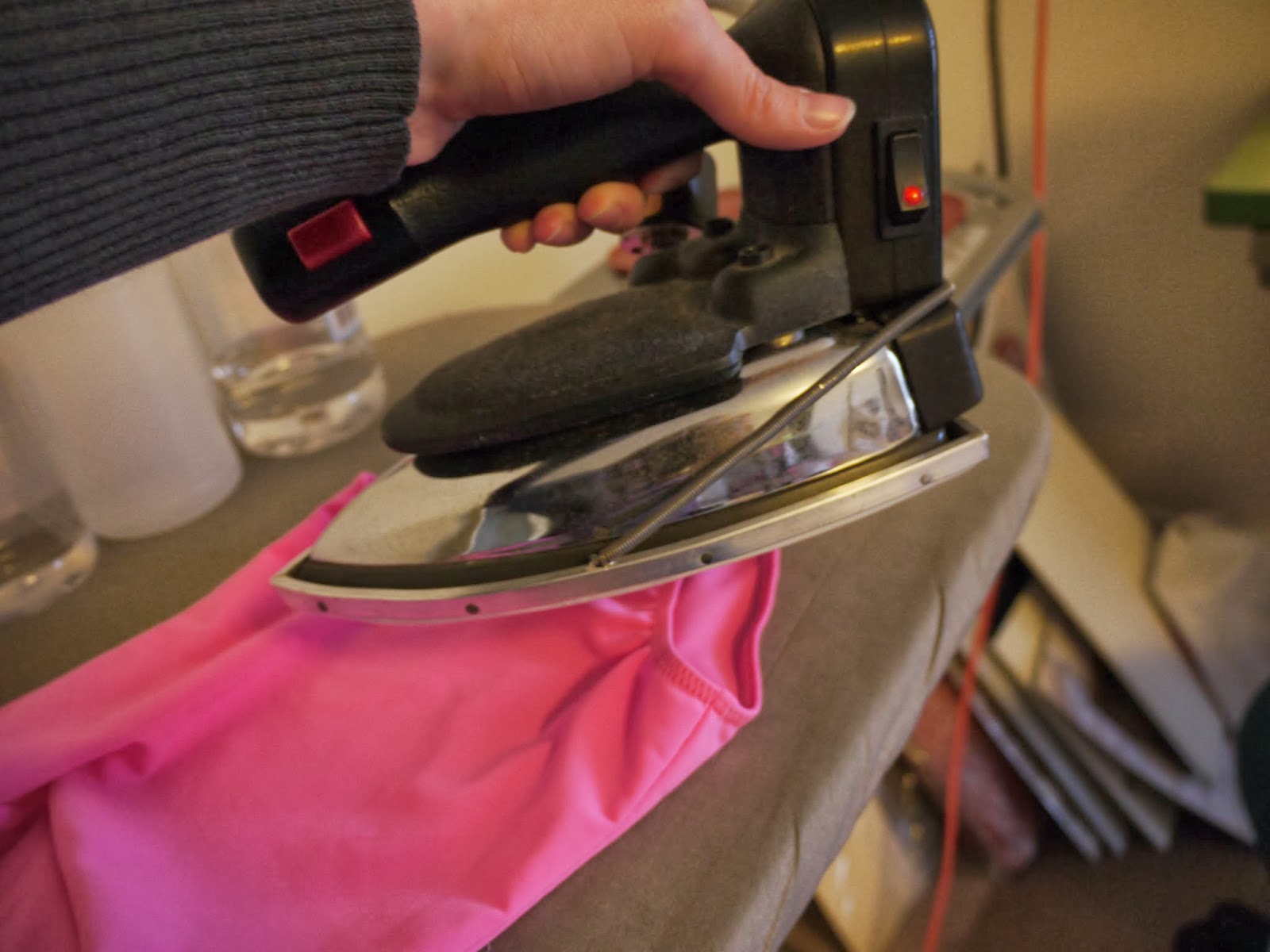
Steam the elstic back into shape with an iron
I like to steam the elastic back into shape. You can also wash and dry (in the dryer) if it is suitable for the fabric. This leotard is made from nylon Lycra and I am choosing to line dry it.


Finished leg opening
All done. One more note, when sewing through elastic use knit elastic not braided. Knit elastic can be sewn through without stretching out of shape. 1/4" wide is appropriate for children's swimsuits and 3/8" is better for women's.

February 03, 2014

Pattern drafting in LibreCAD

At the start of the new year I commented about trying to figure out what to do next. I described my feelings as reaching the end of one road and trying to decide which road to take next. You might assume there were only a few options, but in reality there are many. One option was to look at languishing projects to pick back up. I have two rather large projects. One will take me many years, the other is about half done.

The really large project is sodaCAD. I started a software project back in 2010, but let it drop because I lacked the skills to work on it. SodaCAD is my attempt at an open source pattern making software. Most commercial or enterprise level pattern making software packages are very expensive and have onerous maintenance fees and licensing. I've always wanted to provide an alternative.

sodacad logo and icon


After much research and a few different attempts, I stumbled upon LibreCAD. LibreCAD is a free alternative to AutoCAD. Commercial pattern making packages have AutoCAD at its core. LibreCAD contains many essential CAD drawing functions already, so it is a perfect foundation to build on. I actually learned how to draft patterns using AutoCAD in college. What I lack is programming skills, but that is slowly coming.

Before I can work on optimizing LibreCAD, I had to test it out and actually try drafting a pattern to test its capabilities. It took a bit of time, but I managed to draft a bodice front.*

A bodice front pattern drafted in Librecad
LibreCAD is by no means the ideal solution (not yet!) for this kind of work. It is, in many ways better than Adobe Illustrator or Inkscape. Illustrator and Inkscape lack precision and efficiency. Inkscape in particular, tends to be fuzzy when it comes to numbers. Say you draw a square that is 25 x 25, but you move one side out 1 inch. Now you have a rectangle that is 25 x 25.95. LibreCAD has no issues with precision. It does lack efficiency for pattern making, so I made many mental notes for improvement.

LibreCAD is available for use now on Windows, Mac, and Linux. If you do decide to try it out, I would recommend watching some video tutorials on YouTube. The interface and drawing functions take some learning. I have no idea how long it will take to get SodaCAD ready for use.

*This pattern piece is available in sodaCAD source files for demonstration and testing purposes.

January 23, 2014

Shoulder slope pattern correction

LisaB asked me to explain:

Raise the shoulder at the neckpoint 3/8" on front bodice to correct shoulder slope problem. I need to apply this correction to my t-shirt pattern too.
I tried my first cardigan sample on several times and noticed the shoulder seam was not pointing in the right direction. The seam at the neck point was pointing toward the front rather than laying right on top of my shoulder. I also looked at my t-shirt pattern and observed the same problem. This indicates a possible shoulder slope problem or shoulder to hem length problem on either the front or the back bodice or both. To figure this out, I ran a basting thread in my cardigan shoulder seam area and looked in the mirror to see where I needed to make the adjustment (no fitting buddy or dressform at my house, unfortunately). I also pulled out my blouse pattern and compared the shoulder seam. In the end, I needed to move the shoulder up at the neckpoint 3/8" on the front bodice. This increased the shoulder to hem length on the front just enough to allow the back bodice to relax backward and position the shoulder seam right on top of the shoulder.

Raising the shoulder point at the neck 3/8"

Not everyone will need to make this adjustment. This was a problem inherent in my own patterns to fit me. The drawing below, I hope more clearly shows how the shoulder seam was laying.
View of the correct shoulder point on the body

January 21, 2014

Adapting a block pattern into something else pt. 8 : the final pattern alterations and a finished design

Modeling the final version of the cardigan
It took me quite a while to finish up the pattern modifications for this style. I would try on the first sample and look in the mirror, then go back to the pattern many times. There were a few things that were not right. Each time I would try it on, I would pull the jacket forward so the back neck rested higher. This would throw off the shoulder line. Finally, I realized I needed to raise the back neck and raise the shoulder at the neck point on the front bodice. This situated everything nicely. The first jacket is definitely a wearable first muslin, but the second sample turned out great.

Final pattern alterations:
  1. Remove extra wearing ease. I noticed that many similar cardigans are not really that much bigger than the average t-shirt, so keep this in mind when adapting your t-shirt pattern.
  2. Raise the back neck 3/4". I had left the original neckline of the t-shirt, which ended up being lower than I wanted for the cardigan.
  3. Raise the shoulder at the neckpoint 3/8" on front bodice to correct shoulder slope problem. I need to apply this correction to my t-shirt pattern too.
  4. Shorten sleeve length.
Cardigan with scarf


All that's left is to double check the seams to make sure they match and cut the pattern out of tagboard. This jacket is now ready for further iterations. Maybe a shorter or slimmer version. A waist line with darts. It's all possible.

If I wanted to take this cardigan into production, I already have some of the information needed and recorded in my blank forms:
  1. Style and cutting sheet lists all the pattern pieces with spec drawing.
  2. Sewing spec lists each step of construction.
  3. Fabric swatch cards with content information.
  4. Recorded the pieces in the pattern catalog.
To turn this into a more complete spec package, I just need to add:
  1. Finished pattern measurements for quality control
  2. Grading spec
  3. Cost analysis
I've also added a wash testing data form, which is not yet available (soon!) and not included in the book. This form records shrinkage information which is critical for knit fabrics.

January 15, 2014

Knitting: Myrtle Cardigan pt. 4 - the sleeves

I started knitting the sleeves a couple of weeks ago. The instructions for the sleeves, like the body, are dependent on the size. This makes sense because the lace pattern needs to be adapted for each size in order to work. The sleeves continue the all over lace pattern in order to seamlessly blend with the body. I had to read the instructions several times before I completely understood what was supposed to happen.

I am knitting the medium size. I followed the instructions exactly (I think) and this is what I ended up with.

For the medium size the pattern is written so that the lace pattern is repeated except for the underarm area. In this area you maintain stockinette stitches until the sleeve increases are completed. Then you start chart F for the length of the sleeve. I knew that if I saw this every time I wore it, it would drive me crazy. I'm not sure if I did something wrong, but this does not seem right.

There is a sleeve increase chart, but it is not used for the medium size. I debated ripping out what I had done and restarting with the sleeve increase chart, but I wasn't sure I really wanted an all lace sleeve. Instead I decided to center just one repeat of the lace down the center of the sleeve and do the rest in stockinette. I think it might work better with the sleeve cap decreases.

December 13, 2013

A Pattern Review for J. Bernardoni's Nutcracker Cavalier Doublet Jacket

In the ballet world, the Christmas season is Nutcracker season. This year, I was commissioned to remake the Nutcracker/Prince jacket for Utah Artist School of Ballet's Children's Nutcracker. The director requested red stretch velvet but other than that I designed it. She approved the design and I had a very short period of time to build 2 identical jackets, 4 days to be exact to make photo call. The director was understanding that the jackets for photos would be wearable and only partially decorated. Within a day, I found out one of the two dancer's would not be there for photos. Since this was a short build, I bought a pattern to use from Tutu.com. Pattern No. JB11002 Nutcracker Cavalier Doublet by J. Bernardoni, a New York costume designer. Tutu.com is the only source for this pattern and I believe it is not actually listed on their website but can be ordered via phone. (I am not affiliated nor was I compensated with tutu.com or the pattern designer). Also this pattern comes one size per an envelope and is printed on heavy white paper. I always trace off my patterns and never cut out the original that way I can make changes as needed.

Reviewing the Pattern

In costuming, I am used to not working with pattern instructions. Oftentimes, patterns are drafted in house, cut into fabric and handed over to the stitcher, sometimes with a design sketch and brief verbal instructions. This pattern has instructions but they are written very simply and with the assumption you know what you are doing or built something similar in the past. I briefly skimmed through before I began. I noticed that 1/2" seam allowances are included. Hem allowances are 1" with 1/2 seam allowance making for total of 1 1/2" turned up. The pattern designer, included a pattern pieces diagram with a cutting guideline. He doesn't include yardage amounts nor fabric recommendations. Having made doublets in the past I estimated approximately 2 yards per jacket. My fabric was 60-62" wide which in the end was an over estimate of 1/2 yard per. Usually, I like to buy 10% more than is needed for future repairs or alterations, slightly more if the fabric has nap or one way pattern direction. The pattern designer lists two different flat-linings; coutil (for the body, epaulets and collar) and washed muslin (for the sleeves) and one interfacing of fusible hair canvas.

Fabric Choices


For my project, stretch velvet was chosen. The director wanted it to fit generically so it could be used for years to come. I was hesitant to use a stretch fabric when the look and design is for a woven. Often with men's ballet tunics, woven fabric tops can be made in two pieces,  an over vest and a stretch under shirt with sleeves attached. This enables the dancer to have full movement of arms. I have seen some built without using the undershirt method and instead stretch panels are used in the sides or wherever needed, etc... This pattern doesn't use the undershirt nor does it mention using stretch fabrics. This is where experience and knowledge of a show's choreography is necessary so changes to the pattern can be made. I chose to go completely with stretch fabrics for the jackets. My flat-lining fabrics were 4 way stretch cotton lycra for  the body, shiny milliskin for the sleeves (gives just a little bit of slickness) and rayon bemberg for the collar and tails. Interfacings (from Fashion Sewing Supply) used were shirt crisp for the collar and tricot deluxe for the body front and tail sections. (I am not affiliated nor was I compensated with Fashion Sewing Supply, just really love her products).

Applying interfacing to the jacket tails


Pictured here is a side back. The interfacing is in white and applied to the tail portion. This is where I deviated from the pattern instructions which has you apply fusible hair canvas to the tail lining. The fabric being pinned on top is the flat lining. 


Pinning the flat lining


Side back ready for flat lining as stated in pattern. 


The lining is too short
I made the side seams with 1" seam allowances as well as the
center back.
The jacket is completely flat lined except the tails. This is the way I would have created the pattern. One thing that bothered me about the original patterns is that the lining stops short of the side seam allowances. (see picture). This would look unfinished if the sides were ever let out. Most likely they probably won't be, (most dancers have similar sized bodies) but you never know. I think the pattern designer did this to eliminate bulk which in theory it is a good idea. Also, the front and back are constructed separately, sleeves put in flat and then the sleeve seam and side seams are sewn in one. I don't like this so much. I like to have the sleeves separate and and the jacket finished up to the sleeve insertion for a first fabric fitting. This way I can make adjustments to the shoulder line and arm scye if needed. I have to make a note here, I made the jackets up completely with no fittings nor measurements of dancers ... got to love regional/community theatre).  


Tail lining


Finished linings in the tail. 


Pinning the trim to the jacket front
Almost done!


I only have a female dress form so the jacket looks a little odd. As I was pinning the trim on, I made the decision to hand tack the trim. Velvet can be quite finicky and I didn't it want it to stretch the fabric out. I think a walking foot on a machine would have been nice. One day I will buy one...


Nutcracker Cavalier Doublet Jacket


Even with hand tacking, I got some weird pulling but on stage it was not noticeable. I also got some bagging out on the sleeve, probably due to the flat lining (milliskin) fighting the velvet. These are some of the reasons I wished I used a woven fabric instead. 


Overall, I really liked this pattern. I could tell it was made by a costumer who knows what they are doing. Personally, I would have been fine without seam allowances included. I look forward to trying out more of his work. 


Full Nutcracker ballet costume with jacket
The Nutcracker


Nutcracker jacket on prince
The Prince