October 27, 2008

A toddler sizing rant from a frustrated mom

This mom's blog about twins Hannah and Sophie gives another perspective on the children's sizing problem. I feel her frustration, and I can understand because as a pattern maker and designer I have difficulty getting the sizing right too. The comments on that particular entry suggest she start her own business selling clothes that fit.

If she were to start a business selling toddler slim clothes, she would discover the same difficulties as other children's fashion designers. Sizing is a big problem that falls all over the anthropometric map. Adult sizing is rather stable in the sense that adults reach a size and tend to stay there - disregarding weight gain or loss. You can categorize adults into sub-groups with similar body proportions and sizing. You can do that with children too but the sub-groups are transitional. Children grow as they age, changing from one group to the next in progression. Ideally, children's clothing allows for that transition in a smooth fashion. In reality, children will occasionally have clothes that are too short, too long, too wide, etc. It is impossible to accommodate them all because they don't all start from the same place. Genetics and individual circumstances play a big part.

Simplified growth chart for children

This not offered as an excuse for the industry. Surely some creative DE could provide clothing for Hannah and Sophie that is comfortable and fits well. I suspect that the twins were premature because of TTTS. The girls appear to be thriving and doing well. Children born prematurely are a unique sub-group that falls outside the norms. They tend to be smaller and grow differently than other children. It would be an interesting challenge for someone to come up with a product line to help them. Any one up for it?

September 02, 2008

Comparing pattern shaping and children's sizes

As many children's wear designers know, children's clothing has a lot of sizes. It can become quite the dilemma when trying to decide which sizes to offer. Some DE's offer their styles in as many as 21 sizes. Way back in 2006 I suggested a theory to reduce the number of sizes by combining or eliminating some of them. You may want to go back and review the entry Too Many Sizes and other related entries to see how I have arrived at today.

Anyway, I have tried to put the theory into practice and I have made some progress. I only offer my styles in sizes 3M to 6x. I am still working on the grades for the 4-6x styles, so I am nearly there. My sizes break down like this:

3M, 6M, 9M*, 12M, 18M

24M/2T, 3T, 4T/4

5, 6, 6x

I don't really consider the 9M as a true size. It is a half size between the 6M and 12M and is graded by splitting the grade between the 6M and 12M. The 24M and 2T are essentially the same as are the 4T and 4 - those sizes have been combined for grading purposes. My website still delineates the combined sizes as separate sizes.

This blog entry is not a discussion on the why and wherefores of children's sizing - a surprisingly complex and controversial topic. Instead, I wanted to show a possible grading/pattern problem that shows up now and then. I have been grading and comparing my basic bodice blocks. You should do this too because someone will eventually see the problem and it will be more difficult to fix.

I have drafted my basic bodice block three times, in each of my sample sizes for each of my size ranges - 12M, 3T, 5. (BTW, you can't use the same pattern piece and grade it in all the sizes. Believe me, that is one large headache). The next step is to grade each range separately. Keep in mind that each sample size will have slightly different shaping, but the general shape and proportion should be related.

Before getting too far, the outer fringes of each size range should be compared. For example, the size 18M should be smaller than the 24M/2T and the size 4T/4 should be smaller than the 5. Originally, I had graded the size 4T and 4 separately. In other words the 4T was based off the 3T sample and the 4 was based off the 5. The reason I combined the 4T and 4 was because the shape and overall size was so similar it was a duplication in effort, and I also ran into the problem where the 4T was actually larger than the 4. If you do separate out the sizes than the 4T must be smaller than the 4. If you don't check your grades, someone will bring two dresses to you and say the patterns are wrong, size labels are switched or some other problem.

In the photos below you can see the problem more clearly. In the top picture, the size 4 is laying on top of the 4T. You can see the 4 is smaller than the 4T. In the bottom picture the 4T is on top of the 4 and it is clearly longer with a larger armhole.
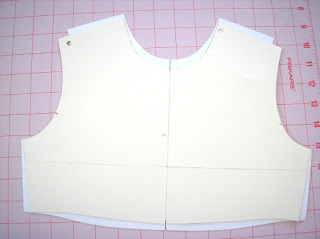
Comparing pattern shaping and sizing of a bodice frontComparing pattern shaping and sizing of a bodice back
To solve this problem, I have been reworking my toddler patterns. I started by combining sizes 4T and 4 so I have one less size to grade. Next my toddler bodices were redrafted to have a shape similar to the 5 (less boxy, smaller armhole). Finally, I regraded the toddler patterns. This is still a work in progress, but the results are much better - each size is progressively larger.

I had the same problem with my size 18M and 24M/2T. In this case it wasn't a grading problem. Instead my infant patterns were proportionally too long compared to the toddler. I fixed this by shortening the bodice slightly.

Anyway, the point is that you should make sure and check the sizes on the outer fringes of each size range and make adjustments so that each size is progressively larger. You can adjust the grade rules (much easier in CAD, btw) or change the shape of the patterns.

(I am ignoring the idea that in the real world an 18M child could be larger than a 24M child. If that is the case, a parent would buy a larger size than 18M and just complain about the craziness of US sizing standards. When I did private label programs for the big box retailers their grade/POM charts progressively got larger with each size. Logically it makes sense even if reality is very different. Anyway, you can allow your sizes to overlap if you want, you'll just need to have an explanation as to why when a sewing contractor becomes confused.).

July 25, 2008

Product Review: Jacket and Pants set for a child pt. 3


Only one person ventured a guess on the size and price point of the hooded yellow jacket and pants I reviewed last week. Jennifer ventured a guess that it would be about $25-30 (AUS) and the Aussie size range of 0000 to 2.

Firstly, it's awesome that an Australian reads my blog! Very cool, this internet blogging thing. Secondly, I acquired this set from a thrift store so I don't know the exact price for which it originally sold. I think this set is private label for JcPenney, but I am not 100% sure. I used to do private label for JcPenney and some other big box stores so the brand looks very familiar.

You would have to look closely to see on the brand tag (partly smeared) was the word layette. Layette sizes normally run 3M-6M-9M or some variation of that (not sure how that translate into Aussie sizes, but probably similar). The set I showed is a size 3M.

Jennifer is probably right with the price point. JcPenney layette price points run about $15-$30 (USD), sometimes a little more. This set was made in China and there is a huge price savings because of cheap labor. A similar layette is available at JcPenney's online store for $20.

The only reason I made a big deal about the price point is because of the amount of detail included in a size 3M. What 3M old child really needs functional welt pockets on a jacket? Such detailing appeals to adults because it appears to add value. But does it really? We like to dress our babies up in clothing similar to ours with all of the same details. BabyGap sells 5 pocket denim jeans for infants too. Not really necessary and perhaps not as comfortable for a newborn, but it sells. Anyway something to think about.

BTW, it would be difficult, if not impossible, to manufacture this item in the US for this price point.

July 21, 2008

Product Review: Jacket and Pants set for a child pt. 2

Up next are the pants. I didn't take a picture of the whole pants. Oh well. Here is a closeup of the waistband. The pants have a set-on waist band with elastic only going partway around the waist. The front has a faux fly - typical of this size range. The elastic appears not to be centered correctly - I'll have to look at it again. In any event, this would be a difficult application. The elastic ends are topstitched through the front waistband. I am sure the waist was done this way so that the faux fly would lay flat.

Detail of pant waistband
An inside view of the faux fly. The center front seam is sewn in one operation. No separate pieces here.

Detail of a faux fly on child's pant front
Each pant leg has a patch pocket with velcro closures. Notice that each outseam is also topstitched.
Detail of patch pocket on pant leg
Another close-up of the waist. The elastic is encased in the waist band and not stitched to the top pant edge like the corduroy pants. Because of the fly front, this is probably how the elastic waist has to be done. Still, I don't like the loose edge on the inside.
Detail of construction of elastic waist in child's pant
Guesses about the size can be left in comments here too. Any guesses on the retail price point?

July 17, 2008

Product Review: Jacket and Pants set for a child pt. 1

Do you like these product reviews? Maybe I should call it product analysis? I like to look at how other people are making their products. Children's products, in particular, require a little bit different construction because they are so small.

Up next is part 1 of a 2 part series on a 2 piece set consisting of a yellow jacket and casual pants. It is picture intensive and I didn't want to post it all in one super long post. I won't tell you the size yet. Maybe you can guess in comments? The fabric is what I call a "popcorn" knit. I think the correct classification is pointelle, but I am not sure. Anyway, it is a textured knit and there are some surprising details that I wouldn't expect in a bulkier knit or in this size.

First up is the jacket. Raglan sleeves, pocket with welts, lined hood, separating zipper, and a screen printed image. I wonder how the screen printed image will hold up in the wash? It is probably tricky to get it to "stick" on a textured knit. All of the sleeve seams and hems have a decorative stitch from a coverstitch machine.

An infant jacket with welt pockets, screen printing, and decorative stitching
Here is a close-up of the pocket. I am not entirely sure how to do this in this knit fabric and have it come out so nice. There is no interfacing or reinforcement stitching that I can see. There is the top-stitching around it though.
A close up of welt pockets in a knit jacket
BTW, the pocket is functional.
A functional welt pocket in an infant jacket
The inside of the jacket with the back of the pocket. You can see the pocket extends into the hem but comes just short of where the zipper is located. You can see the zipper is covered with a facing too.
Inside view of welt pocket in infant jacket
The back neck has a facing in a striped knit fabric. Look at that nice curve on the bottom edge of the facing. Hard to do in a knit. BTW, the facing is not necessary. It is purely for hanger appeal. The neck is finished with a "bias" finish out of the striped knit. The hood is nicely lined too.
Neckline finish of infant jacket for hanger appeal
The sleeves are set in flat. The sleeves would have been hemmed first, set into the body and closed under the arm. This is typical in this size range and price point.
Sleeve construction in infant jacket
The seam end of the underarm is tacked down with a straight stitch machine. This is also typical. It prevents the seam from opening back up during wash and wear. You can backstitch with the overlock seam and eliminate this step, but tacking the seam down provides another benefit. It reduces a point of irritation.
Seam allowance tacked down along hem
Next time I will show the pants. If you have a guess on the size, submit it into comments. I think I left enough clues, so it shouldn't be too hard. I welcome any other questions or comments about the review....