April 18, 2008

Grading Complex Styles pt. 2

Part 2 of this series continues the discussion of how to grade complex styles. It is not necessary to have the Handford book to understand the concept, but some experience with grading would be helpful.

This part of the series was going to contain a lot of explanation with lots of examples. There are two reasons that I held off on that. The first is I am considering writing a book on the subject. I am sure it will be a best seller and I will be able to retire early [eye-roll]. The second is that it would be impossible to discuss every possible scenario. It would be best to explain the principle and let you work out your specific grading problem on your own. You will benefit with having to struggle with the material and learn lots in the process.

Just a side note, these pieces have been simplified, no darts or extra gathers. I am also ignoring the seam allowances. The grading is done the same way regardless. This demonstration only shows how to figure out a length grade. The same principle works for widths.

Anyway, let's move on to the examples....

Graded nest of a bodice pattern piece

Bodice pattern split for a midriff

In order to grade a complex style, you need to have basic blocks that are already graded. On top I have a basic block that is already graded. Below that is my ungraded pattern pieces for a bodice with a mid-riff.

Measuring the difference in length between sizes

There are many ways to determine the total length grade. In this case, I just want to know what the length difference is between the graded basic block and the ungraded pieces. I want to grade my pieces up to the next larger size. To do this, I just lay the ungraded pattern pieces on top of the next size and align the pieces along the horizontal and vertical axis. My drawings are missing the horizontal, but you can pretend there is a line that runs from the side-seam/armscye points across the pieces. BTW if you would rather, you can figure all this out mathematically....

Once you know the length grade difference, you can then decide where you want that length growth to occur on your ungraded pattern pieces. In the examples below, you can have that length split between the two pieces or all of it in one piece or the other (shown in red).

Growth split between the top and bottom pieces

Growth occurring only with the top pattern piece

Growth occurring only with the bottom pattern piece

The question you have to ask is:

How much should a seam move to maintain proportions?


This is where the beauty of computerized grading happens. I can play with the grade as much as I want - plugging in different numbers until the proportions look the way I want for each size. Hand grading would be a little more complex. The more complex the style, the more difficult the grade can become when doing it by hand. Handford's suggestion to tape the pieces together with long strips of tagboard can work in hand grading. The grader will have to determine if additional grade points should be added and how much movement should occur. This can be done by using Handford's red lines of distribution. Sophisticated manipulation at each grade point can only occur in CAD.

Still the principle works the same regardless of how complex the style or method.

1. Determine your total length/width grades.
2. Calculate the length/width difference between sizes at the grade points.
3. Decide where the growth should occur by comparing the total grade and the difference between each size at the needed grade points. What proportionally looks correct? How is my fit affected?

April 13, 2008

Grading Complex Styles pt. 1

Part 1 of this grading series will make more sense if you have a copy of Jack Handford's Professional Pattern Grading book. Unfortunately, the book is now out of print. Still, this entry may be helpful in grading complex styles, especially part 2...

An anonymous reader left this comment:

I love your blog. Thank you so much for all the information. I've recently started grading patterns. I can grade simple styles by following Handford or other books' steps no problem. But when it comes to complex designs, such as clothing that has unusual shapes and consists of multiple panels, I have trouble placing the "distribution lines" (red lines in Handford's book) on the patterns. Handford suggests by putting the patterns on the mannequins and draw the red lines. But sometimes it isn't practical as I'm using a CAD program.
Any suggestions?

This is a good question and can be confusing. The first thing I had to do was go back and look at Handford's book to see those red lines. Sometimes when I read a technical book my eyes glaze over and I skim until I find the info I am looking for. To be honest, I have had to study Handford's book several times to grasp what he is saying. In any event, I couldn't recall those red lines....

The red lines are illustrated on page 1-2 of Handford's book. He uses the red lines to indicate where a pattern grows or shrinks. The rest of the book has more illustrations of basic pattern pieces that show this. The key is to read page 3:

Obviously the cutting and spreading or overlapping of each part of each pattern to grade it one size up or one size down would be far too time consuming and invite much chance for error to be practical.

In other words, a grader could draw those lines of distribution on each pattern piece and then cut the pattern apart to spread or overlap them for the next size. He is absolutely right that such a task would be extremely time consuming, error prone and tedious. This is the failure of the Price/Zamkoff book on grading because this is how they explain grading. It was the primary reason I was so confused about grading too. If you were to grade by hand, could you imagine making duplicate copies of your base pattern so you could cut it apart? You would then need to carefully align the pieces, tape them securely, redraw the pattern, and cut it out. Then you would have to start the whole process over again for the next size. Yikes!

I don't mean to be so hard on Price/Zamkoff because they explain the concept of grading correctly. The problem is that it is not practical, even in a CAD environment.

I am not sure why Handford places those red lines in his illustrations other than to illustrate where the growth is occurring as you grade using his method. In his method, you move a pattern piece a certain direction at each grade point. The grade points are related to those red lines but are actually located at a pattern edge, usually a corner or mid-point.

Anyway, the reason I didn't remember seeing those red lines is because I ignored them. As a CAD grader I simply select a point and enter in the amount of growth. In my head I know a piece is growing in the middle of the pattern even when I assign the growth to an outside corner or point.

Anyway, I have blathered too long.... The commenter is correct that with complex styles the growth/shrinkage must be placed properly. Handford illustrates a slightly more complex style of a bodice with midriff on pages 93-94. The pieces are taped together with strips of tagboard and graded at the same time. On page 89 Handford makes the suggestion of placing the style on a form to determine where growth/shrinkage should occur. While his suggestion is valid, it is difficult to make the conceptual leap from a 3D form with lines to a table top with flat pattern pieces.

I have never done this. Partly because I have only graded children's pattern pieces. There have only been a handful of styles that I would consider very complex. Since I did this on CAD I had the luxury of playing around with the grading until I felt it was correct. I came up with my own method that works for me. It is not much different from putting a jigsaw puzzle together and only involves a little bit of math.

CAD makes grading complex styles very easy. Unfortunately, the night is getting late and so a complete explanation will have to wait. For now, you must know your total width and length grades, say for a bodice pattern piece. If you have a bodice with a midriff and the total length grade is 1" (I don't know I am making this up...), divide the total length grade between the two pieces so that the growth looks proportionally correct.... Anyway, more later...

March 27, 2008

Peasant Blouse Pattern Conquered


There are a few styles that have always perplexed me. The peasant top with an elastic neck and elastic sleeve cuff has always driven me crazy. When I relied on pattern making books to develop the pattern, I would start off with a kimono style. Bad move because it will create a neckline on the bias. On most styles, this will happen by default. But try tunneling elastic into a neckline casing that is on the bias? It doesn't happen. At least not well. Funny thing is, I have a RTW sample with tunneled elastic on a curved neckline. I am fairly certain the factory that sewed it had a set-up with a 1/4" rolled ball hemmer with an elastic feed. Anyhoo. I don't have one of those nifty set-ups.

The secret is that the neckline should be on the straight grain. I received a helpful tip from the blog Just Tutes with her peasant blouse tutorial. I didn't copy her method exactly. I had to study why it works and where her measurements came from. I drafted a peasant blouse off of my basic blocks and my measurements to get the same basic shape as hers. Amazingly, it worked well enough and I just need to grade my pattern for other sizes.

March 06, 2008

Tutorial: Reduce/Remove Sleeve Cap Ease

I have written an additional entry on sleeve cap ease. After reading this entry be sure to check out Reduce/Remove sleeve cap ease pt. 2.

Melissa wrote some comments on my blog entry A Problem with Cap Sleeves:

I was really excited when I found your blog on the children's sleeve draft from Armstrong's book. I have been working on a project for weeks now and I'm having a lot of trouble with the sleeve. Starting with the Basic Sleeve Draft, I found there was too much ease and took 2cm off the bicep measurement when I read that you take the ease out. But my worry is the shaping of the sleeve cap, it just doesn't look right to me. Even before I took out the ease, it looked like the under arm shaping was really short. When I compare it to bought patterns and the pictures in the book, it just looks like the notches are really low, and there is a very small amount left to go under the arms. I have tried a zillion things and it's been driving me crazy and I hope you might be able to shed some light on my sleeve shaping problem. Thanks so much!
I responded:

One thing that is probably causing you trouble is the placement of your notches. The notches should match up with the notches on your bodice. They don't necessarily imply that is where you should start easing. Home sewing patterns use those notches to indicate the start and end of easing and thus some of the confusion.

And just as an aside, There is more than one way to remove ease. You can lower the sleeve cap, fold out extra (like a tuck), or shorten the bicep at the underarm seam. I'm sure I did some combination of the above.
This is my promised tutorial. Even though I prefer the Armstrong shaping for cap sleeves, it still leaves too much ease. If you draft the sleeve exactly as outlined in her book, you will have to correct your draft by reducing or removing that ease. On page 68 (second edition) she explains that a sleeve should measure 2 inches bigger than the bicep and have an average of 1.5 inches of sleeve cap ease. On pages 69-70 she illustrates how to reduce/add ease to your sleeve. As I have stated before 1.5 inches of ease is simply too much. Some fabrics require 0.25 to 0.5 inches of ease, but not much more. Armstrong does use the notches to indicate easing. If your sleeve has no ease then the notches are just match points.

Just a few more words before you get to the drawings. This is just my method - Armstrong's is similar. My hope is to just illustrate the principle and not hard fast rules. You can have ease, if you choose, thus the tutorial is on how to reduce or remove the ease. You can use this same method to fix the patterns from the Big 4 - which notoriously have too much sleeve cap ease.

First step in walking a pattern to match corresponding edgesBefore you can remove/reduce sleeve cap ease, you need to know how much ease the sleeve already has. To do this you need to "walk" the sleeve cap along the armscye - without seam allowances. This is one of the few times I actually remove seam allowances when pattern making because they actually might get in the way. Align the center sleeve notch with the shoulder seam and walk the pattern along until you get to the underarm seam. Armstrong does this procedure just the opposite by starting at the underarm seam and moving toward the shoulder. Either way will work and her method is probably better. I usually do this in a CAD environment and my brain says start at the shoulder. It doesn't really matter so do what you think is right.


Continue to walk the sleeve cap along the armscye More walking.


Matching the notches while walking the sleeve along the armscye Still walking. You can see at this point that my underarm notches meet up. This won't be true in the real world - this is just how my drawing ended up. When I am done altering the sleeve, I move the notches where I need them to be. Right now my goal is to get the sleeve cap and armscye to be the same distance. This is where the Armstrong method might work better for you as the underarm notches don't move.


Measure any difference in length Finally done walking. Now measure any of the sleeve cap that is left over. This is how much ease you have on the front. Yes, sleeves have a front and a back and I only walked my sleeve along the front armscye. You will need to repeat the procedure since most of you will have assymetric sleeves. My sleeves tend to be symmetric for children so I only have to walk the pattern on one side. Make sense? Now that you know how much ease you have, you can decide how much to remove.

Two options to reduce sleeve cap easeThis is where things can get a little fiddly... There are a few different ways to remove sleeve cap ease. I usually use a combination of these methods because I want to maintain a nice sleeve cap shape. Not too flat and not too round. My eyes have been trained to recognize a good sleeve cap shaping and it is not something I can pass along to you. You will have to experiment a little bit to see what works best. Try to keep the convex and concave curves balanced (again, how to explain that?). In this drawing I show two places to reduce ease. The first is to shorten the bicep line by moving in the underarm seam. Armstrong's extra 2 inches is too much for children. It may be too much for adults too. It all depends on your desired fit. The next place to remove ease is to lower the sleeve cap height. With my cap sleeve, I lowered the sleeve cap height at least 1/2 inch and re-drew the cap. Again it depends on your fit and the shape of your sleeve to begin with.

Remove sleeve cap ease by splitting the pattern and overlapping Another way to reduce sleeve cap ease is to split the pattern and overlap it - similar to these drawings (remember I am only working on the front side so don't forget to do the back). Redraw the sleeve cap. This method reduces the bicep but may help preserve the cap shaping.

Remove sleeve cap ease by splitting the pattern and overlapping As I stated before, I probably did a combination of these three methods so that I didn't do anything too drastic. It will take subtle changes to distribute the ease reductions to retain a nice sleeve cap shaping. Finally, check your notch placement on the sleeve and move it to where it should be.

Any questions?

February 29, 2008

Etsy, Ebay Strike, and Lead Issues Again

I have heard no news about the Ebay strike and whether or not it made a difference. My gut feeling is more people left Ebay than previous "strikes" but I doubt it made much of a dent. The walkout will have to be far more drastic. Besides that, there were some Ebay boutique designers who signed on to the strike and still had listings run during the week. Yeah, I checked. Shame on those designers who played both sides. I don't really care if those designers continue with Ebay or not. It just speaks volumes about their integrity. You can't say one thing and do another.

In the mean time I have been browsing Etsy sellers - sellers of child related products. I have been looking at what these sellers are making and it leaves me a little concerned. I think it is great so many people are finding an outlet for their "handmade" products. About 90% of the sellers are just fine, but it is that other 10% that are a cause for concern.

I had thought about profiling Etsy designers who appear to have awesome products, but then my blog would quickly turn into an advertising medium. I am still mulling it over, so I may still do it. Etsy designers should be aware, though, that I will offer a no-holds barred critique of their product - that is if I do it. How can I offer a fair critique without the product in hand?

I could openly critique Etsy sellers that are selling products that concern me. I can imagine the backlash if I focus on any specific seller. Etsy users seem to be a loyal bunch. Besides, I don't want to create a negative aura with my blog or my participation with Etsy.

Anyway, those have been my thoughts over the last week. What are the products that cause me concern?

1. Taggies inspired products. There are many copy-cat products on Etsy and I don't think the sellers realize the "idea" has been patented. I don't agree with the patent, but its there and it can't be ignored.

2. Absence of care/content tags. These tags are required not only on clothing but other textile products. I have seen burp cloths, blankets, bibs, and wash cloths being sold without legally required tags. Those items must have tags if sold in the US and probably elsewhere.

3. Drawstrings, Ties, and Dangles. I have seen "boutique" clothing being sold with ties in the neck and waistline areas and long trims that hang loose. Ties and ribbon dangles don't technically qualify as drawstrings but there have been recalls on related products. Ties that are too long can be a trip hazard. Further, I have seen a lot of dresses and pants that are too long, at least on the models. Such clothing is also a trip hazard.

Anyway those are the top 3 areas of concern.

Finally, California's Lead in Jewelry policy goes into effect March 1st. Check the link at the top of the page. California issued a report of stores that have sold lead-laden jewelry. There are heavy fines involved and they are inspecting stores of every size.

February 20, 2008

Design a clothing line with a plan

Coffee and notebook
If you watch Project Runway or believe any of the stereotypical Fashion Designer drivel, you may think a line is designed by pure inspiration. A designer goes to a museum and is inspired by a piece of artwork and can magically create 5-7 pieces that all work together. Or perhaps a designer flips through some swatches and tosses some to an assistant to make samples out of. This kind of thinking is silly nonsense and will lead to disaster.

It is true that a designer can be inspired by a piece of artwork, a fabric print, color, etc. But unless one designs with a plan, or end goal, it will only be an exercise in design for design's sake. A design plan should follow some basic steps and answer basic questions:
  1. Review the past line.
    1. What sold best/worst?
    2. Customer comments
    3. Returns
  2. Review past goals and set new ones.
    1. Did you meet sales expectations?
    2. What are my sales goals for this season?
    3. How is my budget?
    4. Set design budget for the next season.
  3. Shop the market between seasons.
    1. What are my competitors selling?
    2. What are their price points?
    3. Do I hang with them?
You'll notice that none of these questions have anything to do with design. They are ordinary business questions and it is good practice to review them at the end/start of a new season. Finally, I sit down and actually "design" my line.
  1. Shop for fabric/trims. (this is where I find my "inspiration".
    1. Does the fabric express the brand?
    2. Does it fit within the price point for raw materials?
  2. Determine number of styles/pieces.
    1. Can any styles be carried over in new color/print?
I then sketch, come up with words to describe the group and generally get lost in the design process for about 2 days. I sample my styles directly in the real fabric. I don't do muslins or toiles - those are only to work out pattern problems. The sample making process can take a few weeks and gets a little nitty gritty, but at the end of the process you will have designed you line.

January 21, 2008

Grading Pants Notes pt. 3

The following is my final entry on grading infant-toddler pants. Having a copy of the Jack Handford grading manual will be helpful in understanding what these notes mean, especially for this last entry. Hopefully you have at least read the introduction and the instructions for grading a bodice. If you don't have a copy of the book, save these notes anyway - they may come in handy. Part 1 contains an explanation of direction arrows, Part 2 explains notation.

My infant-toddler pants are between knee and mid-calf length. I designed them to peek out just below the skirts of my dresses without distracting from the overall look of the dress. I wanted the trim of the pants barely visible below the skirt hem. So what should be the length grade of my pants?

At the top of the page for the pant grade (i.e., pg 218), Handford states that the grade for various lengths can be determined by studying the grading chart and diagram. The grading chart contains instructions for grading ankle length pants. I don't know why, but it wasn't obvious to me what grade steps to alter. I ended up doing the ankle length grade and decided it was grading to much. Did I mention that I ended up grading my toddler pants three times? Anyway, if you want to grade shorts, or any other length, these are the steps to alter:

Move #5 and #9 (up) is the knee length grade.

Move #6 and #8 is the ankle length grade.

If you want knee length shorts, skip moves #6 & #8. If you want mid-calf length, you could try splitting the difference between the knee length and ankle length grade. Any other lengths will be some variation on the above mentioned moves. If the length is closer to the ankle, follow the ankle grade and vice versa for shorter styles. In other words, these moves are flexible and depend on the style you are grading. It also depends on the personal preference of the individual grader. I graded my pants using the knee-length grade.

One reason I had a little bit of difficulty with determining the length grade has to do with my computerized grading experience. Moves 5 & 6, for example, can be combined in one grading point. The grading of children's patterns can be simplified because the shapes and growth is simpler in some ways. Since you can select an individual grading point and put in relative changes, the moves are interpreted a little bit differently. I am a self-taught grader and it takes me a bit more effort to determine my approach.

Any other question on grading pants? I hope these notes are helpful.

January 09, 2008

Grading Pants Notes pt. 2

The following are my notes on grading infant-toddler pants. Having a copy of the Jack Handford grading manual will be helpful in understanding what these notes mean. Hopefully you have at least read the introduction and the instructions for grading a bodice. If you don't have a copy of the book, save these notes anyway - they may come in handy. This is part 2 of the series. Part 1 contains an explanation of direction arrows.

This will be a short entry and only partially about grading pants. Mostly it is about Handford's notation and what caused me confusion.

Overlaying directional arrows on a pattern that is to be gradedIn this drawing I superimposed the direction arrows onto a bodice pattern. There is a similar drawing in Handford's book, page 6 and in Kathleen Fasanella's book, pg 174. All movements start from your point of origin which I have indicated in my drawing. Depending on how you set-up your grading, it will be helpful to draw direction arrows on your patterns.

Now notice the little black triangle under the point of origin. Handford uses this triangle in many drawings. I interpreted those triangles to mean the "point of origin" and that is where I messed up.

Compare the drawings for pants of women (pg 77), men (188-189), and children (219). You'll notice that Handford adds or drops those black triangles almost randomly. Some drawings have them, some don't.

The black triangles don't indicate "point of origin". Instead, I think Handford is borrowing the notation from geometry where it means "right angle". Your direction arrows should be perpendicular - at 90 degrees. If you look at the pants drafts (sorry no more drawings for today), you can see his direction arrows are drawn down the center of the pant legs with two black triangles - meaning the lines should all be perpendicular. In my head, I was seeing "point of origin" or (0,0) on an X-Y coordinate plane. Interpreting things this way caused me to move my pattern pieces incorrectly (my own dumb fault for trying to over analyze things).

Anyway, by nesting my pieces I found my error and realized Handford's direction arrows do not always show the point of origin on all of his drawings. They just show direction.

Clear as mud?

January 03, 2008

Grading Pants Notes pt. 1

The following are my notes on grading infant-toddler pants. Having a copy of the Jack Handford grading manual will be helpful in understanding what these notes mean. Hopefully you have at least read the introduction and the instructions for grading a bodice. If you don't have a copy of the book, save these notes anyway - they may come in handy.

These are the first of my notes on grading pants using the Jack Handford book. Part one of these notes is an explanation about directions and movements of the pattern pieces. Later I will talk specifically about grading pants, shorts, and what I think is a mistake in the children's chapter. Handford's book is a textbook and like most design text books he starts with grading women's styles. The book progresses from woman's bodices, pants, and skirts, to men's styles, and finally to children. When design/pattern making/grading book authors finally get to the children's info, the information becomes abbreviated and incomplete (if they include it at all). Handford's book is different because he does include infant and toddler information and it is more complete than any other grading manual out there. Still, he falls into the same trap. He assumes the student has worked through all of the previous chapters before arriving at the children's chapter. He assumes you have a strong grading background and understand his method completely. But what about those who have no interest in grading woman's clothing and skip ahead to the chapters with the most relevant information? This is what I did.

Now I do have a strong grading background - computer grading. Hand and computer grading are similar and Handford's method is how it is done in the industry. The direction of the grading is done in a similar fashion. The grade rules are similar. The grade steps are the same. But physically moving a hard, paper pattern around versus selecting points and entering relative coordinates is different. Despite that, I have a general sense of how a pattern should grow or shrink between sizes - and that helped me finally understand Handford's method better.

Directional movement in grading in and outTo start out, you will need to compare the grade instructions for women's pants to children. If you turn to page 79 (grading of women's back pant), you will notice arrows with words around each pattern piece. The arrows look like this drawing. If you flip over to the toddler pant grade (page 225), you will see arrows, but no words. It is at this point that Handford assumes you will know what direction is In, Out, Up, or Down. Now study the drawings of the women's pant and the children's pant. Do you see any other differences? There is one major difference that threw me off - I'll explain later...

Directions in pattern grading, in, out, up, downThe next thing to understand are directions. All patterns will move IN, OUT, UP, or DOWN. Handford shows how this works on page 6 in relation to a bodice. The children's chapter doesn't have these extra helps. So I drew arrows like on the right and below to help remind me of grading direction. I added the words to body center or to body side to remind me of how to move the pattern IN or OUT. As you can see, IN or OUT can change depending on whether you are grading a left or right piece (applies to front or back too). Directions may change again when grading darts. Be sure to study styles with darts to see the changes. Infant-Toddler styles do not have darts, so movements will occur like these drawings. Movements UP move toward the body head and DOWN toward the feet. UP and DOWN movements are always the same.

I hope I haven't thoroughly confused anyone yet. I felt like this brief explanation of the notation and movements was necessary before getting into more detail.

If you have questions, please leave them in comments.

December 17, 2007

Drawstrings and Child Safety

Below is an article that I wrote about Drawstrings. It appeared at Fashion-Incubator on December 17, 2007. This edition includes a picture of a bib with bias ties that was not previously included.

In 1996 the US Consumer Product Safety Commission (CPSC) created guidelines for the use of drawstrings in children's upper outerwear. The guidelines specifically target drawstrings found in the hoods and waistlines of sweatshirts. They were created after reports of several injuries and even death of children who wore such clothing that became entangled. The guideline applies to clothing sized 2T-16 and is considered voluntary.
CPSC’s drawstring guidelines do not represent a standard or mandatory requirement set by the agency. And, while CPSC does not sanction them as the only method of minimizing drawstring injuries, CPSC believes that these guidelines will help prevent children from strangling by their clothing drawstrings.
Even though the guideline is considered voluntary, it would be in a DE's best interest to follow them. In the first two weeks of December 2007, there have been 5 recalls of children's clothing with drawstrings!

Child jacket with drawstrings in hoodWaist ties on child's pantsWaist ties on child's pantsTies at the neckline of a child's t-shirt
Knotted neck ties on a child's sweater

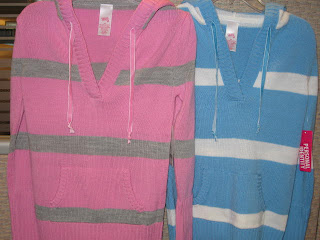
The latest recalls are representative of the type of drawstring issues that keep showing up. The jacket has a drawstring at the waist (picture does not show it). The two pants are borderline with the ties at the waistline. They are not technically drawstrings, but they are knotted belts. The belt on the jeans appears to be stitched to the belt loops, but is being recalled because it is a related style to the other. The bright pink shirt with long pink ties are located near the neck. The hooded striped sweaters have knotted velvet ribbon ties. All of these products were found in major department and chain stores. The irony is all of these stores should know better because these guidelines have been in place for over ten years. The buyers should know. The quality auditors should know. The manufacturers should know. The technical designers should know. And yet, the problem continues to show up. As you can see, there is broad interpretation with the guideline and how it is applied. The original guideline applies to outerwear and the recalled jacket certainly fits. But what about the recalled t-shirt and pants?

The difficulty comes with understanding the difference between an industry standard, voluntary guideline, regulation, and law. For example, the lead levels in painted products began as a guideline and has now morphed into a regulation that can result in severe fines and penalties if not properly followed. The transition began with voluntary recalls by manufacturers and the CPSC. As the public became more aware of the problem and the danger explained, children's products that contain lead are now under mandatory recall. I believe the drawstring guideline is starting to go down the same path. The pattern right now is in voluntary recalls and public information. As public awareness increases, there will be public pressure to make this guideline a law or regulation. From a public or consumer point of view there is no difference between a voluntary guideline, regulation or law.What began as a voluntary guideline for drawstrings in upper outer wear for children 2T-16 has resulted in unintended consequences for related products. Any childrenswear designer has to question the use of ties for any age child in any piece of clothing. Potential sources of strangulation or entrapment are everywhere. Consider this bib:


This bib was purchased about 2 years ago from a discount retailer. Pre-guidelines, this bib would have been sold with knots on the end of the bias bindings. Now, it is sold without the knots. Yet, it becomes a strangulation issue because the ties could still become caught in a high chair. Do the guidelines cover this too? Sure there are other types of closures, but they pose potential choking hazards. Snaps, buttons, and velcro pieces can come loose if not applied properly. What to do? Feed the baby naked and hose them down afterward?

Other products that can cause concern:
  • Bibs with ties made of bias binding, ribbon, or fabric.
  • Girls dresses with waist ties made of fabric or trim. The ties may contribute to the design of the dress, but also provide a fitting mechanism.
  • Dresses with detached sashes. Some sashes may measure 60-72 inches and are not permanently affixed to the garment.
  • Dresses, tops, or pants with added trim that may be loose, especially ribbon dangles.
  • Hats with ties made of ribbon or fabric.
  • Hats with straps, either attached on both ends or attached on one end with some type of closure on the other.
I am sure blog readers could come up with other examples. When you take safety issues to the extreme, there are all sorts of hidden dangers in clothing. From a realistic and practical design perspective, you can not design a 100% safe product. The pressure is more extreme with children's clothing. No one wants to unintentionally injure or contribute to the injury of a child. What to do?

I have had employers and DE's ask me (I question myself) about products on the above list. I don't have an easy answer for them. The first place I turn to is the CPSC website. There are no further guidelines other than the drawstring guideline issued in 1996. The next place to look for industry standards is ASTM. ASTM has the same drawstring standards as the CPSC, but charges you $30 for a licensed copy (read ASTM licensing requirements before purchasing anything from them. You might be surprised at the kind of restrictions you will be under). Another option (not necessarily the best) is to look and see what other companies are doing. How long are their waist ties on dresses, for example? The concern is that even major retailers have trouble following their own internal guidelines (and yes, most of them do have internal guidelines regarding drawstrings). Finally, your company can come up with your own company standard.

I would prefer a voluntary industry standard for the above listed products. I think this is something that can be done. In this endeavor, I am currently working on a letter to send to the CPSC, and possibly ASTM. I will be requesting further clarification on drawstrings and ties in children's clothing, especially for infants. The drawstring conversation is just beginning. Post any comments or questions you might have about this issue.

November 29, 2007

Aldrich vs. Armstrong pattern drafting books


The two most useful (IMO) books for children's pattern making are by Winifred Aldrichand Helen Armstrong. There are others, but I rarely consider them because they lack essential information, and/or are outdated. Some of you may ask about Childrenswear Design by Hilda Jaffe and Rosa Rosa. IMO, Childrenswear Design offers a decent overview of the biz but lacks a lot of detail in the pattern making chapter. Both Aldrich and Armstrong are good references, though I have a stronger preference for one over the other. Tiki has left some interesting comments on another blog entry about her comparison of Aldrich vs. Armstrong. I thought it might be useful to reprint them in a separate blog entry. I'll follow up with my own opinions about the strengths and weaknesses of each book.

From Tiki:
I've been doing the same, pouring over measuring charts and re-working patterns. My 4 y.o. is my fit model, though, so I do have the luxury (ha!) of dressing her up when I need a fit, but it's by no means easier than having a dress form that won't want to dance around the room while I'm trying to check the fit.

Thank you so much for your explanation below about the flat patterns. I meant to respond earlier, but then got caught up in the holiday madness. Anyway, after much pondering conceptually over the "right" pattern method, I was encouraged by your explanation, especially that it's the fit that matters, not so much the method for getting there. I know that probably sounds simple and obvious, but since I have no formal patternmaking training, everything is a learning experience and I sometimes get stymied because I want to do everything "right." So I finally put pencil to paper to draft Aldrich's and Armstrong's patterns and compare them to mine. My patterns are a more like Aldrich's classic, although my armhole shape isn't quite as cut out (so my armhole is somewhat in between her flat and classic). I think the shoulder width on her flat block is too wide, but I guess that's part of what creates a boxier fit versus the slimmer fit of her classic block.

I did notice that Aldrich seems to modify the front armhole and lowers the front shoulder slope even in her "flat" blocks for wovens (on the infant woven on p. 25 and on the body/shirt block on p. 39), although it's not as pronounced as in her classic block (on p. 89). And when I cut out my front and back patterns for the classic block and woven flat block, the shape and contrast between the front and back of each are not that different. In other words, the difference in the armhole shape between the front of the classic and the back of the classic is very similar to the difference in the armhole shape between the front woven flat block and the back woven flat block (I laid the fronts over the backs and compared). Of course, the armhole shaping between the front classic block and the front woven flat block are significantly different, as are the back classic and back woven flat. I'm not sure exactly what that means, really, except that she seems to apply the "true" flat (meaning identical front and back except for the neckline) as you suggested to casual knit boxy styles like t-shirts (which she drafts also for older children on p. 45).

One more thing about Aldrich's book that I find confusing. I do prefer her drafting method to Armstrong's (for children, I haven't done anything with either of their adult patterns)--it seems simpler because it uses fewer complicated measurements (I suppose because she makes certain educated assumptions about the slope of the shoulder, etc rather than using actual measurements).

However, her book seems a bit schizophrenic, like several people drafted different patterns and she compiled them into one book. For example, the points (0,1,2,3, etc) are not in the same places in her various patterns--sometimes point 0 is center front and sometimes it is a point just above center front that lines up with the inner shoulder. Then her patternmaking steps are not consistent throughout. Sometimes she measures the width from this point 0 and then squares down and sometimes she measures the width from the center chest and then squares from there. Her patterns all end up with the same basic shape and I found following her drafting instructions for each pattern very straightforward. But I think comparing one pattern to another is difficult because in one pattern point 3 is at center chest and on another pattern point 7 is at center chest and point 3 is somewhere else. Maybe it's just my inexperience, but I found it more difficult when trying to compare, say, the chest width ease from one pattern to another, than if she followed the same drafting steps for each bodice.

I do love both books as they are great at explaining how/where to modify patterns for different styles. And I like having two resources to compare--they are both a wealth of knowledge.
If you draft your own versions from each method, I would be interested in hearing your comments. I agree with a lot of what Tiki has said about the ease of drafting Aldrich over Armstrong. Though I prefer Armstrong for some things. I am fairly certain that Aldrich created all of the drafts in her book. I think the points of reference are unique to each draft and can't be used for comparison between drafts. It may make things simpler if they were consistent. Also some of the differences may come down to European vs. American fit and expectations. Europeans tend to fit closer to the body - Americans have a boxier fit.

Anyway, here is a brief run down of the highlights (positive & negative) of each book:

Aldrich (third edition)
  • Backs up measurement charts with her own measurement studies
  • Simpler drafting, though some instructions may be difficult to follow
  • Includes Infant sizing and basic infant drafts
  • Draft instructions for flat and classic blocks
  • The only book that comes close to how things are done in the industry
  • The only nitpick I had was the shaping of some of her basic blocks. I agree with Tiki on the shoulder slope, shoulder width and the neckline circumference. These are easy things to adjust once you have a draft to work with. I also did not like her cap sleeve shaping - another thing that was easy to fix.
Armstrong (second edition)
  • Design variations are laid out on separate pages and not squished together like Aldrich.
  • Step by step draft instructions
  • Easy to read measurement chart, though her chart starts at size 3
  • Chapter on knitwear
  • Ignores infants
  • Sleeve drafts have too much ease

November 13, 2007

Lead Test Kits


I had a light bulb moment. Why not use this kit to test trims like buttons, zippers, and metal trims. When I buy buttons, I have no idea where they come from because I buy them from a jobber. All I receive is a bag of buttons. Lead testing at a certified lab can be expensive, not to mention the extreme backlog that is occurring right now. Lead tests start at $35 and can vary by lab. (BTW, getting pricing information is extremely difficult and requires lots of phone calling). Why not use one of these kits?

Consumer Reports states that the kits are only useful for detecting high concentrations of surface lead. False positives/negatives are a real possibility. The CPSC says there are no reliable home lead test kits. The CPSC is in conflict with Consumer Reports and it is difficult to know who to believe. CR actually used the test kits to check toys in actual use by children. Any toys that indicated high lead levels were sent for further testing. The results were surprising as they found some toys not on any recall list with extremely high levels.

While no one should rely solely on the home test lead kits for definitive information, I think it could at least give an indication of a problem. I may buy a kit despite what the CPSC says.

Here are some links to testing labs that require further research. At this point, I can't recommend one over the other. These labs can test for lead as well as most textile testing.

Intertek
STR - lab highlighted by an ABC news article, also does textile testing
Bureau Veritas - formerly Acts Testing

November 09, 2007

Standard Pattern Blocks- Flat vs. Classic

Tiki left some questions in comments and I thought I would address them in a separate blog entry.
I am reworking some of my patterns and have both Aldrich's and Armstrong's books as well. As you mentioned, I have noticed that my own kids' clothes from various manufacturers are drafted "flat" as Aldrich describes it, with the front and back patterns basically identical except for the neckline, but was wondering if you could explain more why that is the standard.
Here is a picture of what Tiki is talking about. Aldrich is the only other person I know of that addresses this topic. It is true that most childrenswear manufacturers work off of flat blocks, especially for infants. Aldrich only presents it for infant casual clothing. But I have seen variations of the idea spanning all children's sizes.

An example of a modified classic pattern block
My basic blocks are a variation of the flat method. The armholes and shoulders of the front and backs pieces are identical. The body widths match (the long vertical line indicates the center back/front). The flat fit is a little more boxy and loose. My fit is not too boxy, but it does allow for some growth. You can see the fit of this bodice on one of my dresses. The patterns are not too boxy because the side seams do taper inward and my front waist has some curve. Aldrich's patterns have a straight side seam and waistline. BTW, I am not done refining the shape of this pattern - I am considering narrowing the shoulders and reducing the armhole. You have to start somewhere with your patterns, and they will evolve as you refine your fit.
I have read the discussion of armhole and sleeve shaping from Kathleen's blog and book and was wondering if the standard in the children's wear industry is due to simplicity in drafting, etc (perhaps because there is more ease built into the design of the garment itself) or if there is a specific anatomical/physical reason that makes drafting the asymmetrical sleeve/armhole unnecessary in children's wear. I guess, in other words, is that only the standard in loose children's garments or would drafting a more fitted children's garment with the same symmetrical sleeve still be correct/standard?
I can't say for sure why this is the standard. It is definitely not something I learned in school, but rather on the job. Tiki's instincts are probably right. There is a simplicity in the drafting of flat pattern blocks, and it does save some time. There is a physical limitation too. The smaller the size, the less practical it becomes to draft a classic block. A flat block gives some wearing ease and allows for growth. Children, after all, grow and a little extra ease allows the clothing to be worn longer. And yes, you can draft a more fitted bodice block with symmetrical armholes/sleeves. That is what I did with my patterns because it is what looked right to me. Here are some pictures of a classic, fitted block with asymmetric armholes (click on images for a better view).

Pattern draft of a classic fit bodice blockThis is a set of classic bodices sized three month. You can see the small armhole - there is little room to draw a nice curve. The back armhole is nearly a straight line. These drafts are based off of Aldrich's book. A classic block would be more appropriate for larger sizes.


Pattern draft of a sleeve with an asymmetric capThis is a corresponding sleeve with an asymmetric sleeve cap. The sleeve cap seems really high and the curves are abrupt, IMO. These blocks could certainly work, but they require more refining. I opted to modify my blocks so they were semi-fitted and flat. The curves are easier and sewing is easier.

There is a relationship with children's body shapes and the flat method. Young children are simple round cylindrical shapes until about the age of 5 and it makes sense to keep the patterns simple.
I'm having difficulty understanding from Aldrich's book what makes the "flat" block or "classic" block more appropriate for a particular style, so I wondered what was standard practice here in the industry. I hope this makes sense.
I look at it this way. Flat blocks are good for casual styles, like t-shirts. Classic blocks are good for more formal looks. Flat blocks are good for infant sizes, classic for older. Your fit and look defines your design and you can opt for either method. Usually I see a modified classic block for fit, but with symmetrical armholes and shoulders (perhaps more of a convention rather than a standard). I have seen some designers use only classic blocks and others only flat. Really, the decision is up to you.

This is a topic I am still researching and trying to understand. I hate to label flat blocks as a standard because there are several possible methods that may be considered "right" or the "standard". Pattern making is considered a technical, rigid system, but don't be afraid to do things your way. I learn things from those who do not have formal training and are not afraid to do things a little different. Sure there are certain accepted standards for labeling patterns or placing notches. Acceptable shaping and fit is open to interpretation.

November 07, 2007

Americana Apron from a 1950's sewing pattern

Ok, this is day 7 of the Sew, Mama, Sew challenge of 30 gifts in 30 days. Here is my entry that was supposed to be for day 1. Of course, I made two, because I was in desperate need of a new one. DH used our only apron to carve some elk - let's just say it's not too pretty anymore. From here on out, I am only doing one of each item on the list that I can manage to accomplish.

1950's apronI chose a pattern I had made as a teenager - it came from an old high school Home Ec manual of the 1950s. I loved this pattern as a teenager, but what I failed to realize is that I (ahem) am not a teenager anymore. The original pattern has a cute bib with ties. I am thinking my younger, shorter sister, aka Twiggy, should be able to wear this with no problem. She recently has expressed an interest in cooking, so I will tuck a couple of my favorite go-to recipes in the pocket.

I know that I said most of my gifts would be made from scraps. Well, I purchased this fabric from the thrift store for about $2 and it has been collecting dust in my stash for at least 5 years. I think it counts - plus, this fabric may show up in other scrappy projects.

1950's apron without the bibI left the bib off of my apron, which works just fine. DH says it makes me look like a 1950s housewife. Not sure what to say about that..... Anyhoo, both aprons are trimmed with some left over ribbon along the hem and pocket. And yes, I am wearing socks with my shoes because the mountains are chilly this time of year.....


Homemaking for teenagersHere is the book that I acquired as a teenager. I still love it. I wish modern Home Ec books were so practical about making a home as this one.

Up next on the list for Nov 8th is "Whimsy". I have no idea what I will come up with. I may browse some books at the library for ideas. Whimsical is something I am not so this may be a good design exercise.

November 05, 2007

Sewing Tutorial - Set-in sleeves

This is my first sewing tutorial for sewing set-in sleeves flat - please forgive the photo intensive entry and anything that is not too clear. Here, I am testing some refinements to my cap sleeve pattern. I am doing the sewing with my domestic Singer 503 (a fabulous machine, btw). The technique is essentially the same on a 4-5 spool serger or industrial straight stitch machine. Some of this is my personal opinion, some fairly standard fabric handling techniques. Please note, my sleeve pattern has no ease.

Start sewing a sleeve with a sleeve cap against the feed dogsPlace the sleeve against the feed dogs, the body on top. Notice that I am using no pins, no basting, and no ease stitching. There is a single notch at the center of the sleeve cap. My sleeve is symmetrical front to back so there are no extra notches to indicate the back or front of the sleeve. Adult clothing would have extra notches, so make sure to match up fronts or backs or you will have a funny looking sleeve.


Hand position for sewing a sleeve without pins Do you see the placement of my hands? My left hand is holding the body and my right hand is controlling the sleeve. This is one of the major differences of industrial vs. home sewing. Home sewists like to pin the two layers together and have everything move together in lock step. With this method I can control the two layers as they move under the foot by ever so subtly pulling or pushing. It takes time, practice, and confidence in your pattern to develop this skill but it is absolutely essential.

Matching notches when sewing a sleeveThis picture just shows that the shoulder seam and the sleeve notch meet up. Another industrial technique is that the operators will tap the foot pedal. Home sewers press down on the foot pedal like they are at the races. But during certain operations, the operator can gain more control by tapping the foot pedal. This can help while going around a curve.


A set-in sleeve sewn flatThis picture tries to illustrate why the sleeve should be next to the feed dogs. If there is any ease (and it should be minimal) the feed dogs will do the work of easing for you. My sleeve has no ease so this picture isn't accurate. If there were ease, it would look something like this on the inside.


View of the sleeve capThis is a view of the top of the sleeve cap. There seems to be a few puckers, but that is a combination of poor lighting and the fabric - a poly-cotton broadcloth. The sleeve cap is actually nice and smooth.


Sew a side seam from waist to sleeve hemStitch the side seam from the waist to the sleeve hem making sure the armscye/sleeve cap seam allowances are turned toward the sleeve. The seam allowances, when turned in the right direction, will fill the sleeve cap and help give it a nice rounded shape from the outside. Some operators will allow the seams to lay in opposite directions (for bulk, they may go in opposite directions, but otherwise they shouldn't).


Finished sewn sleeveThe finished sleeve.