November 18, 2011

Transferring patterns to tag board : notches and guides

As part of finishing up my pattern blocks, I needed to add the armhole notches. Double notches for the back and single for the front. The front and back notches are a different distant from the side seam rather than symmetric. This helps ensure that the front sleeve matches the front armhole and vice-versa. The notches indicate nothing other than front and back.

This is my original sleeve from blouse 1.0 and 2.0. This sleeve can be used as the basis for any future variation. The original blouse has an elastic casing, so I noted the details related to that on the pattern piece.

I also finally got around to making the buttonhole guide. My awl from my book making helped make the holes in the tag board, but really any basic awl will work.

Further pattern making work:
1. Redo collar band shaping - again. [sigh]
2. Make a straight, short sleeve pattern in oak tag.
3. Buttonhole guide for collar band.
4. Long sleeve pattern with shirt sleeve placket and cuff.
5. Study/test block fusing of collar

November 09, 2011

Transferring patterns to tag board : an example of a blouse

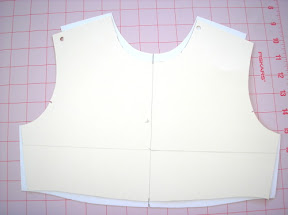
Front and back bodice pieces in tagboard
 After sewing up Blouse 2.0, I felt confidant enough to transfer my pattern pieces to oak tag or tag board. Tag board is the same stiff paper product used in file folders but available in large sheets or rolls. Some pattern makers do all of their patternmaking on oak tag, which is a better practice. But, I usually do my initial patterns on tracing paper or medical exam paper. At some point I do transfer it oak tag for durability. These patterns aren't necessarily production ready. They are designed for the way I work at home. The darts are cut out so I can trace the dart shape on the fabric. In industry darts are marked with drill holes, just as an example.
Collar and collar band pieces in tagboard
I still need to create a buttonhole placement guide and place the armhole notches. I figured out about how much fabric I need to make a blouse and noted it on the main bodice piece. Fold lines and seam allowances that are different from the norm are indicated. I should have marked the interfacing piece in red ink - forgot to go retrieve the red pen from the office.
Paper pattern pieces ready to store away
Anyway, my paper pieces are stored in an envelope for future reference.

February 09, 2011

Answers to some pattern grading questions


Tabitha of the Refugee Crafter sent me these questions. I thought her questions were enough for a separate blog entry.

What pattern pieces do I grade?


Thank you so much for all the patternmaking information you've provided on this blog! You've helped me make the jump from altering other's patterns to creating my own patterns this last year. (I purchased Aldrich's Metric Pattern Cutting for Children's Wear and Babywear thanks to your recommendation and love it.)

I'd love to now make the move to selling my own patterns but need a little direction in regards to grading which I am hoping you can provide. (I really am quite new to all this so please forgive the naivety of my questions!)

1. If I have created a ruffled shirt pattern in a size 12 months (just for example) can I grade each of its specific pattern pieces up or do I have to go back to the basic block, grade it up, and then alter it (again) to create another larger sized pattern? (Common sense tells me I should just be able to grade my pattern up, but I was confused by a line in the Aldrich book's grading section and thought I'd ask you for clarification. I hope my question makes sense.)

You would grade the pattern pieces for your style.

Can I use a computer software program to grade a pattern?


2. You often refer to grading on a CAD program. What is this program and is it widely available and reasonably priced? Does it have a steep learning curve? (I'm well versed in the vector-based Adobe Illustrator and the rest of the Creative Suite, would that help in learning this?)

There are several CAD programs out there specifically designed for apparel pattern making and grading. Unfortunately, they are not reasonably priced. Software packages start at about $10,000. The grading module is often times extra. If you are computer savvy and have used CAD programs in the past, then making the leap to an apparel specific CAD program is no big deal. For most though, it is a steep learning curve.

I have been following several independent pattern makers that make and sell patterns to the home sewing market. They are using Adobe Illustrator, so I guess it is possible to use that software to draft and grade your patterns. I don't endorse the practice because I don't know that Adobe Illustrator can create drafts that are accurate or precise. I suppose it is possible, but I've tried it in the past and it was an exercise in frustration. It would be a time consuming task regardless because many pattern making procedures are not automated. I would imagine grading would require the use of layers. Adobe Illustrator is not a technical drawing program.

The ideal procedure would be draft your patterns in CAD, grade them, and then export them to Adobe Illustrator to pretty them up. If you draft and/or grade by hand, you will have to digitize your patterns first. And remember that a CAD program will not teach you to grade. It's a tool not unlike a pencil and piece of paper.

What about the Jack Handford book?


3. You also mention Jack Handford's grading book. Is this book only useful if you are doing grading by hand or would it also be useful if used in conjunction with a CAD program? If a CAD program is out of the question is this my best bet?

I grade by hand and with CAD. I use the Jack Handford grading book for both methods. The only difference is that I do not move the pattern around as I would when grading by hand. Instead, I select points and define the change using an x, y coordinate system. The grading charts are useful in either case, but it will take some effort to apply them in a CAD environment. The Jack Handford book would be good to study and learn from because his system is how it is done in the industry. It would be good to learn the hand method first and will certainly be less expensive then buying a CAD program. The Jack Handford grading book is currently out of print and the price is high.

December 20, 2010

Tutorial: Reduce or Remove Sleeve Cap Ease pt. 2

I received a really great question on my previous tutorial on how to remove or reduce sleeve cap ease. Gina's question deserves it's own blog post.

Well, what do you do if you have big arms but too much ease? If I move it over I will lose bicep room. I am working with a dress right now and everything fits but the sleeves are tight and the have too much ease. How do I widen the sleeve get rid of ease and fit it to the armhole?
Thanks
This is a really great question and may require me to consider re-writing my tutorial. My previous tutorial is based off my experience drafting patterns for children's clothing. Usually it is not a problem to reduce the bicep line because it's usually too big anyway. My overall changes are small because I am perfecting patterns that I have drafted myself.

If you are working with a commercial pattern for adults, the approach will be similar. You can't always reduce the bicep line and the overall changes may be quite significant. Patterns from the Big 4 notoriously have too much sleeve cap ease. To be fair, if you follow the drafting instructions in some pattern drafting books, you end up adding in a fair amount of ease too. One pattern making book has instructions that result in as much as 1.5 inches of ease in a set-in toddler sleeve. Way too much. Such a practice is not common in the fashion industry and the production sewers will refuse to set-in the sleeves.

I had difficulty coming up with a solution and so I had to ask my pattern making friends at the Fashion Incubator Forum. We have to assume that everything fits Gina as it should, though it's possible there is some other fit issue that is contributing to the bicep width problem to begin with.(1) There are two possible solutions and neither is quick nor easy. Both will require testing. To add bicep width, slash and spread or slash and pivot the sleeve to the desired measurement. This alteration will require fixing the sleeve cap anyway.

1. Draft a new sleeve from scratch. (My solution)

2. Reduce the sleeve cap height equal to the amount of ease to be removed. (From Nora of the Fashion Incubator Forum).

Sometimes it's just easier to start over. It may save time in the long run and you will get exactly the sleeve you want.

If you would rather fix the sleeve, you can try Nora's suggestion. Nora's suggestion leaves the bicep width alone and only adjusts the sleeve cap height.

Walking a sleeve along an armscye
1. Begin by walking the sleeve along the armhole in a similar manner to my previous tutorial. In this case, start at the bottom and walk the armhole toward the shoulder. You will need to walk the sleeve on both the front and back armholes matching up the front of the sleeve with the front bodice and the back bodice with the back sleeve. Your sleeve should not be symmetrical and you will need to check the entire armhole. As you work, you may want to check the entire armhole and sleeve cap.

Measurement length difference

2. Measure from the seam line of the shoulder on the bodice to the center notch of the sleeve. This will be equal to the amount of ease on one side of your sleeve. Repeat for the back armhole. Total up the ease for the front and the back of the sleeve. This will equal the total sleeve cap ease.

Reduce ease by lowering cap height

3. Reduce the sleeve cap height equal to the amount of ease that needs to be removed and redraw the sleeve cap. You will need to repeat these steps until you get exactly the amount of ease needed to set the sleeve and no more.


Neither Nora nor I can guarantee that this method is the answer. This method will require lots of back and forth testing and iteration. The method is similar enough to my previous tutorial that I think it will work eventually. If you have the patience for lots of testing, then go for it. Also remember that you may still need *some* ease. When we say zero ease, we don't really mean zero ease. You may need some to help set the sleeve in. The only way to know is to sew up a few samples. 1/4" to 1/2" of total ease is not unusual. This ease is required to help sew opposing curves together. The sleeve should be against the feed dogs as it moves under the foot and the action of the feed dogs may require a little bit of ease so that the sleeve cap and armscye meet up in the end.

1. The armhole could be too small or too big. It may be in the wrong location or scooped wrong under the arms.


Thanks to Nora for her suggestion.

July 15, 2010

Potato Sack Dress

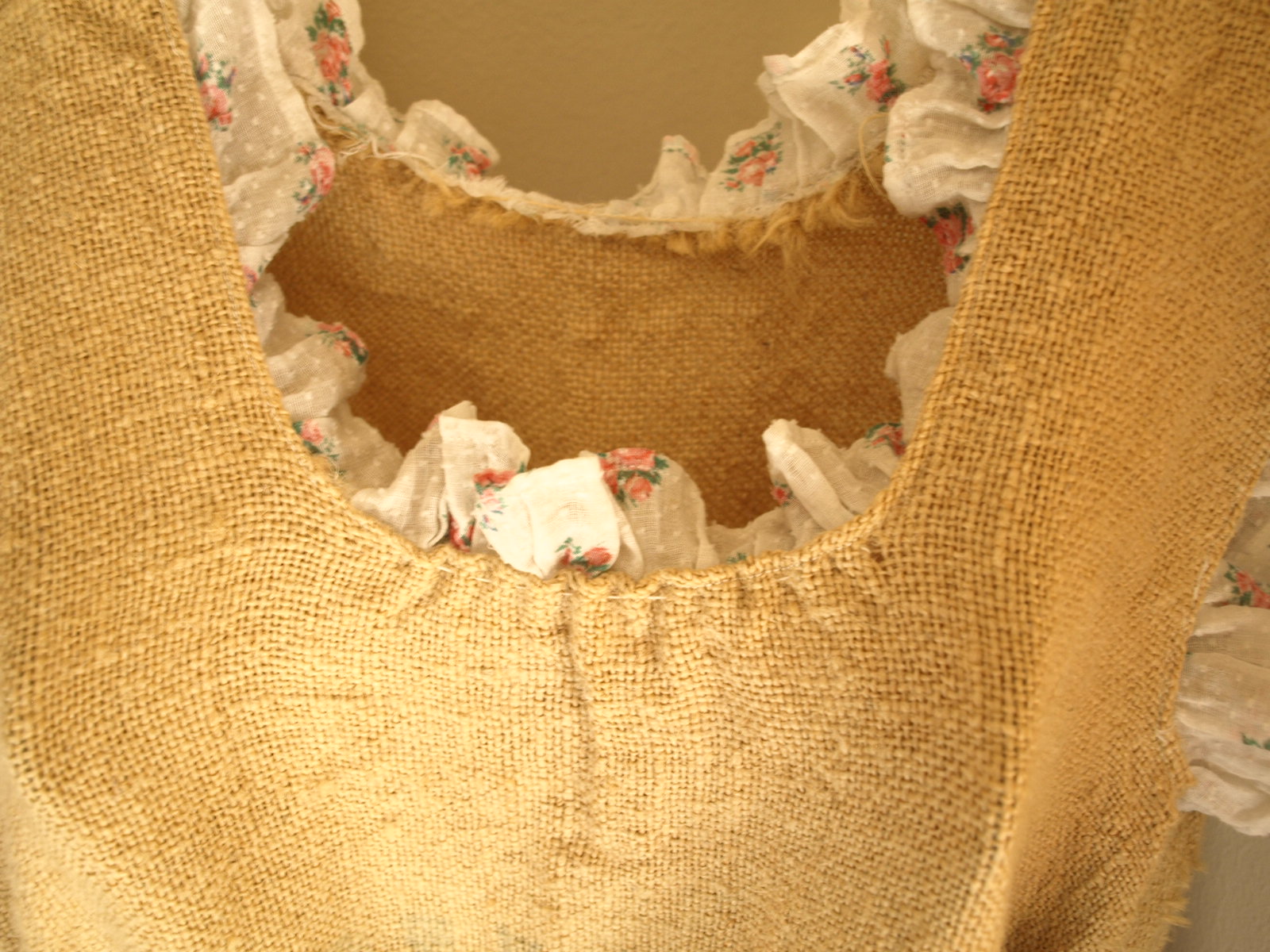
My local town in Idaho has a little museum and this dress was on display with a fun story. The story is that high school freshman girls had to wear a potato sack dress for a full day as part of their initiation in the 1950's. Back then potatoes were bagged in burlap sacks. I couldn't imagine wearing this dress for a full day. One girl felt sorry for a freshman and sewed ruffles on one of the dresses to pretty it up.

Dress made from a potato sack.

Potato sack dress with the addition of ruffles at the neck.

The tradition has long since disappeared as potatoes are now packed in paper sacks. Some local resident donated this to the town museum along with a picture of the girls in the dress.

April 14, 2010

Crochet Dish Scrubbie and knit dishcloth

I have had a flare up of carpal tunnel and possibly arthritis. I know I am too young for the arthritis, but this flare up was different from years ago. Many years ago I found that knitting and crocheting actually helped my carpal tunnel. Of course it can actually make it worse if you do too much. It must be something about strengthening the muscles in your fingers and hands...
Anyway, I am working through my meager yarn stash and making practical stuff. First up is a dish scrubbie or tawashi. I love this and have made several. There are many different styles and I may try other versions.

Crocheted dish scrubbie

I am also making dishcloths. I like the texture of this one.

Knitted dish cloth

The pattern is called Double Bump and is available as a free Ravelry download.

April 10, 2010

Bookbinding tools from book board

I have been meaning to post about some easy to make bookbinding tools made from book board. Right now my book board comes from upcycled notebooks from the thrift store - if I can find some in good shape. For just a couple of dollars you can make these essential tools. I can't take credit for the design as these are copies of what I remember using in the conservation lab at BYU-Provo.

Cutting guide with finger guard for book binding

First up is a cutting guide with finger guard. It is about 3/4" wide and is ideal for trimming book cloth. This design is not ideal - the ones I remember had a built up section in the middle that made it easier to grab and hold on to. Still, this works pretty good and I may get around to fixing it. The upright end goes to the outside, facing away from the book to protect your fingers from the blade as you cut.

Punching cradle made from book board for book binding

This is a punching cradle bought as a kit from a book binding/paper store. It is fairly simple and could easily be reproduced. (The kits are no longer available). The white section is tyvek, but could also be cardstock. Over time you have to glue additional tyvek or paper because lots of punching will weaken the join.

Corner trimming tool to trim book cloth in book binding

Finally, this is what was fondly called the corner-matic in the conservation lab. It is used to cut the corners of book cloth when making up the cover. I think the Banister book has instructions for something similar, but I much prefer this design. This pictures shows the corner-matic face up so you can see how it is put together. To use it, place it face down over the corner you want to trim and you will get a nice 45 degree cut the right distance from the board corner.

March 16, 2010

Dress Design by Hillhouse and Mansfield


I have been looking for Dress Design by Hillhouse and Mansfield (1948) for years. It was a hot item on Ebay at one time and sold for much, much more than it was probably worth. This book has become highly collectible because it contains detailed pattern draping and drafting instructions for 1940's women's clothing design.  I found a very nice copy of this book for a mere $2 at a thrift store. I knew if I kept my eyes open at the thrift store, it would eventually show up and I checked the used books every time I was there. Yep, I was quite excited to finally find this!

This book came to my attention in design school. There was an advanced pattern making/theater class that utilized this book as a textbook. The book was, of course, long out of print and the college gained special permission to print special spiral bound copies. Word spread among the design students about this book and copies of the book would sell out before some of the students of that class could even buy their copies. I was never able to grab a copy when I was in school.

Dress Design by Hillhouse 1940's waist styles Dress Design by Hillhouse 1940's complex dress design

You can see from these two pages that the designs are iconic and also complex. It's these two characteristics that makes the books so highly desireable and collectible to people who wish to reproduce a 1940's vintage style. Many of these styles would be difficult, if not impossible, to replicate in a modern factory. The labor charges would be enormous. Regardless, this pattern drafting manual would be a great resource to study and learn from. I have not yet attempted any of the drafting instructions, so I can't comment on the difficulty. For me the book is for inspiration.

February 04, 2010

Wedding Dress Care/Content Labeling follow-up

I admit that sometimes I make mistakes. A person reading my previous blog entry on a wedding care/content label pointed out some inaccuracies in how I wrote my suggested label. The FTC has some guidelines on how to write labels, both for content and care. I've read these instructions many times, but I sometimes need a refresher. Yes, it would be a good idea for anyone who has to write labels to read the instructions themselves rather than rely on a blog entry (or an anonymous commenter).*

Care instructions follow the general form:

Washing
Bleaching
Drying
Ironing
Warnings

If a dress truly cannot be dry cleaned, then the label should include that instruction. My label suggestion would be more accurate if I had included that instruction. I had also placed the bleaching instruction in the wrong order. Perhaps a better, more accurate, and perhaps correct label (changes in bold) would read:

100% Polyester
Do not dry clean.
Hand wash or
Spot clean in cold
water with mild
soap. Do not bleach.
Hang to dry.
Do not iron.
Made in China
RN12345 (<------ Made up)
---------------------
Avoid the use of
alcohol based products
such as hairspray,
perfume, etc., as these
may damage the dress.

The commenter also pointed out that if there is a reasonable basis for care instructions, then a manufacturer does not need to destroy a dress to prove it. I guess the question that must be determined is what is reasonable? In my opinion (and just for this commenter, this IS my opinion, for what it's worth), a new wedding dress manufacturer should destroy a few dresses to prove their labels. If you think something can be dry cleaned, you should be able to prove it. Same with any other care instructions. Over time, you may be able to reduce the type and amount of testing provided you do not change your component parts. This is probably the reason behind some of the testing requirements in the CPSIA. When you change a component (sometimes even from the same source), you have introduced a variable which may result in different testing guidelines.

I know wedding dresses are expensive, even the initial samples. Is it reasonable that every dress be tested to prove the care instructions? I am not sure every manufacturer goes to that extreme. But it is reasonable that a few have been. Testing a whole complete unit is the only way to test for compatibility of components. Testing a whole complete unit will tell you what a customer will experience. Wedding dresses have a lot of sentimental value and you wouldn't want a customer to have a dress ruined by poor or incorrect cleaning instructions. But this decision is best left to the manufacturer and the responsibility they are willing to bear if something were to go wrong.

As a manufacturer develops, it is reasonable to also test components. It is common for a manufacturer to use the same polyester satin in multiple styles and all they do is change up the trimming. In this case, the satin has probably been washed tested a few times and they know how it should be cleaned. But the trimming is different. In this case, I take some yardage, stitch the trim on and wash it (or dry clean it) - multiple times.

I can recall some concern I had about some flocked glitter on a chiffon. The glitter can fall off because the dry cleaning solvents will dissolve the glue. Washing by hand or machine can cause the glitter to fall off due to abrasion. So we tested various scenarios and came up with a reasonable basis for care. The same scenario can be applied to beads. Though I must say, based on my experience testing, some beads can be dry cleaned and some cannot. Some will fall apart even when hand washing. You won't know unless you test.

It is reasonable that a manufacturer has proof for the testing they recommend. I believe this includes documentation. You won't have documentation unless you test something. These days, I am not sure that a government regulator will appreciate your good intentions or your word without some kind of proof.

And finally, it is true that the CPSIA does not specifically mention wash testing (as I stated in my previous blog entry). It does imply that any testing be done by a certified 3rd party lab. When I worked various private label programs for Big Box stores, they required wash testing by an approved 3rd party testing lab. At that time we were able to negotiate creating an in-house wash testing program to save money. We were required to submit a copy of our test results with the 3rd party testing reports to the technical designers of the big box stores. In the days of CPSIA, I imagine this is no longer possible (I haven't worked on any private label programs in a while, so someone else who has will have to clarify this point). So while the law may not specifically mention wash testing by a certified lab, Big Box retailers might require it anyway. This is thus my reasoning for why I said what I said.

*When I wrote my original blog entry, the FTC site was down and had been down for a few weeks. My intention was to verify and correct my article and I didn't do that because I couldn't. It was one of those things that fell off my radar and I didn't get back to it. My apologies to anyone if I misled. I appreciate comments that politely correct me when I have misstated something. However, I won't print comments that are insulting and offensive.

January 17, 2010

Warning: Tagless labels in baby clothes and the CPSIA

My sister sent me an update on the problem. It appears that the re-formulated paints may include latex tainted paint, similar to silk screen paint. My niece had another reaction even worse than previous because her entire back flared up red. The pediatrician suggested my niece now has a latex allergy and possible nickel allergy. Latex allergies can develop over time with multiple exposures.

Well over two years ago, Carter's and the CPSC issued an advisory to parents about tagless or heat transfer labels located in the back neck of their clothing. They had received reports that the labels were causing allergic reactions and irritation. The advisory stated that the reported incidents were rare and a small percentage of the thousands of units produced. The affected product was primarily the Fall 2007 line. This means the product was manufactured early 2007 or late 2006.

It is difficult to know what ingredient in the labels is causing the reaction. Some have suggested formaldehyde. Others suggest it is the pthalates, which exist at a far higher concentration than other products. It is puzzling that with documented problems that neither Carter's or the CPSC have done a more thorough investigation. Instead the CPSC is bogged down with debates over the amount of lead in the brass ball of an ink pen or whether a bicycle manufacture can use lead in a tire valve. Surely the CPSIA, that ultimate guardian of children's safety would not have allowed this kind of problem to persist. One has to wonder where the consumer protection groups are on this? Why aren't they making a big stink?

You would think that a product that proved to be a problem would have been resolved by now. No. Carter's released their Spring 2009 line with a reformulated ink and label style - two years later. Because there was no product recall there is an untold amount of product still floating around. (Even with a recall, there would still be a lot of product out there because recalls rarely recover 100% of sold merchandise).

You can accuse me of hysteria or panic if you choose. I'm most guilty of cynicism about federal regulations that don't seem to actually accomplish intended goals. But the reason I am writing this is because my youngest niece suffered a reaction to a tagless label. I was even more incensed when I saw this picture.

A tagless label in a baby bodysuit or onesie

You see this label does not even belong to Carter's. It's an Arizona Jean Co. bodysuit, a private label product for JCPenny. The brown around the label is actually my niece's blood! You can see the rash on her back below.

Allergric reaction to a tagless label in a baby onesie

My sister purchased the bodysuit in Fall of 2008 in anticipation of need later in 2009. It wasn't after her baby had worn the bodysuit a few times that she realized the source of the problem. My sister reported the problem to JCPenny and was told she would be refunded her money and receive new product. She was also advised to report the problem to the CPSC herself (which she is doing). Huh? Since I have worked on private label programs for JCPenny, I know how meticulous and thorough they are with safety. This is surprising to say the least.

This is all rather troubling. Doesn't the CPSC require companies to report safety problems immediately? Of course the CPSC may receive a report but how long will it take for them to react, especially now? This problem illustrates how upside down the whole system has become*. We focus all of our energy in silly debates about ink pens, ban rhinestones with no bio-available lead and spend all of our time recalling toys with minuscule amounts of lead - all with no reported injuries. Compare that with the many reports of injuries related to these labels, and we get, well, nothing.


Spring 2009 is two years after the initial reports. Why so long? Why not switch to traditional labeling in the interim? Carter's claims they went tagless to improve the comfort factor - no scratchy label. Well, a scratchy label can be cut out and the problem removed. A tagless label on a baby's bodysuit is not easily removed and must be thrown out. After all this, I think I prefer traditional labels.

Stacked brand and care-content labels

*In fairness, the CPSC is working on a consumer database to report incidents as required by law. They are in the process of comment gathering and workshops. Problems can be reported now, but the information required by the CPSIA is not publicly available. If anything, the CPSC should look at a complete overhaul of their entire website which is a disorganized mess. But that is an argument for another day.

December 15, 2009

Metric pattern cutting for children's wear and babywear - 4th Edition


Winifred Aldrich has released an updated edition of her pattern making book. Besides having a much nicer cover design, it reportedly contains a revised organization and emphasis on flat pattern making. I find this change interesting because more and more design entrepreneurs are utilizing flat pattern making today and this confirms my personal experiences in the industry.

From the abstract at Amazon:

Today’s popularity of easy-fitting styles and knitted fabrics means that basic ‘flat’ pattern cutting is used to construct the majority of children’s wear and babywear and this type of cutting is therefore emphasized in this new edition. Shaped blocks and garments, cut to fit the body form, are still included, and are placed in chapters covering some school uniform garments or more expensive fashion or formal clothes.

One primary difference between flat versus fitted pattern making is that the patterns have the same shape for the front and back pieces. For example, the armhole shaping is symmetrical. Creating patterns in this way results in a looser, more casual fit and it is appropriate for a lot of children's clothing. Even so, I see more of a modified flat method in actual use. Patterns are modified so that they aren't quite so boxy and more fitted. Yet, they retain some symmetry between front and back pieces.

October 26, 2009

Do professional pattern makers work with seams on or off the pattern?

Professional apparel pattern makers work with seam allowances on their patterns nearly all the time. It's faster. I would argue it's more precise. This practice goes counter to what most pattern making classes teach. They teach that you must remove the seam allowances and add them back later. I don't know anyone in the industry that works this way. I think the idea is that working with seam allowances one can create variations that lead to fitting problems later. That's simply not true if you check your new pattern against the original block later. (This is assuming you make a copy or rubbing of your original before you start on a new style. But I'm sure you knew that).

If you are drafting by hand, it is time consuming to remove the seam allowances. Pattern blocks are made with seam allowances on. You would have to keep a set of blocks without seam allowances. It would be so easy to mix up seamed and unseamed pattern blocks. Apparel pattern makers leave their blocks seamed and theatre pattern makers or cutters leave their blocks (or rather slopers) unseamed. In fact a block is a finished pattern piece that includes all pattern markings and is seamed.

If you are drafting in CAD, you can turn the seam allowances on and off. You can work on the cutting line or the stitching line. It's a simple matter of hitting a few buttons. BUT, I have found that CAD programs have difficulty in calculating between seamed and unseamed because it involves a complex series of mathematics. So constantly switching between cutting and stitching lines can produce some weird anomalies. (As an aside, weird things can happen with notches on stitching versus cutting lines too). I have found this is true no matter which CAD system you use. So I work with seam allowances on and directly on the cutting line nearly 99% of the time. This means that I keep the seam allowances in mind while I work.

One Exception


In CAD, it is important to turn the seam allowances off and walk the pattern pieces along the stitching line in a few areas. Collars and necklines is one area that I nearly always check for matching on the stitching line. There are other situations that come up where this important. I learned this the hard way recently.

Two pattern pieces with seam allowances on

In this situation, I split a jacket back pattern piece and added corresponding seam allowances along the split line.

Comparing two pattern pieces to see if the cut edges match

Next, I aligned the pattern pieces to make sure they match. At this point they did and I assumed all was right. Until I got complaints from the sewing machine operators that things weren't matching up. I had to go back and double check.

Comparing two pattern pieces with seam allowances off

I took the seam allowances off the pattern pieces and realigned them. They didn't match, so I redrew the stitching line of the side piece to make sure it matched the center. I added back the seam allowances and realigned the edges.

 Correcting the seam allowances so the stitching line matches

The pieces didn't match again. Sewing machine operators also do not like this because they do not know how to align the pieces. In this particular case, the seam allowances are small, so I left the little "dog-ear". It can be difficult to cut those "dog-ears" off by hand when they are really small. It is easier to machine cut. In any event, there are different ways of dealing with this. I show one method below.

Trimming seam allowances on a pattern piece for better matching

Your pattern pieces will then look like this and match up in every way possible.

Two pattern pieces that match on the stitching and cutting lines

August 31, 2009

Comparing pattern shaping and children's sizes follow-up

Kathleen suggested that I post an update on a previous grading post I did about a year ago. You can read what I wrote previously at When Patterns Collide. In that post I suggested that it would be possible to combine the 24M and 2T and the 4T and the 4. My reasoning being that the 24M and the 2T are essentially the same sizes - why differentiate them? The subject is a little complex and perhaps controversial - at least to pattern making geeks. My goal was to reduce the work load. I was drafting and grading all of my patterns by hand. I am incredibly slow grading by hand. In addition, I was trying to solve one particular sizing problem that shows up in childrenswear, that is hard to illustrate. Since I shut down my Prairie Roses line, I am not knee deep in pattern making as I was a year ago. But perhaps it may be helpful to explain what I ended up doing.

Originally, I broke up my sizes into these ranges:

3M, 6M, 9M, 12M, 18M, 24M - sample size 12M

2T, 3T, 4T - sample size 3T

4, 5, 6, 6x - sample size 5

These ranges are rather typical of what you will find in retail stores. When developing my patterns, I have to make and grade the patterns for each size range separately. You cannot make one set of patterns in one size and grade them up and down all the way. It won't work because that many sizes will cause minute grading errors and strange fit, especially on the smallest and largest sizes. As you define your grading and size measurements, you will find that the 24M and 2T and the 4T and 4 overlap. I followed the Jack Handford grading rules, which are pretty darn good, but end up with a result like this:

Bodice pattern pieces in a size 4T and 4 and how they compare

In the picture above, the size 4 is laying on top of the size 4T. The size 4T is actually too long in length and too wide. I double checked all of my grading and there was no mistake. The size 4T was graded off my 3T and the size 4 off of the 5. The shaping of the sample size pattern pieces varied a little. The toddler was a little boxier because toddlers don't have any waist shaping, whereas a 5 year old does. If I were to leave my patterns this way, someone will eventually hang the two sizes next to each other and think there was some kind of manufacturing mistake. I needed to fix my patterns so that each size is incrementally bigger.

To do this, I rearranged my size ranges, combining some sizes:

3M, 6M, 9M, 12M, 18M - sample size 12M

24M/2T, 3T, 4T/4 - sample size 3T

5, 6, 6x - sample size 5

The next thing I did was reworked the shaping of my toddler sizes to look more like the 4-6x range. I pulled the waist in some and made the armhole smaller. I made these shaping changes because I found that my toddler patterns were just a little too big. Now, I can lay all of my bodice pattern pieces in order and they get incrementally larger from the 3M to the 6x. Your patterns may look different, but it is worth comparing the sizes on the outside edges of your ranges to make sure you don't have something weird show up like I did.

Even though I combined some sizes, I kept this behind the scenes. My customers still saw all of the sizes separated out. If someone ordered a size 24M and another ordered a 2T, the dress would be exactly the same except for the size tag. I offered all of the sizes on my website so that customers would see something familiar. Perhaps it seems a little dishonest? I don't think so because in the real world a 24M child is the same size as a 2T and I was willing to take the chance. For what its worth, no one ever complained or returned those sizes for fit issues.

Now, I don't know that what I did is "the way it should be done". In the past though, I have had people question why the 24M was larger than the 2T and I had no explanation. Once I worked through grading all of my patterns by hand, it started to click in my head. The relationship of the shape of the pattern pieces, the grade, and body measurements are all connected.

August 12, 2009

A Warning on Labeling Bamboo Textiles


Bamboo fabric has long been considered a miracle green fabric. It is super soft, absorbent, biodegradable, and considered antimicrobial. It is true that bamboo is considered an eco friendly plant because it can be grown quickly without the use of chemicals. Many products have been produced from bamboo - from floors to textiles. Some of the eco friendly claims have come under scrutiny, especially bamboo textiles.

Bamboo textiles are produced by two methods. One can be considered sort of green and the other not. With the first method, bamboo stalks are crushed and broken down with enzymes and then combed out. The second utilizes harsh chemicals to break down the bamboo stalks into pulp which is extruded by spinnerets. This second method is the same process in which Rayon fabrics are manufactured.

You can bet that the majority of the bamboo fabrics on the market are manufactured by the second method. Because of this, the FTC has declared that bamboo fabrics must be labeled Rayon with the qualifier from bamboo. While this is a controversial position taken by the FTC, it is more accurate due to the actual processes being used. The FTC has clamped down on some companies claiming their bamboo textiles are "green". The charges include falsely advertising some of the more outlandish claims of being antimicrobial and biodegradable.

Anyway, be careful of how you label bamboo. The FTC has further guidance on how to deal with bamboo.

July 22, 2009

More aggressive intellectual property enforcement by Taggies and Gerber

Taggies


My most popular blog entries have to do with taggies. Taggies are those square blankets with ribbon loops around all edges. I have received a lot of comments asking what the latest is on the patent and enforcement. I can only repeat what other commenters have stated:

1. The Taggies people are continuing to enforce their patent.
2. The patent enforcement lawyers appear to be going after anyone who has any form of a ribbon loop on a blanket edge, whether it is one ribbon loop or several.
3. No one has taken up the task of challenging the patent.

If Etsy or Ebay receive notice from Taggie's lawyers that the product is a potential infringement, those companies will pull your listing. These companies have little resources to investigate the claims, so legitimate or not the listing will be pulled down. You will not be able to defend yourself. If you list an item in your own store or blog for sale, you will receive a letter directly.

To date, it would appear there is plenty of evidence that the patent can be challenged. Commenters claim they had these style of blankets as children or that they have bought a current home sewing pattern with this style. Patterns and instructions abound on the net as do product listings in various online stores. The Taggies people were the first to obtain a patent and therefore believe they own it despite the evidence that the idea has been around for decades. This only illustrates the problem with the current patent protection system. The system is just complex enough that ordinary people have no idea what patents are being sought and if they should be challenged. The patent bureaucrats and lawyers don't understand the manufacturing processes and how common a folded ribbon loop in a seam is. Who has the time and money to fix the problem? Taggies is expanding into Europe and South America, so despite calls for a boycott the company appears to be growing.

Gerber and the word Onesie

Another aggressive brand enforcement problem has to do with the word onesie. Onesie is a registered trademark brand owned by Gerber. You cannot use that particular word to describe an infant bodysuit or unitard unless it is an actual Gerber branded Onesie. Various acquaintances of mine and online shop owners are receiving threatening letters about their use of this word in their product descriptions. Gerber appears to be ramping up their enforcement of their trademark.

These companies have not technically done anything illegal. They have the right to apply for patent and trademark protection. That protection is only worth as much as they are willing to enforce it. So, IMO, let them waste spend their money on it. The one thing these companies are doing is creating ill will among potential customers and retailers. Customers and retailers have long memories and will think twice about buying or indirectly promoting those products to friends. They may be doing more damage than they know.

Baby and children's apparel products seem to have more patent and trademark protection than other sewn product categories. There are bibs, hand covers, sensory objects, diapers, and so much more that have patent protection. I haven't quite figured out why.

July 17, 2009

What is a fabric converter?

Fabric prints

Fabric or textile converters may not be a term some are familiar with. Fabric or textile converters are factories that embroidery, dye, print, flock, bead, pleat, etc. fabric. They may specialize in one area and simply call themselves embroiderers or printers, or they may provide multiple types of conversions. A fabric converter takes specially prepared or greige (pronounced grey) fabric and converts it into finished goods.

There are various forms of greige goods. Generally greige goods are fabrics that come right off the loom. Some have been minimally processed, not processed at all, or the yarns have been processed prior to weaving or knitting. There are various types of finishes that depend on the desired outcome. There are finishes that prepare the fabric for printing or dying. Other finishes enhance the fabric's qualities, such as singeing, desizing, scouring, bleaching, calendaring, and many more. These are finishes done to the fabric prior to printing, dying, or embroidering and so they are still called greige goods by some. Since these finishes do finish the fabric to some degree, they are technically called by other names. There are various acronyms and labels for the different types of "greige" goods and it all becomes kind of fuzzy (or grey, heh) for me. In any event, greige goods are warehoused until an order comes in to print (or whatever) the fabric. Printing and embroidering are some of the fabric conversions done at the very last stage of fabric manufacturing.

July 15, 2009

Printing your own fabric pt. 2 : Sourcing Fabric Converters and Printers

Fabric flower print design

Say you are a fashion designer or retailer and you want to custom print your own fabric. You have the skills (or the funds to hire a designer) to create artwork. There are many fashion designers, and even some retailers, who print their own fabric. Off the top of my head Laura Ashley, Ralph Lauren, and Ikea all print their own fabrics, though smaller companies also do it. This is a bit different than my previous blog entry (Printing your own fabric pt. 1), as these individuals are not necessarily textile designers professionally. But as part of a brand image or look, custom prints become necessary.

There is a lot of existing artwork already out there. Freelance textile and graphic designers are available to create the artwork to complement the look of a line. You can also hire graphic designers, though it may be helpful if they have experience in preparing artwork for textile printing. You could even create your own artwork if you have the skills and inclination. You should receive a "strike off" or proof to approve prior to printing. A strike off is a sample of the print and it should represent the actual fabrics, colors, and print registration of the final goods. Make sure to evaluate the strike off thoroughly before committing to a print run.

As a fashion designer, you can contact fabric converters/printers yourself. They can help walk you through the process of preparing the artwork, setting up the repeat and printing the goods. Each printer will vary in their abilities and processes, so don't be deterred if one place is not a good fit. There will likely be a set-up charge to prepare the artwork, so don't be surprised by this.

The biggest question when printing your fabric rests on minimums. How much fabric will you be willing to carry in inventory? Typical minimums average about 3,000 yards. The smaller the quantity, the higher the price per yard. Stateside factories generally require higher minimums. Overseas factories vary - some high, some lower. Some factories may break up the 3,000 yard minimum and allow you to do different colorways of the same print. Others may require 3,000 yards per colorway. Even then, some factories will do less yardage. It is all a matter of research and asking the right questions.

Q: "Can you do custom prints?"

A: "Yes, but it will be a 3,000 yard minimum and 6-8 weeks."

July 13, 2009

Printing your own fabric pt. 1

Fabric prints

This may be a future series. I recently talked with someone who has been custom printing his own fabric for a few years now. There are several steps involved with printing your own fabric but it isn't as hard you might think. I am talking about having your designs professionally printed by a fabric converter. There are options that have become available to home hobbyists to print their own fabric, but it is extremely expensive. If you were to take this up as a business, you would need a printer who can print hundreds of yards at an affordable price or you would never make any money.

I have to say I admire some of the up and coming print designers. I admire their skill and ability to create a cohesive collection 1-2x/year. Many of these designers have training in the arts, either the fine arts or graphic design. On top of that, they have some experience working with cloth as seamstresses and pattern makers. I wish I was more skilled at designing prints. I think I could do it but I would need to dedicate a great deal more time to it. Maybe someday I will get up enough gumption to try it and print my own designs.

Traditionally, a textile designer creates their artwork using traditional media - paint and a brush, markers, pastels. At the very least then and now, an artist carries a sketchbook around with them everywhere. They are able to capture patterns and designs in the world around them and translate them into a fabric. They can pick colors suitable for apparel or interior fabrics.

I think most modern textile designers today create their artwork using computer aided design (CAD). Adobe Illustrator and Photoshop are the primary tools. (Free versions include Paint or Gimp, Inkscape). Artwork created in Illustrator or Photoshop is not immediately ready for printing. The artwork must be made into a repeat, created by a special filter or plug-in. The idea is to offset the image 50% horizontally and vertically and fill in with the offset parts. Look for a tiling filter or tool in your program to do it automatically. Once this step is taken, the artwork is ready to be printed by some methods (Spoonflower, for example).

For mass production, the artwork goes through some additional steps though I am sure the technology has changed since I was last exposed to it. There are specialized CAD packages in the industry that some artists use directly or through a trained technician. Artwork is brought into the software and the design is fine tuned through color reduction, recoloring, etc. The design is made into a repeat. The process is rather involved because digital artwork has to be translated into the chosen printing method. And there are several methods out there - heat transfer, roller printing, block, screen printing and digital. The method chosen depends on the converter's ability and/or appropriateness for the print.

If you want to be a textile designer, there are two main approaches. You can create artwork and shop it around to existing fabric manufacturers/printers/converters. Michael Miller, Westminster, and others buy the rights or license artwork from designers. Other designers print and sell their own fabrics. In either case you don't necessarily have to understand all the ins and outs of textile manufacturing and printing. Fabric converters/printers can take your artwork and prepare it for printing (their may be an up-charge or setup fee).

Anyway, more to come as I find this to be an interesting topic....

July 07, 2009

Wedding Dress Care-Content Labeling

Care content label in a wedding dress

This article now has a follow-up blog entry with some corrections and additional opinions. Your comments are welcome, but hateful or spammy comments will be deleted.

As I was working on the alterations for this wedding dress, I wanted to see other dresses by this designer/maker. Perhaps the sleeve pattern shaping was intentional and not a mistake? Perhaps the problem is consistently found in other styles? I had no idea who the designer was, only where the dress was purchased. The dress was not in the store's web catalog and the only label in the dress was not helpful. The dress was missing a brand label and had no RN number. Further, the care instructions were rather bizarre/interesting (click on the picture for a closer view). I googled the style number and came up empty.

At a minimum, the dress should have had an RN number on the label. You can search an FTC database to find out the manufacturer of an apparel item. Wedding dress manufacturers/bridal shops have been fined in the past for failing to disclose or intentionally removing this information. Alterationists may remove the labels after purchase but should give them to the bride (links to come later as the FTC website was having problems when I wrote this).

The label states:

100% polyester
Do not dryclean
Spot clean ONLY
Use cold water and
mild soap
Made in China
See reverse for care
----------------------
Do not spray Alcohol
based product directly
on gown such as Perfume,
Hairspray....etc. This will
damage beadworks and
embroiderie designs made of
Rayon, Nylon, and other
synthetic materials.

I found the care instructions rather hilarious. How many of you spot cleaned your wedding dress with only cold water and mild soap? The fabrics themselves probably could be dry cleaned or even hand washed (though that may be more work). The beads will probably dissolve in the dry cleaning solvents, so thus the "do not dry clean" instructions. But, if you can find a reputable dry cleaner who will clean the dress and avoid the beads, then go ahead and have the dress dry cleaned. Otherwise, hand wash the dress. BTW, there were no further care instructions on the back of the label. Many wedding dresses are currently manufactured in China, which may explain the poorly written tag.

The extra instructions are interesting. I suppose it is possible that perfume or hairspray may damage the beads. Though the bride would probably need to be drenched in it before the beads dissolved. Sure would like to put those beads to the test....

The label should have been written to say:

100% Polyester
Hand wash or
Spot clean
in cold water with
mild soap. Hang to
dry. Do not bleach,
Do not iron.
Made in China
RN12345 ( ------ Made up)
---------------------
Avoid the use of
Alcohol based products
such as hairspray,
perfume, etc., as these
may damage the dress.

And of course, the care instructions should be thoroughly tested by the manufacturer. Good industry practice (and the government) dictate that a manufacturer should have a reasonable basis for the cleaning instructions. This means actual test data recorded and stored with the manufacturer. At this point in time, manufacturers (except children's clothing manufacturers) can do their own in-house wash testing. Children's clothing manufacturers will have to have it done by a certified laboratory. Wash testing is not specifically mentioned in the CPSIA, but it does imply that ANY testing will have to be done in a certified lab.

July 06, 2009

Correcting the fit of petal sleeves in a wedding dress pt. 2

I finally had a chance to do up some line drawings to illustrate the problem with the petal sleeves of the wedding dress I recently altered. There are more pictures in the blog entry Petal Sleeves pt. 1.

Side view of a petal sleeve in a wedding dress

Petal sleeve in a wedding dress
The shape of the sleeve pattern adds a lot of extra material under the arm - creating almost a circular sleeve. The hem of the sleeve flapped around like wings. IMO, it wasn't very attractive. Even though the dress was a plus size dress, I can't imagine any woman wanting this style. I find it hard to believe the designer intended this either. I could be wrong since I am not familiar with wedding dress design. I do know that wedding dresses are designed to be easy to alter so perhaps the designer allowed for extra underarm width to accommodate the size of any upper arm. Even so, with the combination of removing excess shoulder height, recutting the armholes and sleeves, the alteration was not that easy. I dare say, it is either sloppy pattern making and/or grading. I would pin the source of the problem on grading from a size 6 all the way into a plus size. I (and Kathleen) have blogged about this many times (search for "Grading is not morphing" at Fashion-Incubator). Plus sizes should have their own patterns separate from Misses sizes. Trying to save time and effort by "grading" patterns from a size 6 up into the plus sizes leads to problems like this. Of course, I don't really know if this is exactly what happened. I would need to look at the whole size range and even the actual pattern pieces to know for sure.

This is what the pattern pieces and fit looked like on the bride before the alteration. The petal sleeve is a regular cap sleeve in the example below. You can see the extra width added at the hem of the sleeve and the wings it creates under the arm.

Pattern shape of petal sleeve in a wedding dress

Below is the shape of the pattern after the alteration. I probably removed a good 1.5" from the sleeve hemline. The fit of the sleeve looked 100% better.

Corrected pattern shape of petal sleeve
Now if the intent of the pattern maker was to allow the bride to be able to lift her arms for dancing, then it was added in the wrong place. A gusset should be added at the underarm - not the sleeve hemline.

Drawing of a cap sleeve with proper fit