December 11, 2013

Adapting a block pattern into something else pt. 7 : Pattern modifications

Testing a neckband construction

Have you ever had a project bug you? I had my first sample hanging in the Design Loft almost taunting me. Originally I wanted a neckband on my cardigan. Then during construction, I changed to a rolled fabric edge along the neckline. The longer I stared at it, the less I liked it. Still unsure how a folded neckband would look, I whipped up a small sample, and what do you know? It worked just fine. It could be improved with a bit of interfacing, but not too bad.

So I pulled out the seam ripper and set to work. In addition, I removed some of the extra ease I had previously added for a closer fit.
Testing the fitting sample
You'll notice there are still a few minor adjustments that need to be made. The sleeves are too long. Yep, I over compensated there. The shoulder needs to be brought back up. And the back neckline needs to be raised. Despite all that, I am fairly pleased with the results. This is the style of cardigan that I really like. It looks sloppy in the photo because I used a rayon/poly jersey knit that is just too lightweight and drapey for the style. The next version will be even better. And yes I do plan to wear this, even in public. It is very, very comfortable.


November 21, 2013

Adapting a block pattern into something else pt. 6 : Sewing a fitting sample

Test fitting sample for a new cardigan design
You can easily spend a lot of time creating a pattern on paper but at some point, it needs to be sewn up. It is while sewing that you'll see your design take shape and lead you to make modifications as needed. I changed the design a bit by eliminating the folded neckband. The neckband is instead a single layer that is allowed to roll. I made this change because the fabric is pretty light and it would need some kind of stabilizer, which I didn't have. The cardigan is very comfortable and fits pretty well. Even so, I added just a bit too much wearing ease. So I need to reduce some of the body width. The upper back is a tad long and the sleeves need shortened.

It's pretty hard to get everything just right on the first attempt. I've done enough girls dress patterns that I don't usually have to do many iterations. Adult clothing takes a bit more tries because I lack experience with it. Industry pattern makers and sample makers will sometimes make many iterations of a design before they get it just right. This is a slightly different approach than home sewists might take. But once the pattern is nailed down, I won't have to worry about it anymore. It will be much easier to create variations on this style too.

Paper sewing pattern
Before I could tackle the pattern adjustments, I needed to stop and get organized. I assigned a style number, created a style and cutting spec sheet, and assigned pattern numbers. I explain how to do this along with providing printable blank forms to fill out in my book. If you prefer keeping a digital record, you can use the examples in the book to create your own spreadsheets. In many ways I still prefer paper and pencil. It forces your brain to think differently - perhaps more analytically. I have used both paper and pencil and spreadsheets. There are advantages to both.

November 13, 2013

Recovering Shoes - a step by step how to guide

Now that Halloween is over I can breathe for just a moment. My girls were Tinker Bell and Periwinkle based from Disney's movie Secret of the Wings. I was super excited for the request and the chance to make wings again, cause let's be honest, little fairies are just cute.  The movie takes place in winter fairyland which is a bonus for staying warm while trick or treating. As part of their designs, I needed shoes that matched their outfits and is the focus of my post today. Tinker Bell wears boots and Periwinkle wears slip-on style slippers. I pulled shoes from the girls' closet according to overall shape and ones that would be easy to sew through, so no leather.


I learned to recover shoes in grad school and was taught to actual separate the sole from the main part of the shoe, not completely but enough to stuff about 1/2" or so of fabric into, and gluing everything back together with Barge cement. This method is a permanent change and I wanted to undo what I was doing.

                                                              This is the shoe before:

Girls red shoe


Recovering a shoe starting with the toe
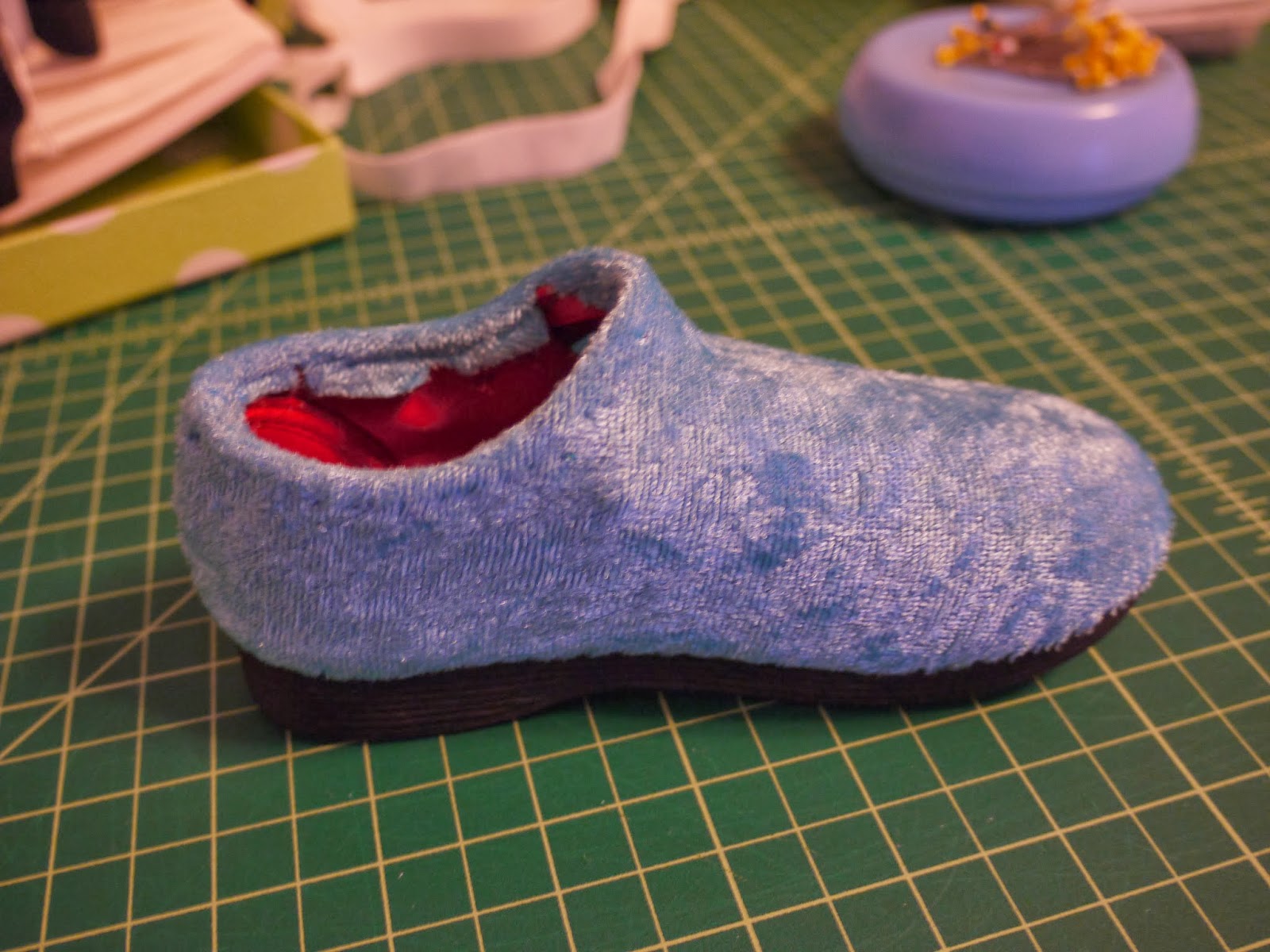
The fabric used for this project was stretch velour. I placed it on the shoe with the greatest stretch running from side to side. (If you are using a woven fabric then you will need to use the fabric on the bias).


Anchor the fabric to the shoe with pins

I used a lot of pins and stabbed them straight in the shoe, right above the rubber sole.


Trim excess fabric

After the fabric was draped and pinned in place, I trimmed off excess fabric leaving about 3/8" to turn under.


Turn under the seam allowances and pin


Here, I turned the seam allowance and repinned.


Recovered shoe ready to sew


Ready to sew.


Sewing new shoe cover with a straight needle


A curved needle would have been nice at this point but I made it work.


Finished shoe cover


All finished except the puff ball.

 I added puff balls and fur trim. 

Fairy costumes with custom covered shoes
The fairies exploring the outdoors.

November 12, 2013

Adapting a block pattern into something else pt. 5 : Making the pocket pattern

Sewn sample of the new cardigan style

Here's a sneak peak of the first sample of my cardigan pattern. I'm fairly pleased with the results, though there are a couple of minor pattern modifications to make. So more about all that later.

For now, we need to finish up the pattern. The last two pieces to deal with are the pockets (shown above) and the elastic casing. I referenced my sweater to determine the pocket dimensions and placement, which is basically a rectangle. Pockets come in all sorts of shapes and sizes with varying amounts of functionality. Pockets should be proportional to the overall garment. They can be graded for larger or smaller sizes to maintain proper proportions. Pockets can be applied in various ways and include seam and hem allowances.

I wanted a very casual look to my pocket so I used a narrow 3-thread serger hem around all four sides and topstitched it on. This allowed the fabric at the top of the pocket to roll. This detail mimics the detail on my sweater. I didn't have a lot of confidence in producing a neat topstiched pocket in which the raw edges are turned under. This is partly due to the fabric and my machine. For a more structured pocket this fabric would need a fusible to help stabilize it.

Pocket placement is noted on the pattern piece by a drill hole. In a factory, an actual hole is drilled into the fabric. I have seen knits marked with a drill that also contained a marking medium such as a washable marker. In that case, the drill bit was like a needle. My pattern at home will contain a hole large enough for a chalk marking pencil to fit. Even though there are lines on the pattern pieces indicating placement, they are not transferred to the actual fabric. They are just there for clarity.

Drill holes for pocket placement

The elastic casing is just another rectangle large enough to cover the elastic. I think mine is about 1/2" x 8".

October 30, 2013

Adapting a block pattern into something else pt. 4 : how to create the neckband pattern piece

T-shirt into cardigan
For review read part 1, 2, and 3 of this series.

All of the major pattern pieces are now done. Next up is to do the neckband, the elastic casing for the back waist, and pocket. These three pieces are just rectangles. In a CAD pattern making environment, I will make pattern pieces for all rectangles and squares. Pattern makers, graders, marker makers and cutters all handle these kinds of pieces a little bit different, so ask if you are not sure.

For me, working on a personal pattern in my own workspace I handle rectangle and square pieces one way. I figure out the dimensions and note them on my style sheet. You can do this for patterns* that will be used in a factory setting too, but you will need to create a cutting guide for any rectangular pieces which might be graded. For now noting the cut dimensions is sufficient.

Up to this point I haven't really needed to consider how the cardigan is to be constructed. The majority of the cardigan has rather simple construction that mimics the construction of the t-shirt. But the neckband can be constructed and attached in a number of different ways. I also have to consider the stretch factor along the back neck. Do I want a 3-piece neckband with seams at the shoulders or a 2-piece neckband with a seam at center back? How do I finish the neckband at the hemline? How wide? All these things have an influence on the dimensions of the cut piece.

I like to keep things simple so I opted for a 2-piece neckband with a seam at center back. A 3-piece band might be necessary if the fabric width is too narrow. A 1-piece neckband might be possible if the cardigan was smaller. Begin by measuring the front and back neckline of the cardigan patterns.

Measure the neckline for the neckband

Now it is a matter of math. There really isn't a formula for this. It's just adding and subtracting.**

Neckband width = (front neck+back neck) - (front and back shoulder seam allowances + hem allowance) + seam allowance for center back + seam allowance at hemline - some stretch factor for the back neck.

Neckband length = 2 * (Desired finished width + seam allowance)

The neckband will be cut across the width of the goods like this:

Cutting guide for the neckband

Dimensions should be written as Length x Width. In this case the Length is the shorter measurement. My neckband pattern piece will then be something like:

5 x 30 inches

A CAD version or hard pattern will look something like this with a pattern number assigned instead of the words neckband:


You'll notice that I have two notches. The notch along the length (the narrow end) instructs the sewing machine operator to stitch the neckband pieces together at that end. The other notch along the width (long direction) is the match point between the neckband and the shoulder seam of the cardigan. This notch is necessary because I reduced the back neck to account for a stretch factor. This will help the back neck fit better rather than stand straight up.

Since I am just making one size and working at home I will draw a picture indicating the notch placement with a measurement along with the cut dimensions for the neckband.


*Managing rectangular and square pattern pieces is the subject for at least two additional blog posts! Yep, it's hard to believe but there is a lot to say on the subject....

**I do all this adding and subtracting right at the calculator.

October 25, 2013

Adapting a block pattern into something else pt. 3 : Modifying the t-shirt back pattern piece and sleeves to make the cardigan

T-shirt into a cardigan
For review read part 1 and 2 of this series.

Next up on my t-shirt block pattern transformation to a cardigan is to work on the pattern pieces for the back. I won't go into too much detail because there isn't much difference from the front.

Trace off the back and add the same length and width adjustments as the front. Extend the shoulder the same amount. Drop the armhole the same amount.

Trace off the back pattern piece, add length and wearing ease


Next I add drill holes to indicate the elastic for the back waist. The elastic takes up some of the extra body ease in the back to make the cardigan appear more fitted. I didn't add additional design ease for extra fullness, just the same wearing ease as the front. If you draft your own pattern, you can add as much or as little as you want. I referenced the cardigan that I am knocking off for placement. In the picture below, the drill holes appear rather large, but that is just for clarity in the drawing. I'll take a picture of the finished pattern pieces when they are ready so you can see what it all looks like. In reality, the holes will only be large enough so a marking pen(cil) can make a mark.

Add drill holes for the back elastic

I also modified my sleeve for length and width. My previous blog post on how to reduce/eliminate sleeve cap ease* should give you an idea of how to adjust the sleeve cap. Walk the sleeve cap along both the front and back armhole of the bodices pieces. The armscye should be longer than the sleeve cap. Note the difference and enlarge the sleeve cap so that it matches the armscye. You can do this by slashing and spreading. Do not add any sleeve cap ease. This is a myth perpetuated by pattern drafting manuals and others. You don't need it.

Adjust the sleeve cap to fit and add length

Finally, I referenced some cardigans in my closet to figure out how long to make the sleeve (plus hem) and how wide to make the wrist. I have a tendency to make my sleeves a little longer than necessary because long sleeves from off the rack stuff tend to be too short for me. Also, I worry about shrinkage. I will be pre-shrinking my knit fabric, but some knits will shrink with multiple washings. In any event, add the length you need for your sleeve.

October 17, 2013

Adapting a block pattern into something else pt. 2 : Pattern modifications to turn a t-shirt into a cardigan

Rather than take pictures of my pattern making process of pencil on paper, I did up some line drawings. Just to refresh, I am tranforming a t-shirt block pattern into a knit cardigan.

T-shirt into a cardigan

I began by laying my t-shirt front pattern piece on to the cardigan that I'm knocking off and took notes on the differences. I had to keep a few things in mind as I compared the two. First, the t-shirt is close fitting with little extra wearing ease. The cardigan I'm knocking off was accidentally shrunk, so I need to add more wearing ease than is immediately apparent. A cardigan or jacket needs enough wearing ease that it is easy to put on and wear over other clothes. I can't tell you exactly how much wearing ease your pattern should have because it depends on what you prefer. Expect to add somewhere between 2-4 inches extra for this style.


Trace off the bodice pattern
The first step is to trace off half of the front pattern.


Add length to the t-shirt
Next, I lengthened the pattern piece based on my notes. My pattern piece includes the seam allowances and hem allowance. I don't remove the hem allowance, I just make a mental note and add the hem allowance to the length I've added.


Creating the draped opening of the cardigan
To get the angled shape of the cardigan, I extend from the center front at the hemline and draw a line from the high point of the shoulder to the hem. Gravity will pull that point down and create the angle along with a bit of drape.

The greyed out area represents an area that is removed. On paper I scribble in any area to remind myself to ignore it. You could also erase it.
Adding extra wearing ease for the cardigan
Next, I add in extra wearing ease by moving out the side seam, dropping the armhole, and extending the shoulder line. The extra ease added to the side seam should only be 1/4th the total ease added because we are only working on 1/4th of the total body circumference.

I'm still debating on how much wearing ease to add. I need to compare my body measurements to the pattern to make sure it is enough.


And this is a far as I've gotten so far. I need to make similar changes to the back pattern piece. I also haven't assigned pattern piece numbers yet. Blank forms for managing patterns are available in my Pattern Making bundle or in the book with complete instructions.

October 09, 2013

Adapting a block pattern into something else pt. 1 : Noting changes for the new style

Pattern notations for modifying a pattern

A block pattern is a sewing pattern that has been proven. It is a pattern that has been trued, perfected and finished with seam allowances. The pattern has been sewn up and tested for fit. In other words, a block pattern just works. A block pattern becomes a part of a pattern file which can be used to make other patterns.

In the industry we rarely draft from scratch. Instead we modify existing patterns (or blocks) into something else. Some pattern making gurus talk about using slopers. Slopers are basic patterns drafted from body measurements and do not have seam allowances. Industry level pattern makers use block patterns, with seam allowances on, to make patterns for new styles*. It saves time.

It's easier than you might think to do this and this is just one example. I'm sure other pattern makers have their own procedures. My own procedures adapt to whatever it is I'm working on and whether I'm using CAD or traditional methods.

The problem:

I have this much loved cashmere sweater jacket. I snagged it off a sales rack a couple of years ago and I absolutely love the cut and fit. You know, the perfect layering piece, warm and soft for those cool days. I usually clean it by running it through the dryer using a Dryel kit. This last time was a disaster as I had left a piece of chocolate in a pocket. Chocolate ended up all over the sweater and everything else. So, I decided to run it through the hand wash cycle on my washer. That was a mistake. While the chocolate did come out, the sweater shrank. It shrunk just enough that I'm not sure I can wear it anymore. It made me very sad. And yes, I know better. I should have hand washed it.

The solution:

I always said that once this sweater was in pieces, I would make up a pattern to make a new one. So here it is. I recently finished up my t-shirt pattern, a block pattern ready to go. I began by carefully laying out the sweater and positioning the front t-shirt pattern on top. I then used scraps of paper to note the differences between the sweater and the pattern. You can see my notes in the picture above.

The notes** usually say something like: Move SH pt out 1/2" (left arrow) ; or Extend hem (down arrow) 3 inches. These notes are sometimes accompanied with drawings as needed. If I was working in CAD, I would just mentally note the differences and make the changes as as I went along. Since I'm drafting with pencil and paper, the notes are essential.

The next step is to trace off the t-shirt pattern and start applying the changes. More on that later.

*There are a lot of pattern making myths out there. I'm trying to keep this blog entry very focused but I'm happy to answer pattern making questions and myths in future posts. Please leave your question or comment below.

**These notes eventually find their way to my pattern piece catalog. I assign a pattern piece number, note the style/pattern piece that the new piece came from, and then tell what changes were applied and any other relevant details. Blank forms for managing patterns are available in my Pattern Making bundle or in the book with complete instructions.

September 30, 2013

A case study in paying for fabric waste

I recently had a customer bring me some fabric for some flannel blankets. She mentioned off hand that some of the fabric had not been cut very straight by the fabric store sales clerk. This is not terribly unusual - I see it all the time with my custom hemstitching customers. I've seen it with fabric that I have purchased. I don't blame the sales clerks entirely. The sales clerks have to handle (wrestle) the fabric on the bolts, try to straighten it out, and then use dull scissors to cut it. The entire set-up wastes time and gives a poor outcome nearly every time. Is it any wonder that the industry prefers fabric on rolls? This is one reason I always buy a bit more yardage.

This particular case was fairly egregious. My customer wanted to have 3 flannel blankets that measured about 36" x 45", so she bought 6 pieces of flannel in one yard lengths. Every piece was cut like the picture below, some were cut as much as 4 inches off.

Skewed fabric
If I were to take the conservative approach and say the fabrics were cut only 2 inches off, that would still leave the blankets 2 inches shorter than expected once I cut the fabric straight.
Evening up skewed fabric
Doing a little math, 6 fabrics times 2 inches means that 12 inches of fabric is wasted. In other words, my customer paid for 1/3 of a yard of fabric that ended up in the trash. I was a bit annoyed considering the current retail prices for fabric. Flannel runs about $6.99 a yard at Joann's which calculates out to about $2.31 in the garbage. And this is the conservative estimate.

Perhaps its not a huge loss. But it's still money in the trash.

I'm not sure if there is a way to avoid this problem. Just buy extra if you need to be sure and have a certain length. Do you have any similar examples?

September 23, 2013

Repairing a leather sewing machine belt

If you own a sewing machine (industrial or otherwise) with a leather sewing machine belt, chances are that you will have to either replace or repair it at some point. Leather belts will stretch or shrink, and/or break. The climate of your workspace and other variables play into the life and condition of the belt. The area around the belt clip tends to get a lot of wear too. Leather belts are a little old school, but they do have a few advantages. They are customizable and relatively easy to fix.

You'll know you have a problem when the belt ends up in pieces or the machine is not operating properly. The leather belt on my Singer Hemstitcher 72w-19 machine stretched out over time and my machine was not going as fast as it should. It was time to shorten the belt.

Tools needed to repair a leather sewing machine belt.
Any workshop should have a toolbox. For this job, you'll need these tools:

  1. Drill
  2. 3/32nd drill bit
  3. Scrap wood
  4. Pliers
  5. Hammer
  6. Utility knife (not pictured)
  7. Belt clips (not pictured)
I purchased a box of 500 belt clips from Southstar Supply. It sounds like overkill, but believe me, you will probably mess up the clip the first time you do it. Southstar also sells leather belting. You'll want extra length because you never know when you'll need it. Leather belting is not cheap, and there are other places on the net that will sell it in cut lengths. So it pays to repair a belt when you can.

One more note. There is a special tool designed to punch a hole in the leather belt for the belt clip. It's expensive. It doesn't work well (from what I'm told) and you don't need it. A drill with the right drill bit works really, really well.

Drilling a hole in a leather belt for a sewing machine

In my case, I first removed the belt from the machine by bending the existing belt clip apart with pliers. You won't be able to reuse it, so don't bother trying to save it (this is why you want a box of 500!).

Next, determine how much to shorten the belt. It won't be as much as you think. If you make the belt too short, the belt won't fit or the belt will exert too much tension on the machine causing the machine to work harder than it should. Using the utility knife, I only shortened the belt 1/4".

About 1/4" from the cut end, drill a hole through the center of the belt. Be sure to drill the hole on top of some scrap wood so you don't damage your work table! You do need your other hand to help steady the belt as you drill, but I was taking a demo picture by myself. All other safe tool handling rules apply.
Inserting a belt clip into a leather sewing machine belt

Place the belt clip through both holes to test, but don't mash the belt clip closed yet (Yes, I've done this!). Take the belt clip off one side and take the belt to the machine and thread it through the holes in the table. Attach the belt clip to the belt ends and place it over the handwheel and motor pulley to test the tension.

Leather sewing machine belt in place

How much tension is needed? It depends on your machine. You need just enough to turn the handwheel properly. In the photo below I'm testing the tension (or slack) on the belt. This is about how much I need to have the machine operate properly.

Testing the tension of a leather sewing machine belt

Finally, mash the belt clip closed with the pliers (sometimes you need a hammer) and you're good to go. It's amazing that a 1/4" shorter in length makes a big difference!

September 16, 2013

Organizing my workspace : Storing patterns cut in tag board

T-shirt pattern cut out of tag board

Well over a year ago I had made the final adjustments to my t-shirt pattern. I usually draft my first patterns on medical examination paper. It is a less expensive paper to draft on, but more durable than regular tissue paper. Once I feel the pattern is perfected (or good enough for now), I transfer the tissue paper pattern to tagboard. It took me well over a year to transfer my pattern to tagboard. Really, it is amazing I managed to keep all the pieces together without losing any. The pieces floated between my craft table and the floor in all that time! Now I can use these pattern pieces for some other design ideas that have been floating around in my head. I store the tissue paper patterns in 6" x 9" envelopes for future reference. Both the tagboard pieces and the envelope are labeled with the style number, size, piece name, seam allowances, and cut quantity.

Pieces cut in tag board are put on pattern hooks and then on racks. I prefer punching a hole in the pattern with a smaller hole punch so I can use book rings. The book rings are used to hang all the pieces of a style together but make it easier to remove one piece from the collection. The pattern hooks can be looped around the book ring and then hung on a rack.

*There are different work flows for pattern making. This is mine. Some professional pattern makers do all of their pattern making directly on oak tag and some are CAD only. Also, I do things a little differently in my home studio versus work. For example, the t-shirt pattern pieces are cutout in half because I place the piece on the fold at home. This would not happen in a factory. Generally, a production ready pattern would be the full piece (left and right sides) and not placed on a fold. It's not always so simple though. The pattern pieces are created to meet the specs of the fabric and production facility so variations may exist.

August 20, 2013

Organizing my workspace : Creating a fabric swatch library

Fabric stash that needs organizing

It's time to start organizing my fabric stash - and believe me this is only one part of a larger whole! Any factory or design space needs to have some kind of procedure and policy in place for how to handle new fabrics. Swatches should be immediately taken and relevant information recorded. If this isn't done, it becomes incredibly difficult to hunt down the information later, especially when you need to do a cost analysis. Even when sewing at home, it helps to know the basics and it makes it easier to grab a swatch when heading to the store for additional supplies. I've learned my lesson after letting my stash of fabrics pile up.

Supplies and tools needed to create a fabric stash library


Here are the tools and supplies you might need if you are following along.

Tools
  • Rotary cutter
  • Cutting mat
  • Ruler
  • Pen
  • Stapler
  • Book rings
  • Fabric headers*
  • Bone folder (optional)
  • Hole punch
I'm using the fabric headers found in the book (or ordered separately on Etsy). They can be printed on card stock or bristol board.

Book rings are incredible organizing tools for the factory or craft room. There are two sizes I like - 1" and 2". Any size you prefer will work just fine.


Acco Metal Book Rings, 1in Diameter, 100 Rings Per Box (ACC72202)
Acco Metal Book Rings, 2in Diameter, 50 Rings Per Box (ACC72205)

How to

  1. Cut strips of fabric. For the small headers 2" x 7" (or however long you prefer). The larger header is about 7.5" wide and however long.
  2. Fold the headers in half and staple in the corners
  3. Store and display as you wish. You can use the book rings to sort your fabric swatches by color, style, or type.
Fabric swatches on a book ring
Here is the beginning of my swatches. I'm waiting on my order of book rings to come so that I can organize them better.